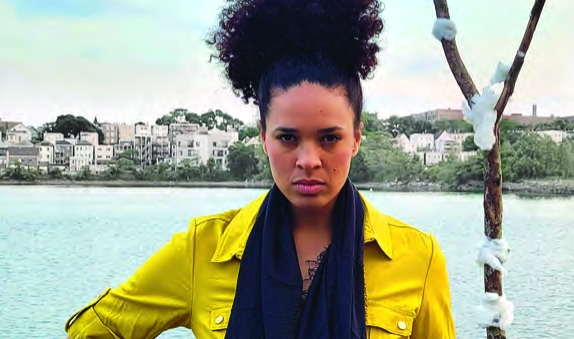
Pearl Scott as the Women’s Chorus leader in “The Suppliant Women.”
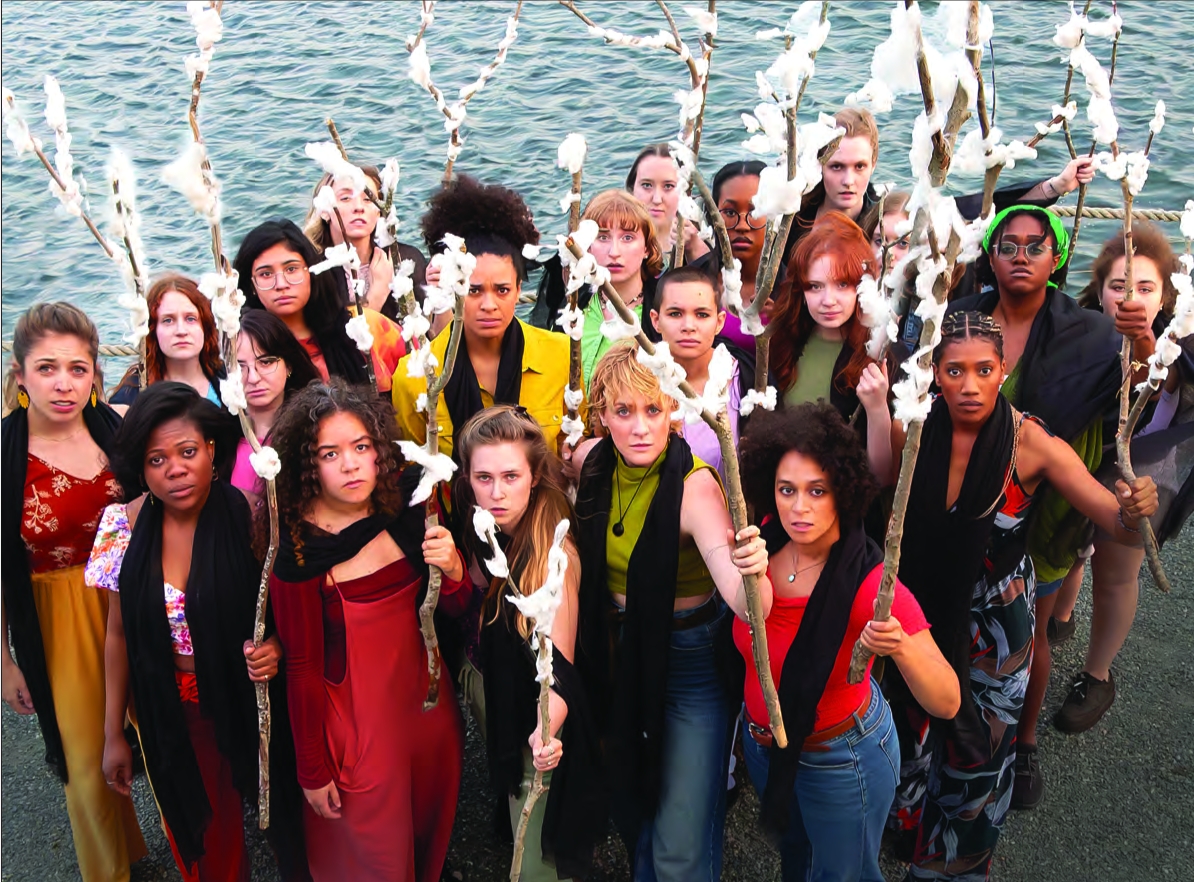
The Women’s Chorus from “The Suppliant Women.”
There is nothing new under the sun and that includes women’s rights and migrants seeking asylum. Both issues are currently at the forefront of news headlines and political discourse. They were also top of mind 2,500 years ago for the Greek dramatist, Aeschylus, when he wrote the tragic play “The Suppliants.”
“The Suppliants” follows a chorus of women, known as Danaids, from Egypt to Greece. The women are seeking refuge in Argos after fleeing a forced marriage to their Egyptian cousins.
Granting asylum to the Danaids is technically the right thing to do but taking them in could start a war with Egypt. The Argive leader, Pelasgus, takes a democratic stance and lets his citizens decide the fate of the suppliant women.
The story is given new life in David Greig’s adaptation for modern audiences, “The Suppliant Women,” directed by Danielle Fauteux Jacques of
Chelsea’s Apollinaire Theater this August. In an interview for
Edinburgh’s Lyceum Theatre, Greig describes the play as “a piece of
theatrical archaeology.”
On a phone call Fauteux Jacques says, “The play is incredibly relevant. It’s about women’s bodily
autonomy in a time in the U.S. when that is obviously under attack. And
it’s about the plight of refugees which is also a very contemporary
issue.”
Fauteux
Jacques along with actress Paola Ferrer say they adapted Greig’s play
for bilingual audiences. According to the U.S. Census Bureau, 67% of
Chelsea’s population is Latinx and 71% of households in the city speak
languages other than English at home. Fauteux Jacques says making
everyone in the community feel welcome is a priority for the creative
team.
She says, “We
work to make the play intelligible in both languages [English and
Spanish] so that even if you only understand one language, you’re still
fully able to follow the storyline and what’s happening on stage.”
Ferrer
points out that Apollinaire has produced free outdoor summer programs
for more than two decades that always incorporated elements of Spanish.
Previously, plays would be performed in English one night and Spanish
the other night and would switch until the end of a run. Although it was
an equitable solution, it was also mentally taxing on the performers.
Now scripts are adapted for bilingual audiences and heavily rely on
visuals, dancing, singing and staging.
Fauteux
Jacques says “‘The Suppliant Women’ has such strong musical and visual
elements that the story can be told in a way that transcends language.”
The
play has a large cast including the Danaid chorus of 50 women. These
women are made up of experienced and new actors from in and around
Chelsea, keeping in line with Apollinaire’s ethos of community. Ferrer
says making Chelsea a destination for
arts and entertainment to revitalize the city after the COVID-19
pandemic is especially important to her. Chelsea was the epicenter of
the outbreak in Massachusetts in the spring of 2020.
Ferrer
hopes the play will allow people to reflect on humanity and moral
dilemmas. She says, “What do we do to help people in need? We see asylum
as a moral imperative. But there’s a
place where the rubber meets the road.” She continues, “What happens
when we cannot protect them? How much security can we provide before we
compromise our own safety? How do we navigate that difficult space in
the middle?”
Free
performances of “The Suppliant Women” are Fridays and Saturdays Aug.
2-17 at Port Park in Chelsea, Massachusetts. The preshow performance
starts at 6 p.m. and the show begins at 7:30 p.m.
ON THE WEB
Learn more at apollinairetheatre.com


