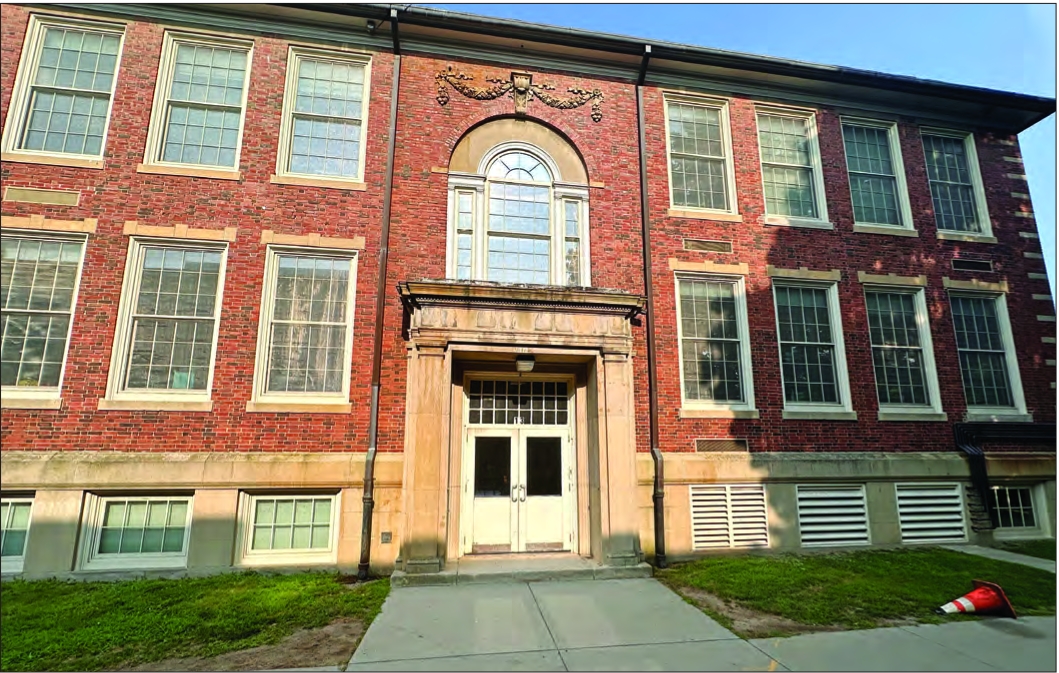
The Lawrence School in Brookline. Allege failure to address racial bullying of Black eighth grader
“A Black eighth grader … was subjected to racial bullying,” read a press release from the Lawyers for Civil Rights last week. It represented the latest salvo from the crusading pro-bono attorneys who originated the suit desegregating Boston’s public schools a half-century ago.
Their targets of late have been school districts with METCO.
LCR’s civil rights complaint alleges that a “delayed response and failure to address” multiple incidents of racebased harassment and traumatic violence constituted a violation of the public schools’ obligations under Title VI of the Civil Rights Act of 1964.
In the worst instance at the K-8 school, the student, MC Henry, was pinned to the floor by a knee on their neck while the other eighth-grader repeated “George Floyd!”
The re-enactment culminated a school year in which MC had been called a “cotton picker.” The family will unenroll from the Public Schools of Brookline.
Along with other METCO students, MC was bused to the suburb daily, crossing a chasm of economic inequality so vast it is visible in satellite photos.
This was not one more expression of racial domination, though examples abound today. The other eighthgrader was not one of America’s mainstream. Their parents do not speak English.
And, arguably, it was group thinking that led here in the first place.
“In
2024,” said LCR’s Mirian Albert, Esq., “you would think that any
reenactment of George Floyd’s murder in a school could clearly
constitute an example of severe racial intimidation.” But, she said,
“that wasn’t the case here.”
Albert’s
complaint critiques the disciplinary response of the district, “the
only step they did take — to tell the perpetrator to apologize — was
exceedingly minimal and arguably harmful. A forced “apology” trivialized
the severity of racial bullying, suggesting that the harm is minor, and
that the victim is at fault if they do not immediately forgive the
conduct.”
Restitution
requested includes a policy review, affirmation of the alleged
violation, a reporting process for future incidents, a new anti-bullying
policy and reimbursement for therapy for MC.
LCR,
formerly known as The Lawyers’ Committee for Civil Rights Under Law of
the Boston Bar, publicized a model anti-bullying policy in April. It
proposes categorizing prohibited conduct alongside disciplinary options
and encoding a prohibition on “identity-based bullying” that would
incorporate gender-identity into traditionally protected populations.
MC goes by they/them.
“If Public Schools of Brookline or the Lawrence School did have a policy on their books similar to the model policy,” argued
Albert, “the Henry’s would have had a better experience and definitely
MC would have had a better experience after all these incidences
occurred.”
Brookline’s school board chair, Andy Liu, pledged to revisit procedures for incident reporting.
“Racism and discrimination run contrary to the values of our school district,” wrote
Superintendent Linus Gillory, Ph.D. Just learning of the incidents
recently, Liu said a fact-finding inquiry is underway. Policy may not be
the answer to solving the problem. The behavior was already prohibited.
Brookline’s
anti-bullying and anti-harassment policies protect populations based on
race and gender-identity. And LCR’s model policy recommends apologies
for some conduct.
Distinguishing
an apology from a “meaningful response,” Albert said, “the perpetrator
doesn’t learn the harm that was inflicted and there’s really no
reassurance that it won’t happen again.”
The
legal filing’s formal distinction between perpetrator and victim
mirrors the discourse of oppression. Such labels cannot apply to
children.
Public
schools with METCO programs educate student populations from different
backgrounds and economic circumstances. Student identities are
multifaceted; groups are not distinct. Factors like religious
affiliation, neighborhood or youth-sport team can establish bonds across categories.
Unquestionably,
intense solidarity forms among METCO students on the predawn bus ride
from city to suburb. Not racebased, these ties do not automatically
extend to suburban minorities, leaving them othered by multiple peer
groups. Such social complexity may help explain how the horror of George
Floyd’s murder could echo in an affluent and progressive suburb of
Boston.
Teenage logic
is fundamentally a question of group-acceptance. A child of immigrants
finishing primary school craves acceptance by their peers. If that child
imagines the oppression of Blacks, as in the murder of George Floyd, as
a commonality with suburban whites, that signals a failure to make
sense of the violent spectacle.
“It’s certainly been discussed,” said Liu, “but, no, I would not say anybody has made sense of such traumatic events.
In 2020, social justice advocates rallied to the vivid
injustices of slain citizens like George Floyd, Sandra Bland, Eric
Garner and Trayvon Martin. Detractors in our long-standing cultural
clash pushed back. The result ing narrative was over simplified:
us-versus-them.
For
Albert, public schools with METCO programs must be held to a higher
standard to protect students. Community discussion, she said, could
improve the
culture. “Schools can’t just leave it in the hands of METCO to make
sure these students are safe and thriving,” she said. The complaint
isn’t intended to hold the perpetrator to account, she said, “the school
is the one that has the moral and legal duty to protect students from
discrimination and bullying.”
“The
school committee takes very seriously,” Liu said, “our responsibility
to have a school environment where all our students feel welcome and
supported. And we have work to do.”