BTU members n front of Boston Public Schools headquarters.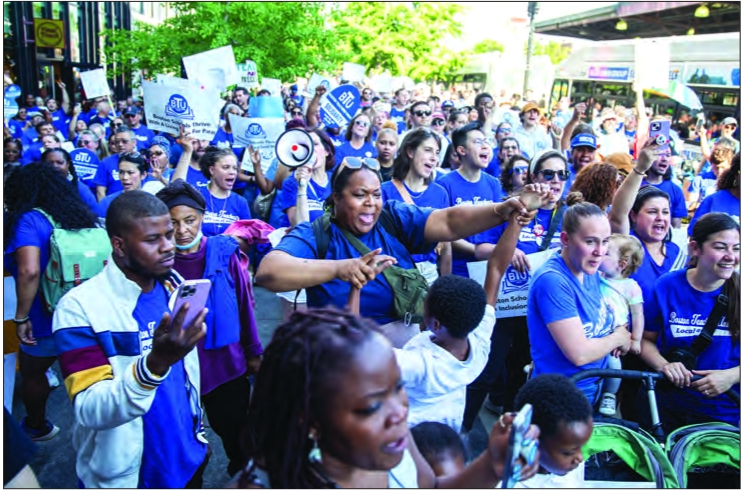
Boston Teachers Union rallied June 5 outside the Bruce C. Bolling Municipal Building.

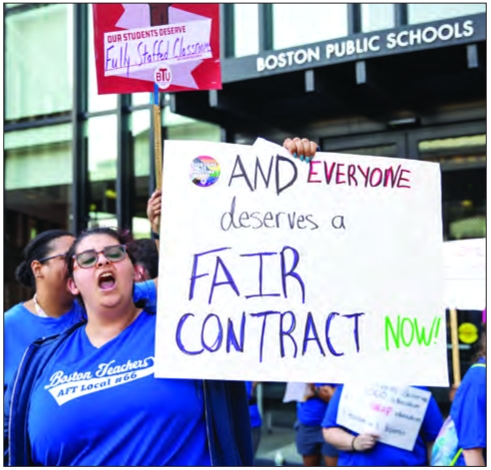
BTU member Tatiana Hollins at the Boston rally.
The Boston Teachers Union rallied June 5 outside the Bruce C. Bolling Municipal Building as the union works through negotiations with the district around a new contract for its staff.
The union, which represents over 10,000 teachers and other professionals in the district, is seeking a number of updates to their contract, with a large focus on improving staff pay, improving facilities and student support and decreasing what they view as excessive workload for teachers.
“Being a teacher these days is an incredibly stressful role. When educators are not provided the same additional supports that teachers elsewhere are provided, it makes the job next to impossible and is one of the reasons it’s hard to retain people in our schools,” said Erik Berg, incoming president of the Boston Teachers Union.
One prominent goal the union aims to address during negotiations focuses on bringing greater support into classrooms. Currently teachers are currently expected to juggle general instruction while also providing the more specialized support for students with Individualized Education Programs — also known as IEPs — or for those whom English is their second language.
The union hopes to end the expectation that educators will have more than one license to be able to meet those additional needs from students, said Berg, who currently serves as executive vice president and will be stepping into the union’s top role in mid-July.
“We
feel that kids are being deprived of necessary additional supports and
the district is saying, ‘Okay, you have to get your special ed license
and you’re going to somehow provide this extra, specialized instruction
in the context of your regular instruction,’” he said. “I think common
sense would tell you that having a second teacher is better and you’re
going to meet the kids’ needs more.”
“The
reality is three licenses does not mean three teachers,” said J.D.
Davis, a history and ethnic studies teacher in the district, who called
pushes like the union’s ask around licensure “long overdue.”
BTU
is also asking for an increase in pay, pointing to low salaries for
some roles represented by the union, especially those like
paraprofessionals, educators who assist teachers in classroom
instruction.
Following
a request for comment from the Boston Public Schools by the Banner, a
district representative pointed to remarks BPS Superintendent Mary
Skipper made during her regular update to the Boston School Committee at
its June 5 meeting.
According
to Skipper, the average salary of a paraprofessional is $44,000 per
year, though the teachers union pointed to some salaries for
paraprofessional roles falling below $30,000 per year.
During
those remarks, she said one of the district’s main priorities in the
negotiations was to “significantly increase” the wages of its lowest
paid employees, like paraprofessionals and applied behavioral analysis
specialists.
She said
the district was looking to work with BTU to take an “equitable
approach” and provide a greater wage increase to those roles as well as
the teachers.
C.J.
James, a paraprofessional in the district, said low pay has forced him
to take two other jobs in addition to the role. Even still, he said he’s
now considering if he can continue working at BPS.
The
teachers union has proposed a $4-per-hour pay increase for
paraprofessionals over each year of the contract, which would last
through 2027.
“If it
was included in the contract, I wouldn’t have to make a decision of if
I’m able to stay with a job that I love with students that I love or to
be able to take care of myself and my family,” James said. “That $4
increase that BTU is proposing would put a big step into what I’m able
to do and make that decision for me.”
During
her remarks, Skipper made little to no reference to the union’s asks
around eliminating the model of having one teacher also hold licenses to
handle IEPs and multilingual learners.
Progress
in conversation with the district is “slow and steady,” Berg said, but
he said those talks have yet to really dig into union priorities, like
addressing the multiple-license model.
“We
haven’t really scratched the surface of some of the more critical
issues, in particular, this issue of the delivery of services to
students with disabilities and multilingual learners,” he said.
According
to a BTU summary of its bargaining efforts with the district from a May
30 session, the district said it was prepared to dedicate extensive
time to discussing the issue, but in the same summary the union said the
BPS had called its proposals on the topic “inflexible” and
“impossible.”
In that
same update the BTU reported that the district had rejected a proposal
that would guarantee every school had a library, and proposals that
would improve student access to mental health services, as another
priority highlighted by the union is increases in the staffing for
mental health specialists and other providers on school campuses to meet
nationally recommended ratios.
Davis said he’s heard widely, from people on both sides of the teacher’s desk, that increased mental health access is needed.
“If
we look at what data and research say, if we listen to the testimonials
of countless numbers of students, and educators, and parents, and
guardians and caretakers, there’s this common message about the need for
more mental health support,” he said.
In
her update at the school committee meeting, Skipper said the district
aims and expects to iron out contract language with the union by the end
of the month.
“We
remain committed to finalizing a deal by the end of June,” Skipper said.
“We know that this is just a few weeks away, but as we’ve narrowed the
proposals, it’s allowed us to ramp up the meeting schedule to finalize
language.”
Berg was less ready to commit to a timeline for the negotiations.
“Both
the district and union have been coming to the table and we hope to
continue to do so and reach an agreement sooner rather than later, but I
can’t tell you that the timeline is going to be two weeks or two months
or whatever,” he said.
According
to Skipper, this timeline for negotiating a new contract is a break
from tradition for the district, which she said normally waits until the
existing contract expires to begin conversations around a new one.
In
an effort to craft this new contract before the old one is out of date,
the district and the teachers union began negotiating in February.
The
contract discussion comes at a moment of transition for the Boston
Teachers Union as outgoing President Jessica Tang moves to head the
American Federation of Teachers of Massachusetts, the smaller of two
statewide teachers unions.