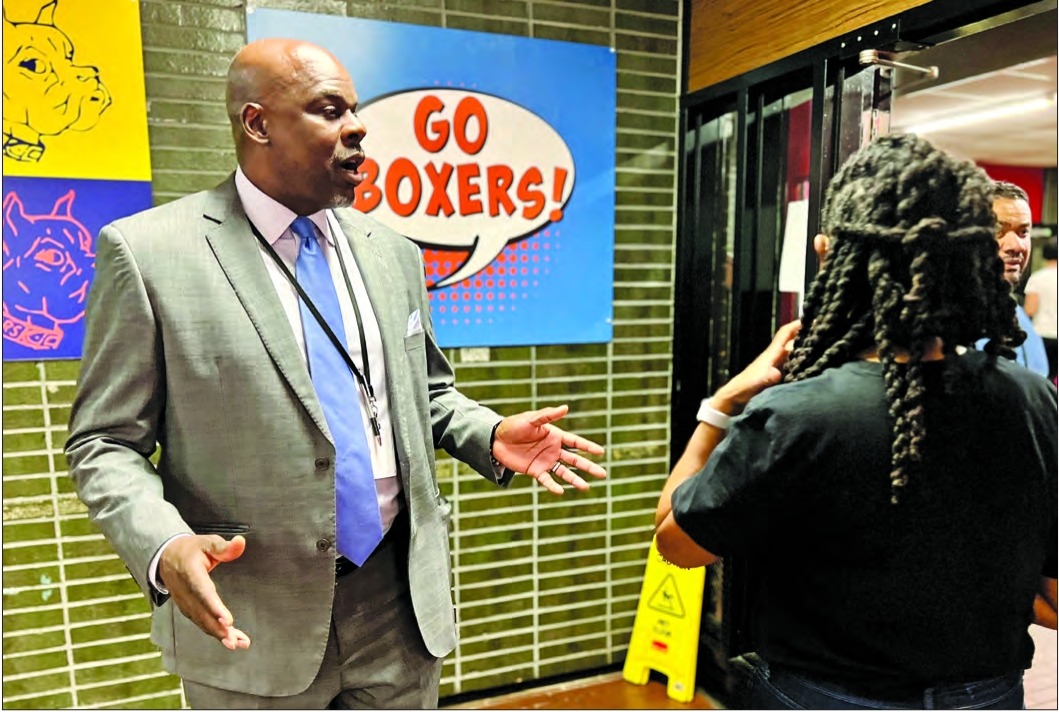
Principal Kevin McCaskill speaks to a member of the school community. Since January, Brockton High School Principal Kevin McCaskill has been rebuilding the foundation for quality public education in the City of Champions. He is confident that a critical mass of teachers, administrators and parents will come together to support student learning.
The principal is looking past summer vacation, well aware of the work ahead.
Plans for fall’s first days of school and new student orientation are being crafted by teachers and administrators in working groups now, he said.
His optimism marks a rebound of sentiment following a winter during which budget deficits, teacherless classrooms and spiraling safety concerns were battering public trust in the school.
Since the February break, headlines about the predominant public high school in New England’s only majority-Black city have improved. The Brockton High Drama Club finished first at the Massachusetts Educational Theatre Guild Competition in March — “state champions,” McCaskill said; Livingstone College, an historically Black college in North Carolina, offered scholarships to students with good grades; the school was designated for work-based learning partnerships with local employers; and the Brookline Center’s “bryt” program brought mental health support to students in need.
Graduation
festivities kicked off June, but the students continue to compete and
excel. Over the weekend, a team of coders was programming autonomous
drones at a national event in Los Angeles. Track phenom Lucas Andrade
ran in the New England track and field championships Saturday. The
school’s Marciano Stadium played host to the Brockton Public Schools
Special Olympics on June 11.
Low
staffing levels have hampered academic learning at Brockton High. Even
so, dedicated individuals excelled on their own merits. BPS established a
club for students with perfect MCAS scores last fall.
“We
have some high-flying students,” McCaskill said. For the focused,
Brockton High has rigorous offerings like AP classes, an International
Baccalaureate Diploma Program and dual-enrollment with higher-ed
institutions.
“You
have students going on to major universities and colleges throughout the
country,” he said, noting that in the humanities, “kids excel.”
He argued, however, that more support is needed for
“students who are in the middle,” disengaged or struggling. He sees the
needs as both academic and social-emotional.
“We’ve
got quite a bit to work on,” he said. “That’s no big secret.” But, he
countered, there’s been a reduction in violence. “You don’t see the
massive numbers” of students in the cafeteria anymore, he said while
acknowledging “wandering is still an issue.”
Financial challenges
McCaskill
is preparing for level staffing next year and beyond. If the financial
situation improves, he hopes to revisit some needed positions.
Brockton’s
recent budget deficits cut into coverage of classrooms and hallways at
Brockton High School. The district hired six new security specialists
this winter, supplementing the team of a dozen.
Districtwide, 150 vacant positions — many teachers —
went unfilled to save money. With that cost savings plus $5.1 million
of custodial costs shifted into the Commonwealth’s American Rescue Plan
Act fund, ESSER III, and other belt-tightening measures, municipal
solvency was more or less secured. The City Council agreed to empty its
financial reserves, however, leaving little room for future maneuvers.
TJ Plante, a consultant with Open
Architects, which prepared a report earlier this year on school
finances, told the school committee last week that he’s “reasonably
confident” a $19-$25 million deficit projected in January would shrink.
Many factors remain uncertain through the end of the fiscal year, but
future taxes may ultimately make up for some $4.1 million of costs that
are otherwise unaccounted for.
Still, the city’s financial straits are profound. Discussing next year’s budget in a
subcommittee, school committee members had to consider underfunding
“critically needed positions” that offer legally required services to
students with disabilities. Ultimately voting to request funds that may
never materialize, the body was hard pressed to willfully jeopardize its
essential duties. Furthermore, federal funding allocated under the
Individuals with Disabilities Education Act (IDEA) prohibits the cuts.
As
one financial expert explained at the meeting, the higher amount
reflected “the positions necessary to open the doors and give just the
same level of service to the kids who are eligible in June, what they
need in September.” He went on to say students with disabilities were
enrolling at a disproportionate rate relative to overall enrollment.
Students eligible for services under the IDEA made up 16.6% of the
district in FY20; 19.6% on Oct. 1; and “almost 22%” on June 1.
New arrivals strain system
Even
with staffing stability, Brockton’s schools may be slowly slipping
behind. After enrollment is counted for funding purposes on Oct. 1,
hundreds of new students arrive mid-year.
“New students means more teachers,” said Dr. Karen Spaulding, the assistant superintendent for elementary-level
teaching and learning, noting that the 239 elementary students enrolled
after October would ordinarily necessitate 10 new teachers.
“I
can’t sound the alarms enough,” she said, even though welcoming new
students to the classroom is a “wonderful goodnews story.”
McCaskill estimated the high school’s enrollment had increased by more than 200 students since October.
New immigrants have presented a particular challenge, since effective teachers need fluency in students’ native languages.
“At
the middle school levels,” explained Kelly Jones, Brockton’s director
of bilingual education, “some Haitian classes have over 40 in them — and
we have classes at the high school that have higher than 70. They are
being taught in lecture halls.”
Brockton
Public Schools is serving 1,324 new multilingual learners compared with
September 2023. Almost half of these new arrivals speak Haitian Creole.
English Language Learner enrollment is now over one-third of the
district’s student population.
McCaskill
is aiming for a multiyear turnaround while remaining realistic about
the 2025-26 academic year. Striking a resolute note, he said: “I can say
unequivocally this will work.”