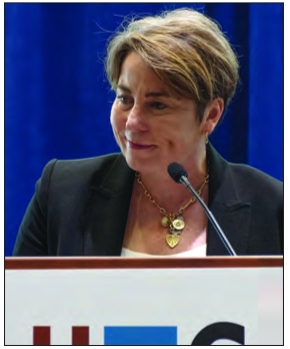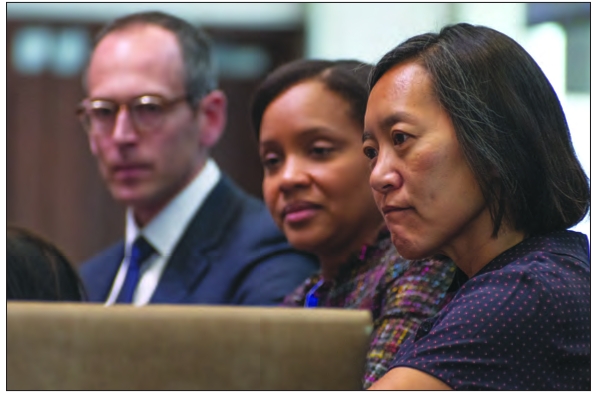
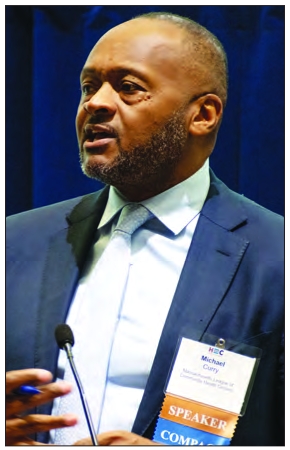
(left)
Department of Public Health Commissioner Dr. Robbie Goldstein,
Secretary of Labor and Workforce Development Lauren Jones, and Secretary
of Economic Development Yvonne Hao speak on a panel about state efforts
to address health equity at the Health Equity Trends Summit, June 6;
(below right) Michael Curry, president of the Massachusetts League of
Community Health Centers and co-founder of the Health Equity Compact,
addresses attendees; (below left) Governor Maura Healey delivers
welcoming remarks. In her address, Healey touted her proposed Mass Leads
act, which would invest in life sciences statewide, including an
increased focus on equity efforts. More than 80 leaders of color meet to discuss disparities in care standards
Leaders in health-related fields called for increased collaboration and broad structural change at the second annual Health Equity Trends Summit on June 6.
“We recognize that we are all in this together. Systemic change towards equity benefits everybody, with lower health care costs, improved standards of care and more vibrant communities,” said Michael Curry, president and CEO of the Massachusetts League of Community Health Centers, during welcome remarks.
The event, held at the University of Massachusetts Boston, was hosted by the Health Equity Compact, a coalition of more than 80 leaders of color in health care and related fields. The group first formed in 2022 to address equity concerns related to care for people of color in the commonwealth; Curry is a co-founder of the group.
Statewide, statistics around health care equity and access leave room for improvement. The Compact highlighted 2023 data from the Boston Public Health Commission that found the average life expectancy in Roxbury lags more than 20 years behind the average life expectancy in Back Bay.
A state Department of Public Health report from 2023 found that Black people were 2.5 times more likely to have serious health problems or die when having a baby compared to their white counterparts.
Addressing those numbers will take a joint effort, said Dr. Bisola Ojikutu, executive director of the Boston Public Health Commission and a member of the Health Equity Compact, during a panel about local efforts to close the city’s life expectancy gap.
“We know that with these big-picture issues of life expectancy, issues of premature mortality, it’s not just about what happens in the health care system. We’re talking about the upstream drivers … we’re talking about structural racism and systemic inequity,” she said. “If we really want to create change,
we really want to turn the dial, can we do this alone? No, we can’t
work in the silos that have been created. This is in need of an
all-of-society approach.”
During
the panel, she mentioned an upcoming city initiative, which she said
the Commission plans to launch later this summer, to bring together
groups and stakeholders across silos to address life-expectancy
disparities and to provide Boston residents with more tangible support
in the short term.
“We
have to get those rootcause drivers addressed, but we also have to have
pathways to address the downstream outcomes,” she said. “We want people
to be able to turn around and have something in their pocket that
reduces the stress and therefore reduces the blood pressure, but
longer-term, we also want them to make sure that they’re connected to
care, and they have physicians, they have access, and all of those
pieces that have to flow together.”
A ‘whole-of-government approach’
Across government, too, leaders are looking to collaborate.
A
state effort called Advancing Health Equity in Massachusetts — or AHEM —
is anchored in the state’s Executive Office of Health and Human
Services but is meant to cross secretariat lines to other parts of the
administration in an effort to close racial, economic and regional
disparities in health outcomes. It’s part of what Governor Maura Healey
called a “whole-of-government approach” during remarks at the summit.
AHEM
has two main focus areas, one on maternal health and the other on
social determinants of health — factors like food and housing access
that impact health but are not directly part of a medical system —
especially in relation to cardiometabolic diseases like heart attack,
stroke and diabetes.
AHEM
has set a clear agenda in its first year, especially around its focus
on maternal health, with goals centered on changing the regulations
around birthing centers to increase access and expanding the doula
workforce, said Dr. Robbie Goldstein, commissioner of the Massachusetts
Department of Public Health, who co-chairs the initiative.
“We’ve
really set out aggressive goals to get these things done in the first
year, and I actually think we’re going to accomplish all of them within
the first year of AHEM,” he said.
The
inter-agency collaboration is even more important in the initiative’s
work around the social determinants of health, where things like food
access and the built environment in communities may fall partially under
control of Health and Human Services, but often require input and
efforts from other offices in the administration, Goldstein said.
“We
know that while that all has an impact on health, the Executive Office
of Health and Human Services cannot control all of that, so we need to
reach out to the other secretariats and make sure that we’re doing this
hand in hand,” he said.
Healey
said the effort is especially impactful given the lofty reputation of
Massachusetts’ hospitals and life sciences industry.
“In
light of this global leadership, it is all the more important and
absolutely unacceptable that vulnerable people and communities right
here in our own state still struggle with access to high-quality,
affordable care,” Healey said. “This cannot continue, and that’s why
we’ve made closing these disparities and achieving health equity a top
priority for our state and our policies and across what we do.”
Legislation
Also
at the state level, the Compact outlined priorities in the legislature,
including a focus on a health equity bill that is currently moving
through the State House.
That
bill, if passed, would create a new state Office of Equity, with goals
like standardizing the use of health equity data metrics across the
state, addressing the cost burden of some medications and improving
access to MassHealth.
Healey
also highlighted her Mass Leads legislation, a $3.5 billion economic
development bill that would, among other things, include a 10-year
reauthorization of the state’s life sciences initiative.
That
program, originally a product of former Governor Deval Patrick’s
administration in 2008, created the quasi-public Massachusetts Life
Sciences Center, which has a focus on supporting and expanding the
biotechnology industry in the state. In 2018, it was reauthorized for
five years by then-Governor Charlie Baker.
At
the summit, Healey said the newest reauthorization, if approved, would
also include a specific focus on equity, elevating it as a priority in
work around life sciences research, workforce, access and outcomes.
“Across
the board, we know that health equity is the key to systemic
improvement,” said Healey, pointing to efforts during the COVID-19
pandemic that closed vaccination gaps and put Massachusetts near the top
for uptake rates nationwide.
During
a panel featuring state leaders, Yvonne Hao, the state’s secretary of
economic development, said the $1 billion the bill proposes in
reauthorizing the life sciences Initiative would continue to support
things like drug discovery but also would direct the state to think more
holistically about health care.
“How
do we not just have the best drug discovery, but make sure it gets to
everybody as quickly as possible so that we close these life expectancy
gaps?” Hao said. “If we can lead in every other way — if we can be the
first state to have universal health care, the first state to have
equality in marriage, the first state to have so many awesome things —
can we be the first state to actually be the best at health care?”
Technology and AI
Beyond
governmental efforts, the summit also looked toward new technological
horizons, with a panel focused on artificial intelligence and its
potential to impact equity in health systems.
Beyond
the sci-fi-esque dreams of being able to have a discussion with an AI
to diagnose an individual patient, Dr. Renee Crichlow, chief medical
officer at Codman Square Health Center and a member of the Health Equity
Compact, said the technology could be used to change systems and
streamline internal processes in a way that could mean more dollars
being spent on patient care, rather than going toward things like a
billing department.
“The
fact is, if you look at the way we spend our health care dollars,
that’s where we’re going to have impact, when we have a practice
redesign when we empower primary care at the level of the clinic,”
Crichlow said.
But the
hope for what the developing technology could bring also comes with
concerns, especially around a tool that has the potential to augment
existing disparities in the health care system.
Much
of the concern comes from the fact that artificial intelligence is
trained and works on sets of existing data, so any predictions it makes
will be based on what things already look like. Marzyeh Ghassemi, an
associate professor at MIT who has worked at the intersection of health
and AI, said that leaves a huge gap between what AI should do to effect
change and what it will do.
“It’s
not being used as a transformative, ‘let me help you fly’ technology.
It’s saying, ‘give me all the data about how your hospital operates now
and I will do it faster and more efficiently for you, with less human
oversight,” she said.
She
pointed to the health insurance company Cigna, which developed an
algorithm that allows it to deny large batches of claims at a time
without review by a medical professional. That algorithm is now at the
center of a class action lawsuit.
Speakers
on the panel also advocated for greater participation of people of
color in the development of the technology and learning models.
They
pointed to research like Gender Shades, an MIT study that finished work
in 2020 that found large gaps between how facial recognition algorithms
performed with variations in skin color and gender. That study found an
error rate of less than 1% for lighter-skinned men, but one of almost
35% percent for darker-skinned women.
“If
we are participating in the development, we must make sure that the
product that we’re going to use is developed on the population that it’s
going to serve,” Crichlow said. “We have to be not only a part of the
creation, but we have to be a part of the people who are doing the
creation.”