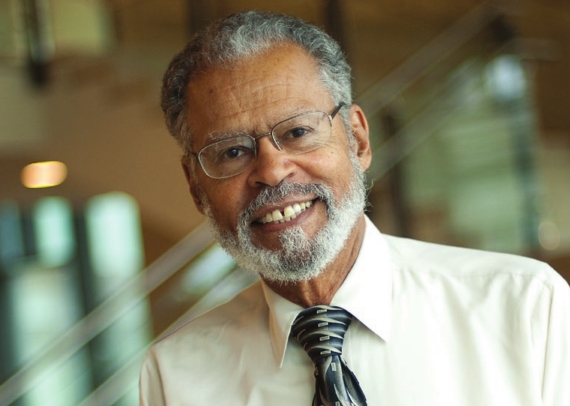
Willard R. Johnson MIT professor inspired a generation of students, scholars and activists
Pioneering scholar, activist and anti-apartheid leader Willard R. Johnson died in October at the age of 87.
Johnson was a distinguished professor emeritus of political science at the Massachusetts Institute of Technology and made history in 1968 by becoming the first Black professor to earn tenure at MIT. His academic research centered on international relations and development policies, particularly focused on Africa. Johnson left behind a legacy that spanned academia, activism and a profound commitment to family.
Born with a passion for justice and a keen intellect, Johnson dedicated his life to
challenging inequities. Johnson was born in St. Louis, Missouri in 1935
into a family that included his brother, twin sisters and his parents,
who were both Kansas natives.
His
father’s career as a bacteriologist with the U.S. Public Health Service
brought the family to various locations, shaping Johnson’s early
experiences. They moved to Tuskegee, Alabama, and then to Pasadena,
California, in 1946, where Johnson graduated from Muir High School. His
pursuit of knowledge led him to the University of California, Los
Angeles, where he served as student body president
and established the campus’ chapter of the NAACP. He studied
international relations and graduated with his bachelor’s degree in
1957, setting the stage for a remarkable academic and activist career.
He
earned a master’s degree in African studies with distinction from Johns
Hopkins School of Advanced International Studies and a Ph.D. in
political science from Harvard University. In 1964, he was appointed
assistant professor of political science at MIT and was promoted to
associate professor in 1969. His dissertation at Harvard led to his book
in 1970, “The Cameroon Federation: Political Integration in a
Fragmentary Society.”
Johnson’s
journey into African studies took a unique route, marked by his
engagement and interest with international relations. Inspired by
Egypt’s President Gamal Abdel Nasser’s bold actions that seized control
of the Suez Canal in 1956 and Ghana’s independence from colonial rule in
the subsequent years, Johnson shifted his focus to Africa. His
dedication to understanding and documenting the continent’s history and
its role in global affairs became a lifelong pursuit and a catalyst for
activism.
Johnson’s
journey to activism began with a vision of an independent, united
Africa. In the 1960s, he envisioned Africa as a key ally in lifting
African Americans out of stifling segregation and second-class
citizenship and later co-founded an organization with like-minded Black
professors to broaden the coursework on the African continent’s
independence movement within the African Studies Association.
In
the midst of a changing world, Johnson stood as a beacon of
empowerment, believing in “the power of a mobilized people” to shape a
better future. His impact reached far beyond the classroom, inspiring
generations of students, scholars and activists.
In
the 1960s, Johnson founded the Boston Pan-African Forum, an
organization dedicated to promoting unity and empowering the pan-African
community. His tireless efforts in the fight against apartheid earned
him recognition as a leader and advocate for human rights.
Another
of Johnson’s significant contributions was the co-founding in 1977 of
TransAfrica — a Washington lobby focused on Africa and the Caribbean.
This groundbreaking initiative brought together Black scholars,
including Harvard Law School graduate Randall Robinson. Johnson later
founded and led the Boston Chapter of TransAfrica, playing a pivotal
role in organizing important protests, such as the massive sit-in at the
South African Embassy in D.C. during the 1980s. As president of the
TransAfrica Boston Support Group in the ’80s, Johnson strongly promoted
divestment from South Africa apartheid economies, which played a crucial
role in the passage of divestment legislation by the Massachusetts
House of Representatives and overriding a governor’s veto.
These
actions ultimately forced a change in U.S. policy, with Ronald Reagan
abandoning “constructive engagement” and signing a 1986 law imposing
economic sanctions on the apartheid regime.
As
a political science luminary and dedicated activist, Johnson’s
influence reached far and wide, inspiring countless students to engage
critically with the world and advocate for positive change. During his
tenure at MIT, Johnson consistently advocated for the diversification of
the Institute’s faculty and student body, pushing for increased
opportunities for both Black faculty members and students. Colleagues
and students remember him not only for his academic brilliance but also
for his kindness, mentorship and unwavering dedication to justice.
Family heritage
Beyond
the lecture halls and protest rallies, Johnson found his greatest
accomplishment and legacy in his two daughters and four grandsons.
Family reunions and special events were cherished moments, even during
research trips to Africa. The family turned work journeys into shared
adventures, as Johnson’s daughters also often undertook special school
projects during these travels.
A
testament to his dedication to family history, Johnson founded the
Kansas Institute for African American and Native American Family History
in 1991. Johnson’s vision of the institute was to preserve and document
family identity, traditions, and accomplishments of members of the
African American and Native American communities of the Midwest. Through
this institute, he fostered inquiry, research and projects aimed at
unraveling the intricate tapestry of his family’s heritage.
For
more than 60 years, Johnson maintained a close friendship with Hubie
Jones, celebrating milestones and anniversaries together. In a unique
twist of fate, Willard and Vivian Johnson, and Hubie and his wife Kathy
Jones, were married just a week apart. Hubie and Willard first crossed
paths at an American Friends Service event in Cambridge, while Kathy and
Vivian met during a shared class on African American history at
Harvard.
Hubie Jones
said Johnson educated two generations of political science students at
MIT, many of whom became African scholars like him, going on to live in
countries around the world, particularly in Africa. In addition, Jones
notes that Johnson would want those following in his path to “stay
focused and resolute in pursuit of social change. The pursuit of major
societal change is a lifetime commitment, it is a marathon!” [and that]
he would also say, “Make sure your advocacy for change rests on a
foundation of solid theoretical knowledge.”
In
retirement, both Willard and Vivian Johnson enjoyed the opportunity to
work on their own projects. Johnson increased his research on his family
history in Kansas and they traveled to visit and interview family
members about his genealogy. They also often enjoyed visiting friends
and places that they were unable to visit while working full time.
Throughout
his career, Johnson demonstrated that knowledge and activism are
powerful allies. In all of his work, he brought people together for
activities of improvement. His legacy lives on in the hearts and minds
of those he touched, a testament to a life well-lived in service to
others.
Johnson’s
wife, Vivian, shared valuable advice from Willard, encouraging future
trailblazers to “demonstrate commitment to family, community, and
learning about those whose work, struggles, and sacrifices made our
lives and opportunities possible.” He believed, she said, that our
country is a work in progress and every person of good will should
continue to find ways of achieving “a more perfect union.”
Johnson’s memorial service was held Dec. 2, 2023 at the MIT Chapel.