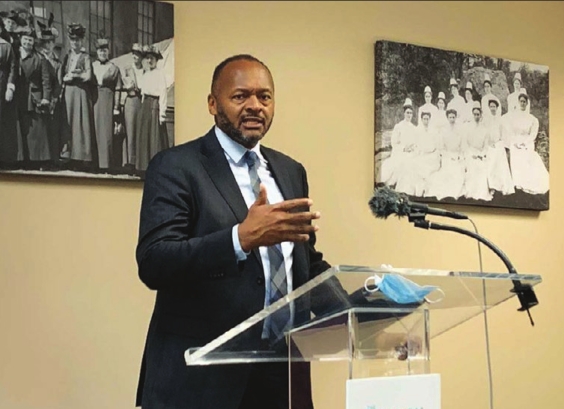
Michael Curry
Summit explores ways to overcome systemic racism in health care
The Health Equity Task Force created by the Massachusetts Legislature issued its final report two years ago, calling for solutions to the inequities in infection, hospitalization and death rates that impact the state’s vulnerable populations, particularly communities of color and low income residents.
Leading members of the task force, including co-chair Michael Curry and former state representative Jeffrey Sanchez, were disappointed in the legislative response to the “Blueprint for Health Equity.”
“Once the report was submitted, Jeffrey called to express a concern that we might not see the necessary changes, and suggested reaching out to others who shared our concern,” Curry, president and CEO of the Massachusetts League of Community Health Centers, said in an email.
Members of the task force then connected with leaders in the Black and Latino communities to form the Heath Equity Compact in May 2022.
“Our vision is the elimination of systemic barriers and creation of new structures and processes that will lead to equitable health care and health outcomes for all in Massachusetts,” Curry wrote in the email.
The Compact, which now includes more than 75 leaders of color in health care in Boston and across the state, on June 13 hosted a Health Equity Trends
Summit that brought together insurance executives, hospital CEOs, health care providers and legislators to address how barriers are reinforcing systemic racism in their organizations and discuss how to make prospective changes.
“We are pulling organizations that often compete and disagree on policy priorities [together] to engage on solutions,” said Curry.
Curry, who is also a former president of the NAACP Boston Branch, said in his opening remarks that the Compact is pushing legislation that would make insurance coverage through MassHealth available to all people in the state, regardless of their immigration status.
Senators Pavel Payano of Lawrence and Liz Miranda of Boston and Representatives Bud Williams of Springfield and Judith Garcia of Chelsea filed the omnibus bill, which also calls for the “prioritizing of health equity in state government, standardizing and reporting on health equity data, (and) improving access to and quality of care,” Curry wrote in the email.
While foundational changes in access to health care can be established through lawmaking, preventing discriminatory practices cannot be achieved through legislation alone. It starts in interactions between patients and care providers.
The summit’s panel discussion on “Roadblocks and Resolutions: Healthcare Leaders’ Commitment
to Health Equity” brought together four Boston-area hospital CEOs to
address structural racism within their organizations.
“There’s
a lot of bias in our organization,” said Alastair Bell, president and
interim CEO of Boston Medical Center. “There were many ways in which
bias kind of showed up, often in very unintentional ways that … lead to
quite disparate outcomes.”
A lack of funding and resources devoted to fixing prejudice presents a barrier to achieving health equity, he added.
Kevin
Churchwell, president and CEO of Boston Children’s Hospital, said
health care organizations have a shared responsibility to collaborate,
as demonstrated during the pandemic. He said the response to COVID-19
was successful due to the communication between health care entities.
“We would have not been successful without the state involvement, without the federal government’s involvement,” he said.
“There can’t be just one side of this equation that is leading the effort.”
In
the same vein, Michael Dandorph, president and CEO of Tufts Medicine,
said that hospitals are also responsible for involving the community in
the discussion to create equity.
“This
isn’t just our problem to solve in isolation. ... There’s a lot of
things happening in and across Massachusetts, and certainly in the
communities that we’re serving, that we have an accountability to
partner with,” he said.
Dandorph
said hospitals and medical institutions tend to overpower community
organizations, when they should be included in the conversation.
“We
really need to be bringing people to the table, and as leaders of major
organizations in our communities, we need to be the conveners, or
participate when somebody else is convening,” he said.
Anne
Klibanski, president and CEO of MassGeneral Brigham, said some of her
concerns are about the shortcomings of longterm preventive care, which
was in a lull during the pandemic because people were not actively going
to see their health care providers. She said that every day, she sees
diseases and sicknesses that have progressed in the time since the
pandemic began and that could have been prevented.
Klibanski
said partnerships with different health care systems, insurance
companies and government organizations during events like the summit
contribute to changing the system.
“It’s the collective power,” she said.
Kate
Walsh, state Secretary of Health and Human Services, asked, “What would
it have meant that a COVID vaccine was developed right here in
Cambridge, if we couldn’t get it into the arms of people in Chelsea and
Roxbury? We cannot celebrate our achievements, if the results are out of
reach for all of our residents.”
Walsh
said strides like the creation of a federal Medicaid waiver “allows us
to access flexible funds to support community partnerships. We can use
MassHealth factors to address upstream issues like housing and food.”
In
his remarks, Curry said, “Still there are too many people in the
commonwealth who do not have the opportunity to live a long life, a long
healthy life, because of environmental conditions and structures that
disparately impact people based on race, ethnicity, income, gender,
sexual orientation, disability or zip code.”


