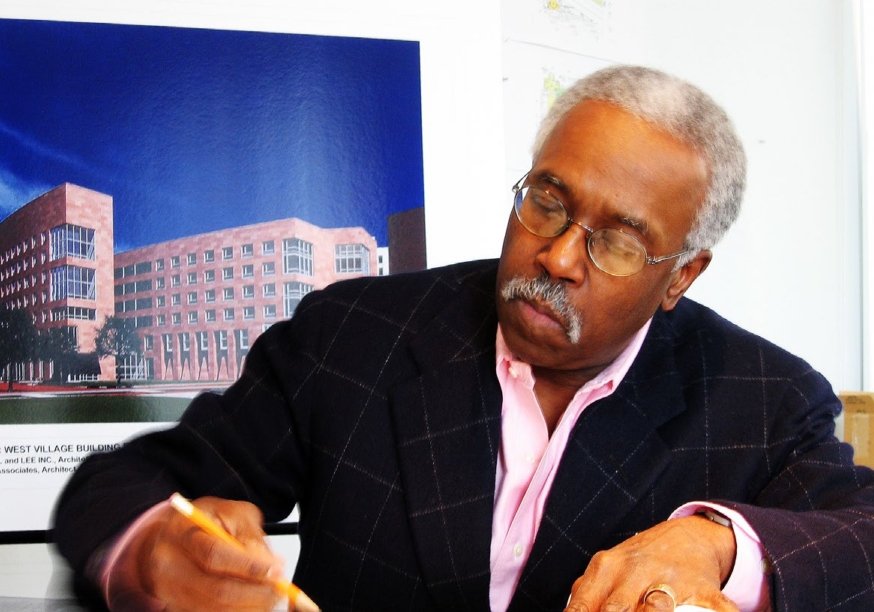
Architect David Lee

A rendering of the P3 redevelopment proposal by the HYM/City at Peace team, which includes residential, lab and retail space.
Large employer could bring permanent jobs
As Roxbury’s largest vacant lot appears finally set to be developed, community leaders anticipate big employers will cross Melnea Cass Boulevard. Neighborhood residents have for decades envisioned plentiful, good-paying jobs close to home.
But economic jitters — coronavirus, then inflation and war — are playing a role in shaping
negotiations on the parcel, known as P3. The developer has yet to identify large employers. Without the addition of permanent jobs, Roxbury’s residents argue, Boston will be breaking old promises again.
When no anchor employer signed up for the plot connecting Ruggles Station to Nubian Square, an earlier developer team, Elma Lewis Partners, lost their chance to build. A financial crisis at the time did not help.
Now, Roxbury is relying on its oldest nonprofit community development corporation, Madison Park, which teamed up with My City at Peace and HYM Investment Group. Experts say this set of developers is prepared to deliver. Their proposal predicts 2,710 total permanent jobs, predominantly in life sciences.
But if big businesses stay away, public benefits may be limited to additional affordable housing and workforce training.
From
an office overlooking the parcel, Ted Landsmark can see activity on the
unfinished site. The Northeastern professor of public policy and urban
affairs has served on the board of the city’s planning and development
agency since 2017. During his tenure, $70 billion in projects have been
approved.
Describing the
planning agency as a facilitator for neighborhood reviews of
developers’ plans, he framed its work as seeking a “balance between the
attractiveness of having commercial developers in downtown build in ways
that generate substantial new tax revenues for the city, and the need
to have more affordable housing built across the city.”
When
Landsmark moved to Boston in 1973, federally financed urban renewal was
winding down. Since then, attempts to innovate solutions have produced
capable community development corporations, minority contractors, a
community land trust along Dudley Street and mechanisms for community
input on new projects.
Landsmark cited a more diverse construction sector
as a valuable outcome of Boston’s development history. He hopes these
community builders can eventually steer Roxbury’s development towards a
community vision.
Community oversight
Under
then-Mayor Ray Flynn, the Boston Redevelopment Authority (BRA) in 1990
negotiated an agreement to formally recognize a community group’s
authority in development projects, the Roxbury Neighborhood Council.
Flynn’s
successor, Thomas M. Menino, further vested community groups with
official authority through the Roxbury Strategic Master Plan, published
in 2004.
The master
plan’s author, architect David Lee, envisioned an oversight committee to
dispose of Roxbury’s remaining vacant public parcels.
“We
wanted to empower the oversight committee to literally provide
oversight to development in [the] community,” Lee said, “but that means
when you go in with a project, you’ve got to get past those guys.”
“Developers
don’t care that there are rules,” he continued. “They just want to know
what the rules are and that everybody is playing by the same set of
rules.”
The Master
Plan imagines economic revitalization of the area’s historic business
hubs. One aim is a “diverse economy focused on job opportunities.”
Landsmark
said the relocation of the Orange Line from Washington Street hurt
small businesses in what is now called Nubian Square.
“One
need only look at the reduced economic vitality of Dudley/ Nubian
Square in relation to Upham’s Corner or Brigham Circle as one of the
unintended consequences of the relocation of some of the transit
services going through the center of Roxbury,” he said.
Proximity
and access to better-paying employment would increase overall income
levels, positioning more Roxbury residents to afford market-rate housing
and have money to spend in neighborhood businesses.
Too much affordable housing?
Lorraine
Wheeler, who represents residents on the Roxbury Strategic Master Plan
Oversight Committee, says Roxbury is over-saturated with affordable
housing and rental units, reducing spending in Roxbury’s small
businesses.
The Master
Plan reflects that, stating, “the high number of subsidized units has
caused some residents to advocate for a greater balance of incomes in
Roxbury and for an increase in homeownership, both affordable and market
rate.”
Last year,
City Councilor Tania Fernandes Anderson, who represents Roxbury, called
on other neighborhoods to host affordable housing.
Louis
Elisa, a Roxbury community leader and former planner, lamented private
redevelopers who buy out long-term residents and further subdivide
units.
“They decide to cut up the building, so a two-family or three-family house becomes six families,” he said.
Elisa
likened Roxbury to tenement housing in New York City, where
over-concentration of poverty created decades of social problems.
Connie
Forbes, president of the Roxbury Neighborhood Council, said, “We are
seeing apartments that are being built that are not human-friendly; they
are not family-friendly. You can’t have kids in a building with no
place to go.”
Forbes framed lax zoning enforcement as an equity issue.
Some older homeowners sold and moved after learning of zoning limits on their property.
New
developers armed with variances “develop whatever they want — nine, 10,
12, 14 units of housing on the same spot that the original owner was
told they can only build three units,” she said.
The
Roxbury Strategic Master Plan was written as a 10- to 20- year
framework. When its large public parcels are disposed, its institutional
importance will sunset.
“Given
all the demographic changes in the neighborhoods we are discussing, and
the fact that development is on something of a pause because of
interest rates, we have a moment where we can be a bit reflective in
ways that enable us to think about how we might have learned from any
missteps or mistakes that took place in the past,” Landsmark said.


