EMPath
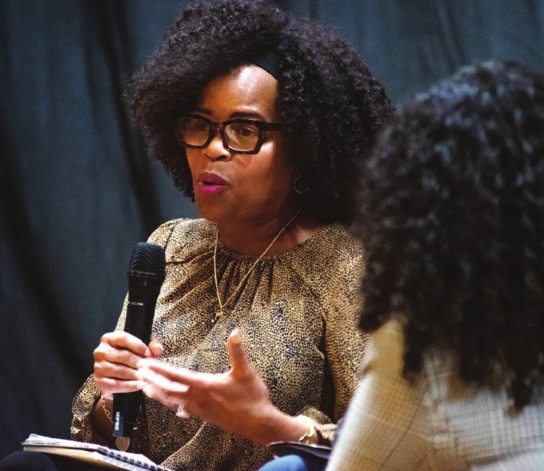
Executive Director Kim Janey speaks during a panel discussion on Black
community demographic trends at Roxbury Community College.
Greater Boston’s Black community has the most ethnic diversity in U.S.
Boston’s Black population is more diverse than much of the United States, according to a new report, “Great Migration to Global Immigration: A Profile of Black Boston,” released April 6.
The report, co-authored by James Jennings, Luc Schuster and Peter Ciurczak and released by the Boston Foundation in partnership with Embrace Boston, used census data from the past three decades as well as historical data about demographics within Boston’s Black population to identify patterns and trends within the demographics.
Jennings, a professor emeritus at Tufts University, said that a major takeaway for him was the level of diversity within Boston’s Black community.
“The diversity is much broader today and it has grown much more rapidly in the last several years than ever before,” Jennings said.
The report found that residents of Greater Boston are far more likely to report ancestries connected to other countries than the United States as a whole. According to the report, the Boston metro area has the largest share of foreign-born Black population of any large metro area in the United States.
It also found dramatic growth in Boston’s Afro Latino population, which more than doubled since 2000. Afro Latino populations in the Greater Boston area more generally and statewide experienced similar trends.
The report argues this growth should not be ignored, as the trend affects, among other things, who wields political power — the recent election of Boston City Councilors Julia Mejia and Kendra Lara, who both have Dominican heritage, being one example.
Schuster, executive director of Boston Indicators, said the growth of the Afro Latino population means that the city and region must consider factors like language when thinking of the Black population.
“The really rapid growth of Afro Latinos in the region means that there’s a significant sub-population that’s native Spanish speakers, and so we need to make sure that we’re meeting the linguistic diversity of Black residents in Greater Boston,” Schuster said. “That just would be far less of a pressing dynamic in a Detroit or a Chicago where there’s a much smaller Black foreign-born population.”
Many of the trends the report identified were especially prominent in suburbs and communities outside of the city of Boston itself. In 1980, 76% of the Boston area’s Black population lived within the city limits; by 2020, that number had dropped to 36%.
Jennings said that this report offers a resource to counter the view that Boston’s Black community is a monolithic entity.
“This
is an opportunity to say to the public, when we look at the Black
population, we have to really disaggregate what the Black population is
in order to understand and for us to work together more effectively,”
Jennings said. “When you look at the fact that some of these groups
bring language differences, does this mean that we have to really expand
what we mean by bilingual education? Because it’s not just in ancestry,
it’s also language where we see a diversity in the Black community.”
Both Jennings and Schuster said they hope the report can inform discussions around what Black reparations initiatives might look like.
“There’s
a big debate about whether reparations should go to just the
descendants of slaves or to redress post-slavery urban policies like
redlining that … discriminated against [all] Black people living in an
area,” Jennings said. “If reparations are associated with rectifying
consequences of those policies, it may be difficult to say that it’s
only the descendants of slaves, generations ago, who should receive any
kind of redress.”
Schuster said that the data in the report might help provide context for who could receive reparations and for what past wrongs.
“I
think the question of who would be eligible for a local reparations
program and what specifically would we be aiming to repair for is a
really important one,” Schuster said. “Hopefully data like this could
help inform those conversations.”
At
an event April 6 sharing and discussing the findings of the report, a
panel of local nonprofit leaders, including former acting Mayor Kim
Janey, discussed what should come next.
Bob
Gianino, president of United Way of Massachusetts Bay and Merrimack
Valley, said, “I think to get the most out of this report, and to
literally use it as a tool, we need to marry this quantitative approach
and understanding with a qualitative approach, where we really deeply
dive in and understand the experiences of Black Boston, and how they are
experiencing the dynamics that play out in the report.”
Jennings,
who also spoke at the event, said that more qualitative data will bring
greater context and understanding to the numbers in the report.
“Those
stories will give us insight to how the numbers really need to be
played out,” Jennings said. “Qualitative methodology is not second-child
to hard data. As a matter of fact, it enlightens hard data.”
Janey,
who now serves as president of the anti-poverty nonprofit EMPath, said
the report will serve as a resource as the city and surrounding
communities work to advance equity.
“I
think there is a lot of work for us to do, but, fortunately, I think
because of the folks who are gathered here today in this room and many
of the people who are trying to move our city forward — whether they
work in city government, whether they’re in the nonprofit space, whether
they’re in the private space — I think we can get there and it’s
reports like this that will help chart that that roadmap for us,” Janey
said.


