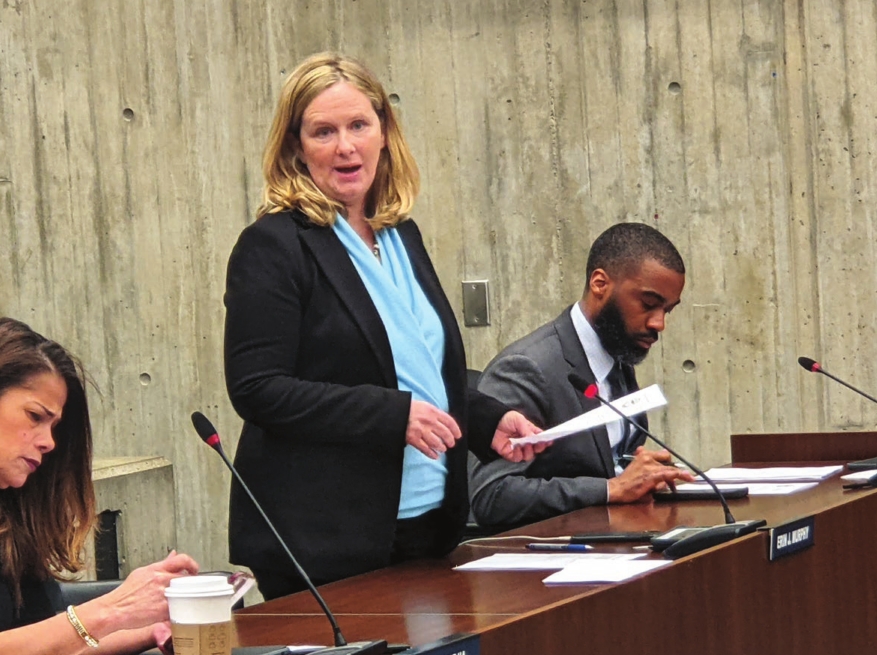
Speaking at last week’s
Council meeting, at-large Councilor Erin Murphy implied that councilors
and/or staff violated open meetings laws.
Murphy airs grievances over redistricting
The ongoing battle over new redistricting maps drawn and passed by the Boston City Council last year is once again spilling over from the courts into the Council chamber.
On Wednesday, two councilors introduced demands for city records in the form of two socalled 17F requests, both seemingly aimed at re-airing various grievances by opponents of the map approved by a majority vote of the Council last fall.
The records requests — one which passed the Council and the other which was defeated by a deadlocked vote — may prove largely symbolic, but they reflect, if nothing else, the degree to which rancor over of the body’s redistricting process has divided and continues to divide the body along political, if not partisan, lines.
These latest maneuvers come as a U.S. district court judge is weighing evidence presented by plaintiffs suing the city, who claim the redistricting process violated the federal Voting Rights Act, the U.S. Constitution and state open meetings laws. A hearing on the plaintiffs’ request for a preliminary injunction that would stall adoption of the new map concluded last week, after testimony that included two current councilors — at-large Councilors Erin Murphy and Michael Flaherty — taking the stand on the plaintiffs’ behalf.
On
the Council floor Wednesday, Murphy introduced a 17F request that
sought a copy of records, apparently already obtained from the city via
public records request by an attorney sympathetic to those opposing the
new map, detailing “any redistricting correspondence between Council
offices and some staff,” according to Murphy.
Murphy
said that she had already seen some of those records, which totaled
over 5,000 pages, but did not elaborate on what the records she saw
contained.
Murphy did, however, imply that the documents suggested some violation of City Council rules.
“Our
staff is an extension of our offices. Our entire staff takes the state
ethics, public records and open meeting law training along with us
because they are also expected to uphold the rules in the charter of the
city of Boston,” Murphy said.
Murphy
had also filed, prior to the meeting, an order for a hearing on “the
constitutional and open meeting law violations of the redistricting
committee,” which contained new allegations that councilors and/or staff
had violated the open meeting laws in a meeting that took place in
September 2022, at the Lena Park Community Development Corporation, a
meeting during which no more than two councilors were present at any
time, according to sources who were present. Were three councilors
present and discussing council matters, the meeting could have violated
open meeting laws.
The
document also contained apparent quotes from communications between
Council staff and unstated recipients that would seem to play to
arguments made by the plaintiffs suing the city in federal court
claiming that councilors were unduly preoccupied with the racial makeup
of districts during the redistricting process.
Despite
its appearance on the Council’s docket Wednesday, that hearing order
was not brought to the floor during the Council meeting.
Murphy’s 17F request failed to pass the Council, after a tied vote of 6–6.
Murphy did not return a request for comment by the Banner.
Councilor
Ricardo Arroyo, among those who voted against the measure, called
Murphy’s 17F request an example of “political theater,” in a statement
to the
Banner, adding
that “If [Murphy] believes an open meeting law violation occurred she
should file a complaint with the attorney general’s office, which is the
appropriate venue for that complaint.”
Councilor
Frank Baker, who helped fund the redistricting lawsuit against the
city, meanwhile introduced his own 17F request Wednesday for city
records pertaining to the city’s hiring of outside legal counsel in that
lawsuit and the dollar amount the city has spent defending its position.
“Pretty straightforward, just looking to get a sense on what is being spent on this lawsuit here in taxpayer money,” said Baker.
That request passed the Council by an 8–4 vote.
In
federal court, attorneys for the plaintiffs suing the city over the
redistricting process attempted to show that councilors improperly
engaged in “racial balancing” as they re-drew district lines, with
particular weight put on the council’s decision to move a block of
largely white residents from District 3 in Dorchester to District 4 in
Mattapan.
Attorneys
for the city argued that council members were obligated to change the
districts due to population changes and were properly doing their job in
exercising discretion over how the new districts would be shaped.


