Romilda Pereira addresses reporters during a press conference on violence prevention in Nubian Square.
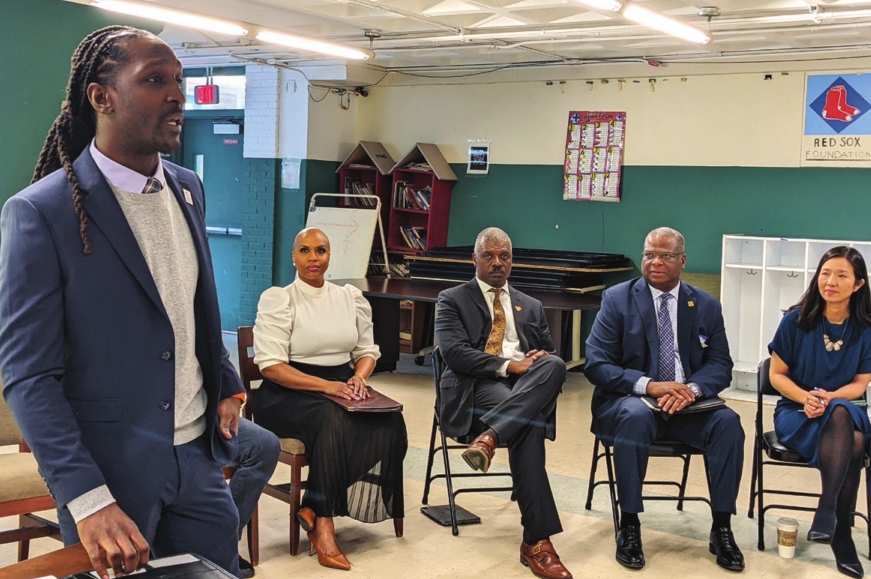
Isaac Yablo, senior advisor for community safety to the Wu
administration, addresses a violence prevention workshop. Looking on are
U.S. Rep. Ayanna Pressley, Rev. Jeffrey Brown, Boston Police
Commissioner Michael Cox and Mayor Michelle Wu.
Mayor meets with community activists in Roxbury
Boston Mayor Michelle Wu and her administration have set a new goal of reducing homicides across the city by 20% over the next three years.
The announcement came Friday, after a three-day-long violence prevention workshop organized and hosted by the Wu administration and the Violence Reduction Center, based at the University of Maryland. Boston is one of a cohort of cities to apply and be selected to participate in the Center’s program of implementing data-informed approaches to tackling gun violence.
The workshop was attended by several dozen community members, activists and city workers all engaged in violence prevention in Boston, a group Wu described as “people who have been in the trenches for a very long time.”
Achieving the new goal “is going to require coordination among all of us, clear goals, accountability, measuring, holding each other accountable and having a united sense that this is a priority of the City of Boston,” said Wu.
She continued, “We will not tolerate being a city where we’re watching what’s happening [from] different silos … We will not tolerate any neighborhood feeling like residents have to live in
fear of violence or experience loss that ripples down generation after
generation. … We have the resources, we have the expertise, we need to
just put it all together.”
The
target of reducing homicides by 20% — to fewer than 32 annually — by
2026, came out of workshop sessions, said Isaac Yablo, senior advisor
for community safety to the Wu administration.
And
the goal is, Yablo acknowledged, an ambitious one. While homicides are
up so far in 2023 — there have been 12 homicides yearto-date compared to
six by this time last year — the city’s current homicide rates remain
among the lowest in decades, down to several dozen in recent years from
over one hundred annually between 1989 and 1991. And violent crime is
down overall. Bucking that trend, however, has been a rise in
youth-related violent crime — a fact Wu has acknowledged repeatedly in
recent months.
“The
city is unique in that we have an extremely low homicide rate compared
to other cities, especially on the East Coast,” noted Yablo. “But the
city must do better in areas, particularly those impacted by gun
violence … If we’re being honest, it’s a very small proportion of the
community that has been disproportionately impacted by gun violence,”
Yablo said.
Yablo said
the city will be building out its violence prevention plan in the
coming months, with listening tours directed at communities most
affected by violence.
Thomas
Abt, founding director of the Violence Reduction Center, and who
facilitated the three-day workshop, said collaboration between key
partners in different roles, from police to community organizers, will
be critical to success.
“You simply cannot be successful in this work without key partners. Violence reduction is a team sport,” said Abt.
An approach based on data
Building
on academic studies of gun violence in cities, the Violence Reduction
Center’s program revolves around data-driven approaches to reducing and
preventing crime by targeting specific hot spots and focusing on
high-risk populations.
In
a presentation kicking off the workshop, University of Pennsylvania
criminologist Anthony Braga portrayed gun crime in Boston as highly
localized — to the point of being concentrated largely along certain
stretches of certain streets or particular city blocks.
Between 2013 and 2022, Braga said, “All of the shootings happened in just 4% of the city.”
Meanwhile,
Braga said, the vast majority of shooting perpetrators, as well as
victims, were individuals already known to the criminal justice system:
roughly three-fourths of homicide victims and offenders had been on
probation at some point before they killed or were killed.
“It
stays a story of concentration, and a lot of these areas have stayed
the same over time. It’s really a story of stability,” Braga noted.
Braga
also asserted that much of the gun violence in Boston is perpetrated by
gang members — a claim that touches on the controversial question of
how the Boston Police Department identifies and tracks alleged gang
activity.
Abt said
reducing crime in those areas will require a focused approach with
unprecedented collaboration between city agencies and community leaders —
and will necessitate preventative measures along with punitive action.
But, he said, changing longstanding patterns is possible.
“You
don’t need to boil the ocean. You need to focus on the highest-risk
people, the highest-risk locations and the highest-risk behaviors,” said
Abt.
The new push to
prevent and reduce community violence is hardly the first of its kind — a
fact that was not lost upon those attending the city’s workshop.
Some are skeptical
Speaking
at the outset, Congresswoman Ayanna Pressley acknowledged that many in
the room have heard similar pledges of action before.
“It’s
hard to come to spaces like this and to not be cynical. We have all
been on this road for a very long time, and we are used to very
predictable algorithms in the wake of violence: community vigils, prayer
rallies, funerals and a lot of finger-pointing,” said Pressley. “And so
in this moment we have to be disruptive.”
Still, several workshop attendees said they have yet to be convinced.
“I
didn’t learn anything new. … it’s the work that we’ve been doing for
years,” testified Romilda Pereira of Project Turnaround, a Boston
nonprofit that works with Boston youth and formerly incarcerated
individuals.
Speaking
to the assembled group at the workshop’s close, Pereira added that she
was “against someone from D.C. coming to Boston and telling us about our
streets.”
Donald
Osgood, who works for the Boston Public Health Commission, was another
attendee who remained skeptical of what he characterized as platitudes
to community activists.
“Stop
saying that the brothers from the streets are the experts — because if
you say that, then you have to empower them,” Osgood said.
Other attendees were more receptive to the mayor’s latest initiative.
“For
a lot of us who’ve been doing this work for decades, it was information
that we knew, absolutely. At the same time, there were people in the
room who had no clue,” said Brother Donnell Singleton.
Thanking
Mayor Wu for inviting the assembled group, Singleton said, “I think
we’re starting to get it. For the first time ever, I think there was a
table that represented Boston during this week.”