
Don Flemons
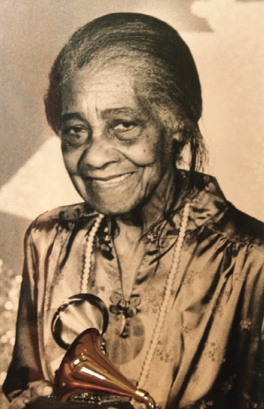
Elizabeth ‘Libba’ Cotten
Dom
Flemons is a modern-day “American songster” who pays homage to the
obscured history of African American folk music while illuminating the
memory of pioneers who left their mark on the genre’s austere roots.
Equally
significant for this Grammy Award-winner and twotime Emmy nominee has
been his commitment to the memory of folk music hero Elizabeth “Libba”
Cotten, who is being inducted posthumously next month into the Rock
& Roll Hall of Fame. The “Early Influence Award’’ designee will
share the honors with Harry Belafonte.
Flemons,
40, is a talented composer, singer, guitarist and banjo player in his
own right. Born in Phoenix, Arizona, to Black and Mexican parentage, his
secondary role as a historian and musicologist seem to loom as large as
his prodigious musical abilities.
In
the midst of a thriving musical career, not even last weekend’s
appearance at the International Bluegrass Music Association Industry
Awards in Nashville prevented him from carving out some time to talk
about Cotten, a selftaught guitarist, banjo player and singer born in
1895 into a musical family near Chapel Hill, North Carolina, in a town
later incorporated as Carrboro.
“If
you see a picture of Elizabeth Cotten, everybody has a grandmother or
great-grandmother reminiscent of her that was stoic, and generous, and
really appealing,’’ he says. “She wasn’t an Angela Davis. She wasn’t a
revolutionary. She was low-key and very calm and collected, even though
she knew the challenges for a Black woman in that time. I think with so
much strife going on in the world, she didn’t allow that to be a part of
her musical or stage presentation. It was like your great-grandmother
picked up a guitar and just played.’’
Cotten
did far more than just play, compose and sing. With her “Cotten
picking” style adapted to a right-handed guitar set-up to suit her
natural left hand, she helped revive the North Carolina Piedmont strum
tradition from the turn of the 20th century to take a modern-day place
during the Civil Rights era when Cotten, then in her 60s, finally began
recording many of the songs she had written in her childhood.
Numbers
like “Freight Train,” “Shake Sugaree,” “Willie” and “Going Down The
Road Feeling Bad,” have been covered by folk and rock luminaries
including Joan Baez, Taj Mahal, the Grateful Dead, Bob Dylan and one of
today’s shining stars — fellow North Carolinian Rhiannon Giddens.
Cotten’s precise
articulation and jubilant interchange between the bass and melody
strings bring a bouncy orchestral feel, accompanying a singing voice
perfectly suited to tell the stories of the Carolina country people.
“She’s
kind of like Lead Belly (Huddie William Ledbetter), because most method
books are going to teach you “Freight Train” in the first two or three
songs that you learn in the Carolina Piedmont style,” says Flemons. “She
became such an essential part of that learning process for anyone
learning finger-style guitar. Chet Atkins did it, so even
country-and-western people acknowledge Elizabeth Cotten as an influence,
whether it be from her recordings or that they may have heard it from
somebody doing her style or her songs. At the end of the day, it all
reaches back to that early North Carolina Piedmont strum band
tradition.”
Deep roots
Flemons
believes the music from the southern states of North and South
Carolina, Georgia, Virginia, Tennessee and Kentucky, was quintessential
American music developed equally by Blacks and whites, with roots in
Africa, the United Kingdom and Ireland, but he stresses that the banjo
originated in Africa.
He
laments, to the degree it has happened, Black disengagement from folk
music. With the Carolina Chocolate Drops, a Black acoustic roots band he
co-founded in 2005, he helped refocus eyes and ears on that lost
history.
“I spent a
lot of time trying to bridge the gap between traditional music of the
1920s and the recordings of the music of the 1930s,’40s, ’50s and on,”
says Flemons. “I’ve really tried to show the people that there’s a
relevance of Black music that precedes the commercial Black music that
everyone is familiar with. Black culture was evolving in an urban
setting in the 1960s, going into the Civil Rights era. At that time
documentarians, primarily white college students and scholars, went down
South, and they recorded a lot of these fringe styles of music. Some of
these musicians were able to transcend into working musicians, touring
and doing gigs and stuff like that, but others stayed in obscurity. I
think that now there’s so much that can be done to bridge the gap
between modernity and tradition within African American folk music. And
that’s kind of where my music lies.”
Cotten,
who was married in her teens, stopped playing music early on, working
primarily as a domestic and raising a family. It wasn’t until her later
years, after joining her daughter in Washington, D.C., and working for
the renowned Seeger folk music family did she slowly regain her musical
identity.
“She has
this very interesting encounter in a department store,” Flemons says of a
widely-circulated story that sounds more apocryphal than real. “She
sees this little girl crying looking for her mother. She helps the girl
find her mother. The little girl is Peggy Seeger. In the course of
conversation, Elizabeth mentions to the mother, ‘Well, I do domestic
work, if you need someone to work in your house.’ So she goes to work
for them. And she began playing music in the house when no one was
around. As the story goes, they heard her playing the
guitar and she apologized. But they noticed she had a really beautiful
style of playing, because she played her guitar upside down like Jimi
Hendrix. They encouraged her to play more, and then Mike [Seeger]
recorded her very first record in 1957. And that began Elizabeth’s
career as a folk musician in the time of the folk revival.”
Flemons
notes that Mike Seeger accompanied Cotten throughout her now-thriving
career until she could no longer tour, leading up to her death in 1987.
Cotten’s
delayed gratification, Flemons says, came to serve America at a time
people were searching for clarity in their lives. In general, he thinks
the integrity that underpins folk music lends tranquility to a
fast-paced society.
“Her
music was not necessarily made for the stage, nor for money,’’ he says.
“There’s an aspect to the folk revival that’s really built on
sincerity, being able to make music that is powerful but is also humble
and is not built on a big commercial platform. Sometimes it’s to its
detriment as well, because certain musicians are typecast into a spot
where they need to be poor, and there’s an ebb and flow to that. But in
Elizabeth Cotten’s day, it was such a new movement, especially in a
young Baby Boomer generation wanting to find the heart of America, where
right before the time of the Civil Rights movement, they were trying to
find something real, tangible, something very rooted. So getting the
chance to see someone like Elizabeth Cotten blew peoples’ minds.’’
Flemons
says Appalachian folk music was an influential factor in the
development of blues, jazz, rhythm & blues and soul music, and
Cotten and her predecessors should be noted for their roles in music
history.
“While she
may have forgotten most of her music in the course of her lifetime,
because there was no need for it or no place to play it, the folk
revival allowed her to delve back deep in her mind, think of her
childhood, and be able to pull back songs that are still a part of the
documentation as well as the musical foundation of what was a part of
North Carolina at the turn of the century,” he says. “If we didn’t have
her, we’d be losing hundreds of songs. Just like any type of
anthropology, it would just go away if someone hadn’t decided to put it
down on paper and on recordings so it could be listened to and enjoyed.
Now it’s been almost 100 years since she began to perform, so her music
has withstood the test of time.”


