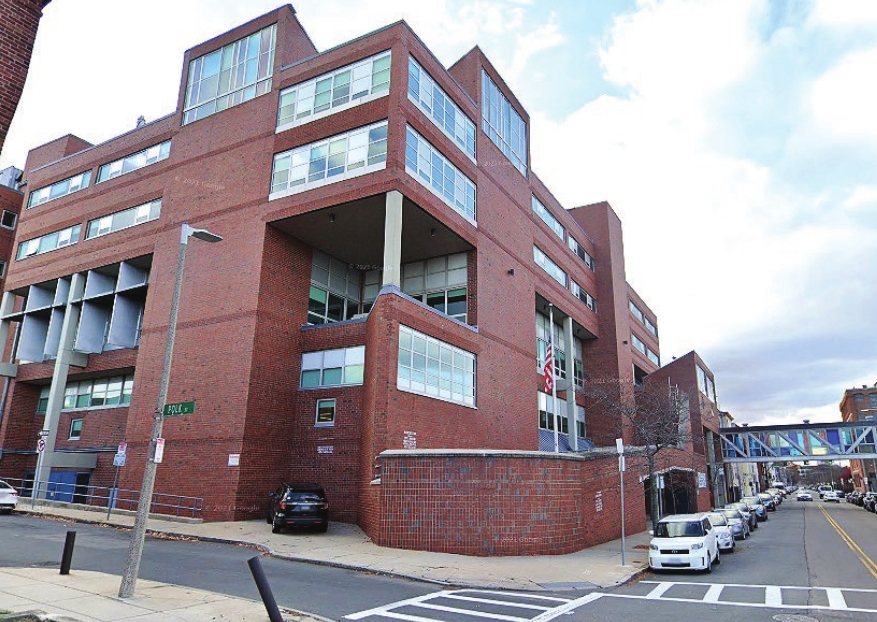
The state’s Department
of Elementary and Secondary Education lists Charlestown High School
among the lowest-performing 10% of schools in the state.
Critics say state school rating system doesn’t reflect what they actually do
In January, Boston Public Schools Superintendent Brenda Cassellius announced interventions in three high schools where lower-than-average standardized test scores and graduation rates could trigger state takeovers of the schools.
Cassellius said she would assemble intervention teams and work with the Boston Teachers Union to assess challenges at Charlestown High School, Madison Park Vocational Technical High School and the McKinley K-8 and high schools.
“I am appointing this intervention team to review data on student opportunities and outcomes, recognizing that we have work to do to deliver on the promise of excellent and equitable education for all students,” she wrote in letters to staff.
While state officials rely heavily on scores on the Massachusetts Comprehensive Assessment System (MCAS) test in their ratings of schools’ efficacy, however, some say schools like Charlestown High underscore the limits of the state’s rating system, which rather than using a comprehensive assessment system, as the name implies, relies disproportionately on a single test.
The average scaled scores for Charlestown High students on the MCAS English Language Arts and Math tests are significantly below those of the state averages, with 37% of students not meeting expectations in Grade 10 English. The state’s assessment system puts Charlestown in the lowest 10% of schools, citing in part its low graduation rate.
Sung Joon Pai, who until last year served as the school’s director of systems and innovation, notes that Charlestown has a higher-than-average proportion of students with disabilities and interrupted or delayed education.
Charlestown High has programs for students with autism, students with multiple disabilities and students in an eightyear Occupational Skills Development curriculum. The latter are students with disabilities so severe, they stay in school learning basic living skills until age 22, then transfer to adult assisted-living programs. Because they earn a certificate of attendance, rather than a high school diploma, the school is penalized by the state, Pai says.
“According to the state’s metrics, they count against the fourand five-year graduation rates,” he said.
The school is also penalized for low MCAS scores from those students and those in its Students with Limited or Interrupted Education program, which typically serves students from other countries with limited years of education as well as limited English skills. Many of those students may not graduate before they age out of the system at 22.
Also
adding to the low MCAS scores at Charlestown: the school’s surplus of
seats. Because the school has empty seats, students who fail at other
schools are often administratively transferred to Charlestown. The
school has 102 students in its ninth grade and 239 in its 12th grade.
Because many of the students who enter the school have already repeated
grades in high school, they further erode Charlestown’s four-and
five-year graduation rates.
Overall,
Pai says, the school’s graduation rate hovered around 55% during the 11
years he was there, owing to the large number of students whose
disabilities precluded them from meeting the city’s and state’s
graduation requirements, but among regular education students, the
graduation rate was closer to 70%.
Despite
the school doing what school leaders set out to do — providing
education to non-traditional students — the state Department of
Elementary and Secondary Education lists Charlestown in its lowest 10%, a
category the state considers “underperforming.”
The
other schools slated for interventions have similar student populations
to that of Charlestown. Madison Park and the McKinley school have
student bodies that are overwhelmingly high-needs. Among Madison Park
students, 85% are from low-income families, 32% are English language
learners and 40% are students with disabilities. At the McKinley school,
98% of the students have disabilities and 90% are low-income.
All are considered underperforming by the state’s metrics.
The
apparent mismatch between what these schools actually do — provide
education to students with disabilities — and how the state rates them
underscores a key problem with the state’s rating system. According to
Jack Schneider, an author and associate professor at UMass Lowell’s
School of Education, the rating system makes no allowances for the vast
differences in a student population such as that of Charlestown, where
94% of students are high needs and 83% are low-income, and Wellesley
Senior High School, where 22.8% of students are high needs and 7.3% are
low-income.
“Unless
the state is going to invest significantly in schools to ensure a level
playing field, it’s completely unrealistic to think that schools
themselves are going to level out the great inequities we have in our
society,” he said.
DESE’s
solution to schools it deems underperforming, the measure Cassellius
appears to be trying to head off, is state intervention — a move that
often has suboptimal consequences for school communities. The Dever
School in Dorchester, for instance, saw a state-appointed start-up
nonprofit cycle through five presidents in two years with no discernable
sign of progress, despite receiving $4.6 million a year from BPS and an
additional $1.6 million from the state.
State
interventions, Schneider says, are driven by the outdated theory that
schools are underperforming due to poor management, and that shifts in
management can boost student performance on standardized tests.
“That
theory has been disproven,” he said. “There is lot of counter-evidence
that not only do [state] interventions not lead to improvement, but that
they also lead to outcomes that are in opposition to what school
communities want.”
At
Charlestown High, a local attempt at intervention led by a group of
parents from the surrounding neighborhood — none of whom had students
enrolled in the predominantly low-income school — proposed transforming
Charlestown into a state-designated “innovation school,” a designation
that would have essentially closed the school and reopened a new one in
the building.
The
proposal, which faced stiff opposition from teachers, parents and
students, would have limited the percentage of special needs students in
the new school to 25% and eliminated substantially separate classrooms,
such as those in which students with autism are taught.
The
plan, which required approval from the Boston School Committee, a
Boston Teachers Union representative and Cassellius, was voted down.
BTU
President Jessica Tang argues that, rather than outside interventions,
Charlestown High, Madison Park and the McKinley schools need
policymakers to listen to the school communities and provide assistance
accordingly.
Cassellius’ proposed intervention, she said, could make that possible.
“What
is true for all three schools is that we need ground-up solutions,” she
said. “The intervention team model enables us to do that and have a
process for stakeholder, student and parent input.”


