Mayor Kim Janey attended the Congressional Gold Medal Ceremony for Chinese Americans who served during WWII.
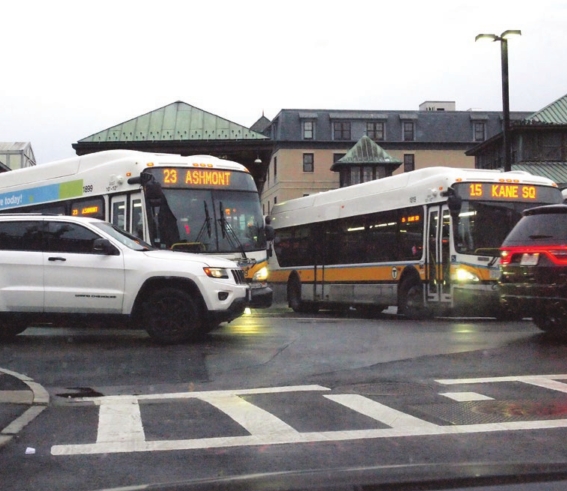
Diesel buses turn onto Dudley Street.
A call for relief in communities plagued by poor air quality
As organizations across the state are looking to shift practices and models to become more climate-friendly, the MBTA is planning a shift to a fully electric bus fleet. The agency proposes a fully electrified fleet by 2040, but some transit activists and state legislators say the shift should come sooner and should have a stronger focus on the communities most impacted by air pollution.
The MBTA’s plan, which was outlined in an April report to the organization’s Fiscal and Management Control Board would work to update infrastructure in bus yards and replace the existing fleet — largely composed of diesel-electric hybrid and compact natural gas buses — with all electric battery-powered buses.
The first steps of the plan include constructing a new facility in Quincy, as the current one lacks quick fixes that could make it suitable to house electric battery-powered buses. The plan also describes $21 million of renovations to the North Cambridge bus yard, which houses much of the MBTA’s electric trolley bus fleet.
However, some activists, like Jarred Johnson, executive director of
the group TransitMatters, said that removing the trolley buses is the
wrong first move, as they are already electric. These buses, which run
on routes 71 and 73 through Cambridge and Watertown, pull their power
from wires that hang over the street and operate without diesel or
natural gas.
In an
analysis released in September comparing the trolley buses with
battery-powered electric buses, the MBTA cited safety concerns with the
wires snapping or maintenance crew having to work in the street to do
repairs. But Johnson said that he thinks the system, which in the middle
of the 1900s was widespread across the city, is reliable.
“We
would acknowledge that those buses have been on the road for some time —
though, I think the fact that they’ve been on the road for a long time
tells us about just how reliable and how useful that technology is,”
Johnson said.
An environmental justice focus
Activists
also suggest the first steps in removing diesel pollution from the bus
fleet should be in communities that experience greater impact from air
pollution.
“One of the
big issues for us is that [first,] it doesn’t actually have any
emissions benefit because those buses are already electric,” Johnson
said. “And then, secondly, there are [environmental justice] communities
that have been asking for cleaner buses for a long time.”
Those
environmental justice (EJ) communities are places like Dorchester,
Mattapan, Chelsea and Lynn, among others, that are comprised of largely
disadvantaged populations at greater risk from environmental hazards.
Mela
Bush-Miles, transit-oriented development director at Alternatives for
Community and Environment and head of that organization’s T Riders
Union, is a Roxbury resident who said she has seen the impact from the
use of non-renewable fuel sources in MBTA buses, especially with the bus
depot at Nubian Square near where she lives.
“All
of these buses going in and out and concentrating diesel exhaust if
they’re idling or whatever, it brings a lot of air pollution and it’s
causing harm to our communities,” Bush-Miles said.
Her three children, now adults, have asthma, and Bush-Miles said they’re still seeing the impacts of breathing struggles.
“We
need our climate to be breathable, we need our air to be breathable,
and we have enough trucks and cars driving around through the community
that we don’t need something to compound the problem,” Bush-Miles said.
For
Justin Ren, a researcher at Boston University who has focused on
electric vehicles, in principle, it doesn’t make sense to pull the
trolley buses before adding battery electric buses elsewhere. However,
whether those trolley buses stick around in the long term is “the
million-dollar question.”
After
pointing out examples of several cities that have embraced trolley
buses with success, Ren said it ultimately depends on the state of the
infrastructure and where priorities lie.
“You
have to really look at, ‘OK, I have a million dollars, where should I
spend it? Do I upgrade the system? Do I replace the system?’ This is
where things get really, really difficult,” Ren said.
Johnson
is a proponent of the MBTA considering in-motion charging technology,
an updated form of the trolley bus system that allows it to not only run
on its overhead wire system, but to use that system to charge batteries
that would also allow it to run off-wire.
The
MBTA, in a comment to the Banner, didn’t say if it is considering that
technology, but did point out that the transit agencies opting to
reinvest in their trolley bus system are those that have an extensive
system in the first place. According to representatives from the MBTA,
there are fewer than 20 miles of overhead wires in the Greater Boston
area. According to a roster of MBTA vehicles from the Boston Street
Railway Association, 28 of the 1,148 buses in the MBTA fleet — or about
2.4% — are electric trolley buses.
Johnson
said he objects to what he sees at the MBTA’s move to insist on making a
standardized fleet. But for Ren, a fleet with a single type of
electrification technology is ideal.
“You don’t want to have a hodgepodge of different systems; you want to simplify,” Ren said.
State-level discussions
In
the State House, the conversation is continuing on another front. A
bill presented by Representatives Christine Barber, who serves the 34th
Middlesex District, and Steven Owens, who serves the 29th Middlesex
District, would push the MBTA to electrify its bus fleet by 2030. Across
the state, other regional transit authorities would have to electrify
by 2040.
“We all know
climate change is something we need to address yesterday and do all that
we can to stop the temperature of our communities from increasing,”
Barber said, citing worse health outcomes in parts of her district most
impacted by transportation-related air pollution.
In
addition to the early deadline to electrify the MBTA fleet, the bill
would focus electrification efforts in EJ communities sooner, by 2025.
“I
want to make sure it’s not just Cambridge and Watertown that are
getting electric vehicles, but that we’re looking at Roxbury,
Dorchester, Lynn, Chelsea — communities where lots of people take the
bus and buses make up a huge amount of the pollution in their
communities,” Barber said.
Despite
ongoing concerns about the state of funding for the MBTA, Barber said
it’s important that the transit agency, which she referred to as “a
public good,” continues to receive the money it needs to keep operating,
and that funding allows the MBTA to move toward cleaner power sources.
“It
is an incredibly important part of our economy, it runs the economic
engine of the Boston metro area, so we need to be investing in the MBTA,
but specifically in electrification and invest in climate change
[action] for communities that have borne the brunt of climate change for
many years,” Barber said.
She
pointed to the Fair Share Amendment — a ballot question that will
appear on the 2022 state ballot and would implement an additional tax of
4 percentage points on any annual income over $1 million — and federal
funding as possible avenues to keep funding the MBTA and its
electrification efforts.
She
also said that, while 2030 is less than a decade away and there has
been no logged action regarding the bill since it was referred to the
committee on transportation in March, she feels 2030 is a reasonable
goal for full electrification of the bus fleet.
“Because
of the amount of use of MBTA buses, they do turn over their fleet and
purchase new vehicles fairly frequently and it’s doable,” Barber said.
Winter challenges
A
potential challenge to a full fleet of battery electric buses: They
face challenges in cold weather as the batteries struggle in the cold
weather.
“Just like your iPhone doesn’t work well in sub-zero temperature, or the battery suddenly dies, it’s the same thing,” Ren said.
According
to a 2019 study from the Center for Transportation and the Environment,
battery electric buses could experience a loss of about 32.1%
efficiency when the temperature drops from the range of 50 to 60 degrees
to a range of 22 to 32 degrees.
In
a 2020 report from the MBTA, battery electric buses with a maximum
range of 110 miles at 70 degrees dropped by nearly half, to a maximum
range of 60 miles, at 20 degrees.
But
Barber said she’s confident the technology will be able to stand up to
Boston’s winters, citing cities like New York and Chicago with similar
climates also working toward electrification.
Some
solutions currently exist, like in-route charging stations that top off
the batteries at certain bus stations or heaters that warm the battery
and keep them running at higher performance. However, the charging
stations require greater investment in infrastructure, and placement
works best in shared bus corridors, limiting their effectiveness on
routes that don’t share much ground. The heaters are often diesel,
reintroducing some level of air pollution.
Ren,
however, said the technology is improving and that expecting it to be
able to support a full bus network is “more than just hope.” He said he
believes within a few years the technology will be there.
For
activists like Bush-Miles, while the details of how are important, the
most important part is getting new electric buses out onto the road.
“We’re
just trying to live a few more years and have a better quality of
life,” Bush-Miles said. “Those electric buses can be part of the
equation that can help us get there.”


