Boston Public Schools Superintendent Brenda Cassellius.
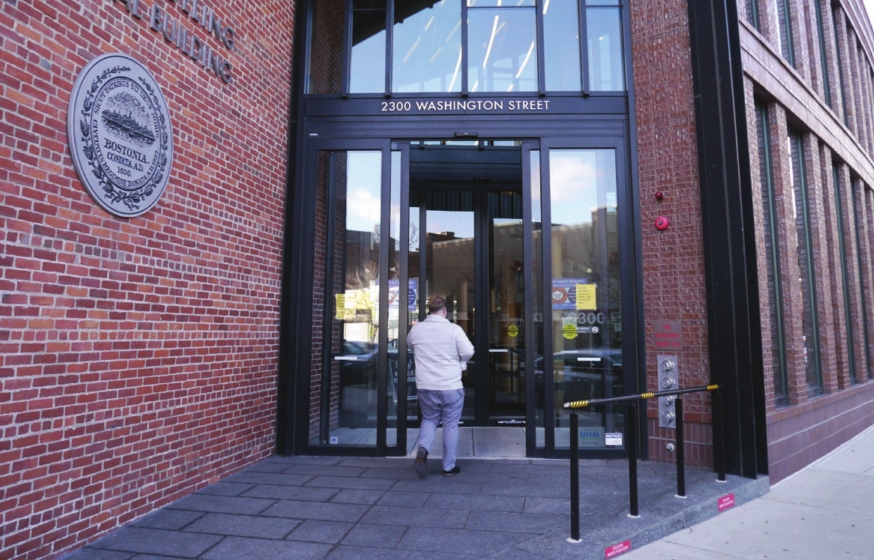
Boston Public Schools headquarters at the Bruce Bolling Municipal Building in Roxbury.
Some call for staffing increases, district takes cautious approach
At the end of last month, Boston Public Schools submitted to the Massachusetts Department of Elementary and Secondary Education its projected spending of $123 million in federal funds from COVID-19 relief packages for the 2021-22 school year.
The funds, which come from the Coronavirus Response and Relief Supplemental Appropriations (CRRSA) Act from December 2020, are part of a collection of about $430 million in federal funds from the March 2020 CARES Act, the CRRSA and the March 2021 American Rescue Plan Act, collectively comprising the Elementary and Secondary Schools Emergency Relief (ESSER) funding.
While local education advocates feel there were some successes in the process to determine how the funding will be used, other portions of the plan fall short in their eyes.
The funding for the 2021-22 school year, referred to as ESSER II, will be used to focus on academic and social-emotional recovery in light of the effects of the pandemic. That is why equitable distribution of the funds was so important for Ruby Reyes, the executive director of the Boston Education Justice Alliance and a member of the commission that BPS created to help distribute funding.
“One of the things that I had really pushed for on the commission was equitable school funding, so, making sure that schools that have been most impacted by the pandemic receive the most funding,” Reyes said.
ESSER I
The first phase of funding, ESSER I, saw about $50 million allocated to individual schools in the 2020-21 school year. The funds were intended to help students return safely to in-person learning with resources like personal protective equipment and improved air quality and filtration within schools, among other priorities.
Its use was focused on BPS schools with larger populations of students with more severe disabilities, students from lower-income families and students for whom English isn’t a first language.
Reyes said she thought this was better than using a weighted student funding formula, which the district uses to distribute normal school budgets, where each student in a school population is given a per-pupil rate based on factors such as disabilities, status as an English-language learner, poverty or homelessness. But Reyes said she feels other factors should also be considered, like which school populations had higher numbers of absences due to technology issues during the pandemic and which communities in Boston faced higher COVID-19 rates.
She said BPS Superintendent Brenda Cassellius said the school district would work to take those factors into account for the second and third rounds of ESSER funding.
ESSER II
According to the plan submitted to the state, the $123 million of ESSER II funding will be split in half, with $61.5 million going directly to schools based on calculated need. The other half will be allocated to schools through the central BPS office.
In a statement to the Boston School Committee Aug. 4, Cassellius said the central office’s 50% of the ESSER II funding will focus on three areas: social-emotional engagement and support; academic acceleration and equitable recovery; and facility improvements.
Cassellius said the choice to focus on those areas was guided by community feedback.
Reyes hopes that as schools move forward to begin using ESSER II funds, students and community members continue to use their voices to advocate for the needs they see.
“Normally we do town halls just on understanding your school budget, understanding where your voice is, so really pushing for parent power, for student power in the budgeting process at their school…,” Reyes said. “And then also, really just pushing families to make sure that they’re asking their principals ‘Where’s our ESSER money funding going?’ You know, ‘These are the things we need,’ and kind of making sure those things are covered.”
More staff needed
Some of what Reyes said she thinks schools need most aren’t necessarily on the table for ESSER funding.
“A lot of our school communities just need more [student-facing] staff,” Reyes said. “They need more
teachers, they need more [paraprofessionals], they need more bus
monitors ... . You know, Dr. Cassellius is always saying ‘all hands on
deck,’ but the reality is we need more hands to actually be able to be
on deck.”
But
Cassellius said that adding staff isn’t something BPS will do with the
ESSER funding because those resources will only last a few years.
“Our
ESSER money is $400 million of one-time funding that we get, and you
can’t depend on that to pay for positions year after year after year;
that has to come out of our operation general fund and just part of our
normal business, which it should be when it’s these kinds of investments
around staff,” Cassellius said in an Aug. 4 interview on the Boston
Neighborhood Network News.
In
the same interview, Cassellius said the district was hiring social
workers for all BPS schools through the district’s ongoing operating
budget to work as part of a support team for students and families. The
teams will comprise a school nurse, social worker and family liaison.
Jessica
Tang, president of the Boston Teachers Union (BTU) and a member of the
BPS ESSER commission, said she thinks BPS educators need more help. And
while hiring more social workers is an important step, it leaves
something to be desired.
“It’s
a great start, and certainly I commend those efforts, but if we truly
want to have fully staffed schools, then there are a lot of positions
that are missing,” Tang said.
Those
positions she’d like to see more of include literacy coaches, special
education teachers, bilingual educators and school psychologists, as
well as full-time art, music and physical education teachers in schools
that don’t have them ESSER funds, she said, should be considered to hire
staff, especially in light of BPS’s goals for the second phase of ESSER
funding, focused on academic and social-emotional recovery.
“We
absolutely believe the funds can and should be used for additional
staff,” Tang said. “If we’re going to address social-emotional wellness
needs, instructional gaps, etc., then we do need to have more staff. …
And even if some of those additional staffing positions are temporary,
they’re still needed. So, we absolutely do believe that some of the
funds should go to the needed staffing to meet special education,
English-learner, early ed and social-emotional wellness needs, just to
name a few.”
Tang said she advocates for BPS using funding from the Student Opportunity Act, a 2019 law
intended to add $1.5 billion to public education systems across the
state, to help support new positions after ESSER funding runs out.
Xavier
Andrews, director of communications for BPS, said in an email that
while the district and the city are excited that funding may increase
under the Student Opportunity Act, there are no guarantees of what will
be funded in the state budget.
“We
are hopeful that the state will increase funding to Boston, which will
allow for certain ESS- ER-funded initiatives to continue,” Andrews said.
“However, we are not operating under that assumption. … BPS is making
equitable and sustainable central investments with our ESSER funds and
we encourage our schools to do the same. While some schools may use
their funds on positions, we continue to emphasize that ESSER is
one-time funding.”
ESSER III
According
to the draft of a three-year plan for ESSER funding released July 9,
the third phase of funding, known as ESSER III, will focus on
reimagining the structure of BPS to make it a stronger, more equitable
system. In her update to the school committee, Cassellius said the
district recently created a student commission to help shape plans for
that third phase.
“That’s
going to be really fun to hear from the student more indepth on those
investments,” Cassellius said. “Based on those priorities and what we
hear from students, families, teachers, staff and partners, we will
release the plan and our overall vision for ESSER later this year.”