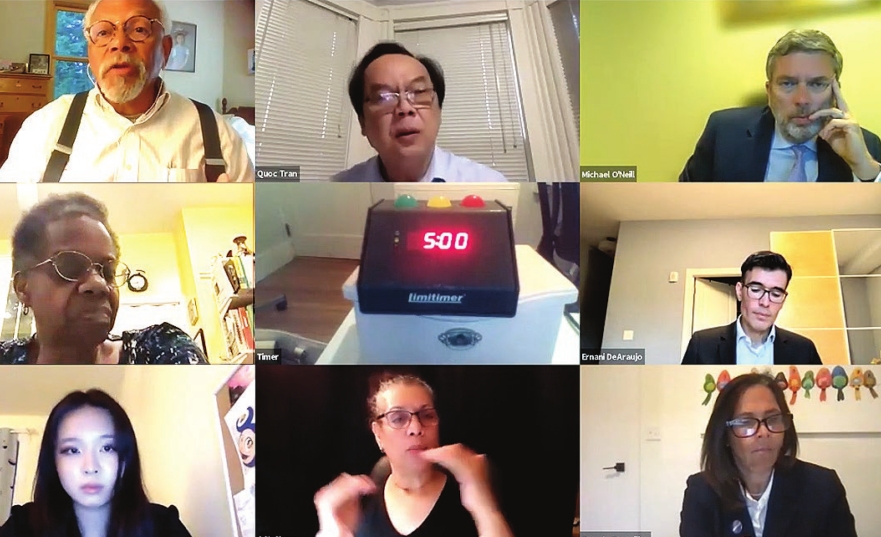
A June meeting of the Boston School Committee.
Councilors advance ballot question that would restore elected body
Boston City Councilors Ricardo Arroyo and Julia Mejia announced Monday a proposed home rule petition for an elected Boston School Committee.
If adopted and signed by the governor, the petition would, by 2026, shift the School Committee, which is responsible for governing Boston Public Schools, from its current seven members who are appointed by the mayor into a 13-member body for which all seats are elected by residents of Boston.
Under the proposal, the committee’s new structure would be like that of the City Council, with one seat for each of the nine electoral districts and three at-large seats to be filled during municipal elections. The 13th seat would be filled by a student representative elected by BPS students through the Boston Student Advisory Council. Under the new structure, the student member would have voting powers, a shift from the current student member’s advisory role.
The School Committee’s current structure was put in place by a 1991 home rule petition. Before that, since the formation of the first school committee in Boston in 1789, the body was elected.
In a press release, Mejia said the shift to an elected body is important to bring the voice of residents of Boston into the school committee.
“We’ve always said that nothing about us, without us, is for us,” Mejia said. “For too long, we have not had a voice in deciding who represents our parents, our teachers, and our children when it comes to designing the future of our school district. Changing to an elected School Committee is an opportunity to lead with the people’s voice, and we would not be here if it weren’t for the advocates holding us all accountable to the work.”
If approved, the shift to an elected body would take place over the next five years in phases. Beginning in 2022, the student member would have voting powers; In 2024, three at-large members would join, through a municipal election, with the seven other members still appointed by the mayor; and in January of 2026, the committee would fully shift to the all-elected 13-member structure.
The city councilors’ proposal comes alongside a petition organized by the Boston Coalition of Education Equity (BCEE) to put an advisory ballot question on the November municipal ballot regarding electing the school committee. The ballot question would be non-binding, but according to a press release, supporters hope it would put pressure on the mayor and City Council to move forward with the switch.
Lisa Green, a BPS parent and member of the BCEE, has helped get the petition moving. She said she has had experiences where
she has gone to School Committee meetings to comment on proposed
policies and felt that she was listened to, only to see committee
members vote the other way because, she said, the members are bound by
the will of the mayor.
“A
good school committee member is one that’s going to be responsive to
their community,” Green said. “What we can’t continue to have is School
Committee members who are knowledgeable, well-meaning experts in the
field of education — they ask the right questions, they listen to public
testimony, they’ll even express, sometimes, solidarity with the voice
of the people —[who] then go vote the other way because they’re
constrained by the political agenda of the mayor.”
Tanisha
Sullivan, president of the Boston branch of the NAACP, said that, given
the importance of education, allowing the people of Boston more say in
running the public school’s governing body is a valuable step.
“Public
education is a cornerstone of our community and critically important to
help ensure that our young people have the opportunity to reach their
full potential,” Sullivan said. “Having an elected school committee will
allow for more active engagement of families, students, educators and
other stakeholders in the policymaking of our school district.”
The conversation over an elected or appointed school committee is also spilling over into Boston’s mayoral race.
In
their responses to the Progressive Massachusetts questionnaire, mayoral
candidates Kim Janey, Michelle Wu and Andrea Campbell said they support
a hybrid School Committee with some members appointed by the mayor and
others elected by residents of the city. Annissa Essaibi George said she
proposes a nine-member body that is partially appointed by the mayor
and partially appointed by the City Council. In the surveys, John Barros
was the only candidate to say he opposes changing the structure of the
council.
In a
statement emailed to the Banner, Janey said that she thinks it is
important to create accountability toward the public while also
maintaining accountability to the mayor.
“I
support exploring a hybrid model for the school committee, to include
appointed, elected and additional youth members with voting power,”
Janey said. “While more accountability to parents, youth and
stakeholders is welcome, it is absolutely essential that a direct line
of accountability to the mayor be preserved.”
Ruby
Reyes, president of the Boston Education Justice Alliance, said that
she thinks a hybrid committee that is both elected and appointed is
incongruous with other democratically governing bodies.
“We
don’t have a hybrid mayor; we have a person who’s elected by the
residents of Boston,” Reyes said. “There’s no move to not have a
fully-elected City Council. These are positions that are vital to
policymaking and decision-making, but nobody’s questioning whether or
not that should be a democratic process.”
For
her part, Green said the ballot question was intentionally left
open-ended, leaving the final structure — whether hybrid or fully
elected — to be determined by an open process. She said she sees the
home rule petition put out by Arroyo and Mejia, with whom she’s worked
on the issue, to be more of a placeholder.
“You
couldn’t put a ‘TBD’ in there,” Green said. “We might have liked that:
‘TBD, depending on the public process,’ but that’s not how it works.
They had to propose something, so they came up with that structure. But
they have committed to a process to arrive at the eventual final
structure. [What’s in the petition] is just a boilerplate or a starting
point.”
Green said she
sees the eventual structure of the school board as currently up in the
air. The important piece is that it better reflects the will of the
people of Boston.
“The
goal of the signers of the ballot petition is to democratize the
governance of BPS, and the goal of the home rule petition is to arrive
at that eventual structure of the school committee in the most
democratic way possible,” Green said. “We’re not saying ‘Restore the old
school committee’; it’s going to be a new structure, co-designed with
the people of Boston, through that open public process.”