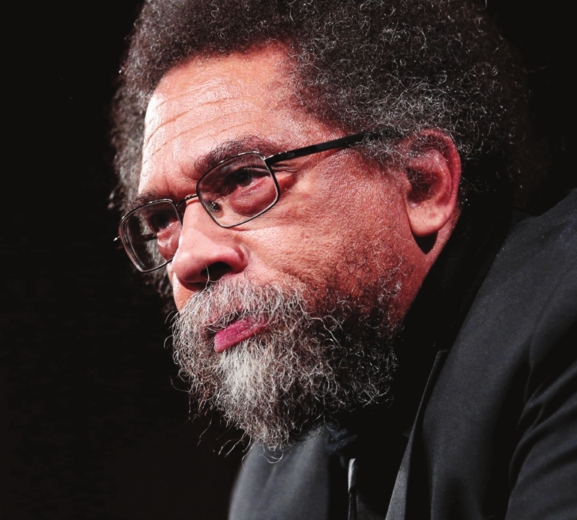
Cornel West Move comes after university refused to consider acclaimed prof. for tenure
Harvard University Professor Dr. Cornel R. West, who had been threatening a second departure from the Ivy League institution since he was not offered a tenured position last month, announced Monday that he will leave for a post at Union Theological Seminary, where he was first hired at 23 years old.
“I am moving from Harvard to Union Theological Seminary in New York City! Our struggle for truth & justice continues with style & smiles!” the philosopher, author and activist tweeted, with a link to an interview in The Boycott Times.
West, 67, who left his tenured University Chair post in 2002 following a public clash with former Harvard President Lawrence H. “Larry” Summers, returned as a professor of practice of public philosophy at the Harvard Divinity School and in the Department of African and African American Studies in the Faculty of Arts of Sciences in 2017.
“It’s time to go. I can only take so much disrespect,” said West on Tuesday. “I’ve got work to do, and don’t have time for pettiness.”
West said Harvard could have retained him if they had started the tenure process, but that now he is looking forward to moving on after he finishes the semester teaching two law school courses.
“Oh, I’m fired up!” he said of returning to Union.
West’s second departure comes after students and faculty members rallied unsuccessfully to pressure the university to grant him tenure. West and others at Harvard said the university’s decision to not grant him tenure is part of a pattern. Currently, 8% of tenured professors and 13% of tenure-track professors are underrepresented minorities, including Blacks and Latinos.
“Respect is something you can’t just calculate and negotiate. A lot of people have told me ‘Take the money and go, take the money and go, Brother West.’ I said no, I wasn’t raised like that,” West told the Banner last month. “We’ve got something called integrity.”
Harvard senior Injil Muhammad, a member of Harvard Black Men’s Forum, said it’s “a disgrace” that West was not offered tenure.
“I hope that Prof. West is making the best decision for him but I’m really disappointed in the university for not granting him the request that would’ve allowed him to stay,” said Muhammad. “His impact really can’t be overstated as far as how much he helps students really live up to the creed that is intellectual curiosity, and seeking truth, which is the motto of Harvard University,” said Muhammad. “His influence on me has been incredible over the course of my four years.”
West said the love between him and the students is mutual.
“I have a tremendous sense of gratitude to them. It’s been a love fest,
it’s a beautiful thing,” he said of his supporters. “They’ve got to
keep the pressure on the administration to make sure they’ve got young
Black professors and scholars who gain access to the highest levels at
Harvard. If I can open doors for the younger generation, then this whole
crisis will have been a positive thing.”
West
had the backing of the Divinity School and the Faculty of Arts and
Sciences, both of which requested he be reviewed for tenure. While a
faculty committee recommended West receive tenure, university
administrators appeared to block the request.
“On
behalf of Harvard Divinity School, we want to express our sadness at
the departure of our esteemed colleague, Cornel West,” said David N.
Hempton, dean of the faculty of divinity, and David Holland, acting dean
of HDS, in a statement. “Since coming to Harvard in 2017 as a jointly
appointed Professor of the Practice of Public Philosophy in HDS and FAS,
he has made an enormous contribution to our curriculum and to our
capacity to address issues of racial justice in the United States and
around the world. We had hoped to retain him on our faculty for many
years to come.”
At
Union, where West previously served from 1977–84, 1987– 88 and 2012–16,
he will hold the Dietrich Bonhoeffer Chair and teach classes covering
philosophy, politics, culture and practice, with a particular focus on
the origins and evolution of white nationalism. He will join the faculty
on July 1.
“We are
thrilled to welcome Dr. West back home to Union, where he started his
teaching career, at this time of momentous challenge and opportunity,”
said Rev. Dr. Serene Jones, president of Union Theological Seminary, in a
statement. “Dr. West lives and breathes the values that Union aims to
instill in all of the future leaders, scholars, ministers and activists
we educate. His esteemed legacy of engaging the most pressing problems
facing our world — including racism, poverty, sexism and so much more —
is an inspiration to all, and illustrates the power of faith to create
profound change.”
West
has received an outpouring of support from a large coalition of
students from various campus organizations who worked together to draft a
petition signed by over 1,800 people.
“Harvard has a history of treating its radical and justice-oriented scholars as dispensable.
Primarily,
Black studies, Indigenous studies, and ethnic studies scholars have
been recruited, then discarded as untenured faculty in one-year
postdoctoral fellowships, contingent professorships or three-year
lecturer positions,” read the petition. “Ultimately, Harvard’s denial of
tenure process to Professor West is a testament to Harvard’s continued
expulsion of faculty who offer incisive analysis of white supremacy,
racial capitalism, Zionism and the military-industrial complex, all of
which Professor West fervently critiques.”
“It’s
Cornel West. He’s a national figure. Very few other scholars of
religion or race, even in the humanities, are as cited or as acclaimed
or prolific as I think Cornel West is,” said Harvard senior Ajay Singh,
who is part of the Ethnic Studies Coalition at Harvard. “And so, it’s
sort of astounding that Professor West wouldn’t even receive
consideration for tenure, just given how much of an intellectual giant
he is. It just doesn’t make any sense from a meritorious context.”
Harvard has a checkered history of granting tenure to and retaining Black and brown faculty.
The
institution did not offer a tenured position to any Black professor
until Martin Kilson received the distinction in 1969. Derrick Albert
Bell Jr. was the first Black professor to be tenured at Harvard Law
School in 1971. He left the university in 1991 to protest the lack of
women of color on the faculty at the law school.
In
his March 8 interview with The Boycott Times, West was critical of the
university’s record of granting tenure to people of color.
“Harvard
has actually done very well in terms of bringing different peoples of
different colors and gender at a high level into the administration,” he
was quoted in the reader-funded online publication. “But it does not
yet translate on the ground in terms of faculty. It does not yet
translate in terms of being able to speak to the seeking of truth
amongst the students.
We
were there together for many years and you can testify to that. And so,
in that sense, brother, I’ve got to make my move to the great Union
Theological Seminary. My perennial home.”


