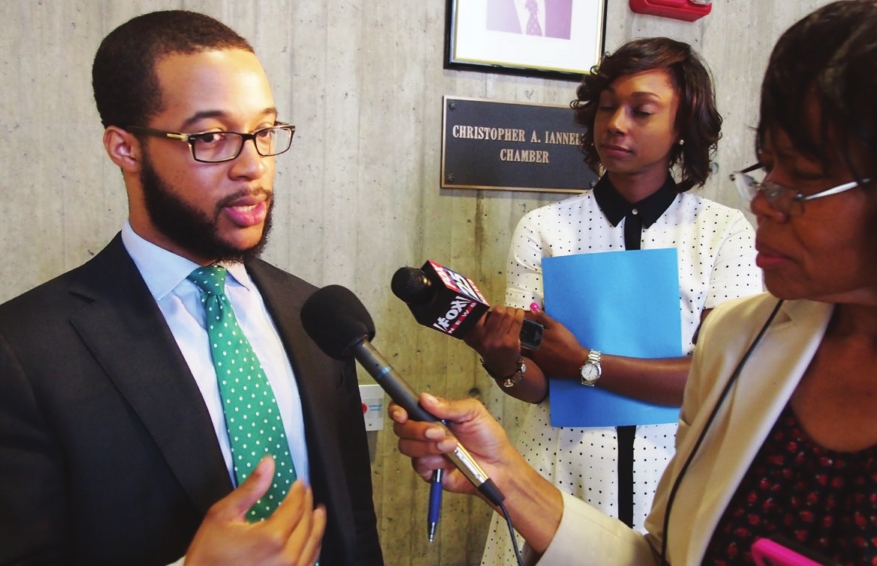
Segun Idowu, executive director of the Black
Economic Council of Massachusetts, raised $1.5 million to grow his
organization’s capacity to help Black-owned businesses.
BECMA to expand services across Mass.
Back in June, Boston was emerging from months of lockdown that saw joblessness rise and businesses close. All the while, weekly protests over police shootings helped drive a wide-ranging public discussion of racial inequities in Boston and across the nation.
Amid these turbulent weeks of mid-2020, Segun Idowu had an idea.
As executive director of the Black Economic Council of Massachusetts (BECMA), he had been working feverishly to secure more resources for struggling blackowned businesses in the state, many of which were left out of relief efforts such as the federal Payroll Protection Program.
It was then that BECMA launched its Greenwood Challenge, aimed at raising $1 million to help black-owned businesses in the state not only survive a tough time, but grow. The name was taken from the Black business district in Tulsa, Oklahoma that white Tulsans attacked and burned to the ground in 1921.
The idea came as Idowu was speaking with entrepreneur Herby Duverne, whose security consulting firm Windwalker Group has grown and thrived despite the tight economic times. Duverne offered BECMA a $100,000 donation to help it grow. Idowu decided he would seek a grant to match Duverne’s donation.
“We
knew we needed to be ambitious, given the moment,” Idowu said in a
Banner interview. “We’ve only been around five years. It’s not like we
had a large endowment we could draw from.”
Soon
came donations from the Barr Foundation ($300,000), the Boston
Foundation ($200,000), Eastern Bank ($100,000) and the Shlomo Fund
($100,000). By Nov. 30, BECMA had raised $1.5 million. The success
surprised even Idowu, who is not one to shy away from challenges.
“We
thought it was very ambitious even to hit $1 million,” he said. “Up
until the donation we received from Herby, the largest donation we ever
had received was $50,000, from the Boston Foundation.”
Besides
supporting small businesses directly, the funding will allow BECMA to
increase its own capacity. Currently, Idowu is the nonprofit’s sole
employee. With new hires, Idowu plans to expand the group’s work in
Boston and in other regions of the state where Black business owners
face challenges specific to their area. To better reach businesses
across the state, BECMA will establish regional chapters, Idowu said.
“This
will help the organization more effectively advocate for its members,”
he said. “The issues of concern to businesses in Worcester are very
different from those of concern to businesses in Springfield and
Boston.”
The majority
of the funds raised, though, will support BECMA’s work providing
technical assistance to small businesses as they navigate pandemic
economics.
“We want to help small businesses with their back-office operations,” Idowu said.
One
thing the pandemic made painfully clear was how underprepared many
Black-owned businesses were to receive help from federal, state and
local government. Lack of proper bookkeeping protocols and necessary
certifications prevented many small businesses from accessing Payment
Protection Program loans and other forms of assistance.
“We were blocked out,” Idowu said, “because we didn’t have relationships with banks.”
During
the pandemic, businesses that didn’t have the proper legal status or
that paid employees off the books were at a disadvantage. Even in good
times, however, those same limitations prevent businesses from accessing
government contracts and the financing they need to grow their
businesses.
“We want
to make sure that businesses have all their affairs in order so that
they have access to capital and contracts,” Idowu said.
BECMA
will also begin a procurement program, Idowu said, that will function
as a sort of matchmaker to help corporate partners procure services from
local Black businesses.
“We
will match people that want to grow their businesses with corporations
that want to expand their minority contracting,” he said.
Now
five years old, BECMA has taken on new board members, some of whom
represent areas outside of greater Boston. The new board members include
business owners from Randolph, Worcester and Springfield.
“It’s important to me that we have voices from all industries in all corners of the state,” Idowu said.


