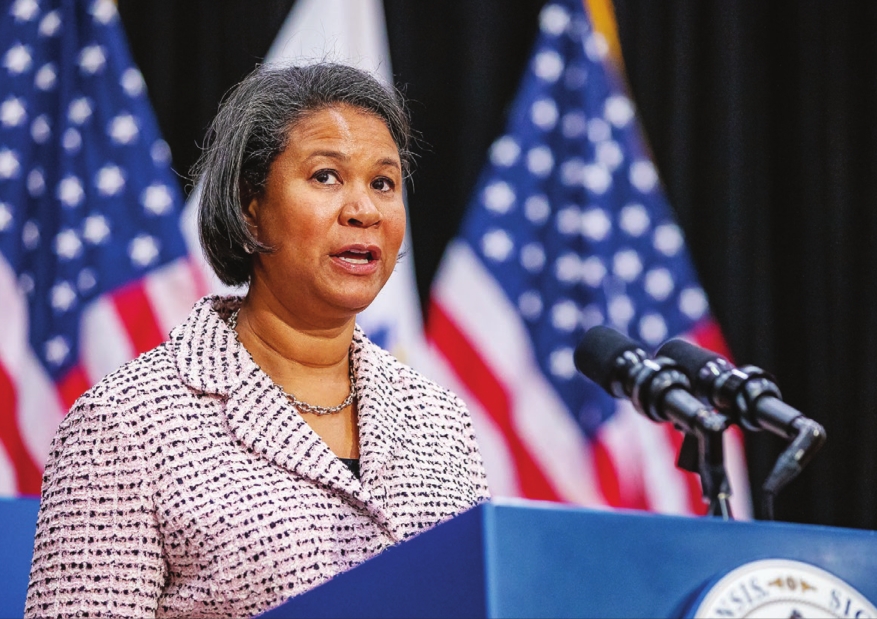
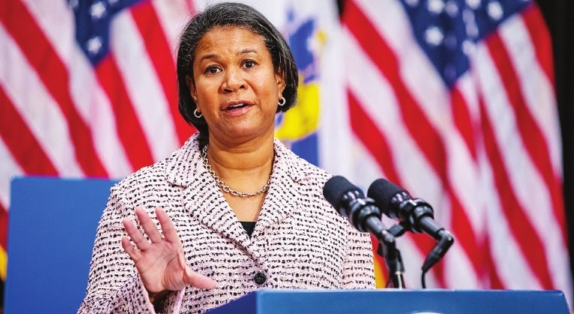
Kimberly Budd
Will be first black woman to lead court
Following the passing of Chief Justice Ralph D. Gants in September, Governor Charlie Baker has announced his nomination of Kimberly S. Budd to lead the Massachusetts Supreme Judicial Court. If confirmed, she would be the first Black woman to become chief justice.
Budd, whose father is former U.S. Attorney Wayne Budd, was appointed by Governor Baker to the Supreme Judicial Court in 2016, after a long career in Massachusetts courts. Her legal career began in the Massachusetts Appeals Court, where she was a law clerk for Chief Justice Joseph P. Warner. The Governor’s Council will meet to vote on her nomination in their assembly on Nov. 12 at 10 a.m.
“I’d like to thank the governor, and the lieutenant governor, for putting their faith in me,” Budd said at a press conference on Oct. 28. “This opportunity is unquestionably bittersweet. If confirmed, I
promise that I will give my very best effort, as the chief of the
oldest, continuously-running appellate court in the Western Hemisphere.”
Budd’s
nomination has been met with widespread support from judges, attorneys,
and legislators in Massachusetts. Former justice Geraldine Hines, who
has known Budd throughout her career and worked alongside her in 2016,
praised her commitment to justice.
“I
wouldn’t want to see it lost that she is supremely qualified for this
position … She’s young and energetic, she’s a visionary,” Hines told the
Banner. “We’re all proud of the history making moment, but I think
beyond that, people should feel very confident that the court is in good
hands,” she said.
Hines
pointed out that the governor’s nomination creates a stark contrast
between the State House and the White House after the appointment of
Judge Amy Coney Barrett to the United States Supreme Court.
She describes Budd and Barrett as stark opposites.
“[Budd
is] Somebody who is committed to protecting rights, and [Barrett is]
somebody who is apparently committed to undoing the very difficult and
hard work that has been done over decades to secure rights,” Hines said.
Budd
is well known for an opinion affecting jury duty. In the decision of
Commonwealth v. Lawrence Heywood, she wrote that a blind juror was
properly allowed to serve on a jury despite not being able to view
evidence. The landmark decision against discrimination demonstrated that
people with disabilities are still considered “peers” in the courtroom.
“The
decision to appoint Kimberly Budd to be the next Chief Justice of our
Supreme Judicial Court is a historic one,” Congresswoman Ayanna Pressley
said in a statement. She called Budd a “worthy successor to our late
Chief Justice Ralph Gants.”
“Make
no mistake, representation in government matters—and our judiciary is
no exception. In this moment of national reckoning on racial injustice,
we must continue working to increase diverse representation in our court
system. This will move us closer to the promise of equal justice for
all. Governor Baker has the opportunity to continue diversifying the SJC
with his next two appointments, and I urge him to do just that,”
Pressley said.


