Little progress on efforts to hold police accountable for misconduct
Back in July, lawmakers on Beacon Hill were moving full steam ahead on a package of progressive police reforms, spurred on by nationwide protests over police violence. Then the process ground to a halt, as police unions lobbied elected officials to water down key provisions that would require greater accountability and transparency.
Three months later, the legislative logjam shows no signs of clearing, even as Massachusetts news media continue to churn out headline after headline of longstanding police malfeasance and corruption: state police officers who remain on the job despite criminal charges, state and local officers who collect overtime pay for hours never worked, officers whose misdeeds are hidden from prosecutors who depend on their testimony in court.
In instance after instance, the most rudimentary efforts to hold officers accountable, open police proceedings to public scrutiny or rein in police abuse seem to run up against a wall of resistance from the public officials who have decision-making power over police budgets.
“The real problem is when we enter negotiations with police officers, we enter saying ‘These are our heroes,’” said state Rep. Russell Holmes, whose district includes parts of Mattapan and Hyde Park. “Some of my colleagues put them on a pedestal because they put their lives in danger.”
Yet that same attitude of hero worship doesn’t advantage other classes of workers, Holmes notes.
“We’ve seen doctors, nurses and grocery store workers put their lives on the line during this pandemic,” he said. “They’re not thought of as infallible.”
Across the United States, a general attitude of deference to police among elected officials and voters has blunted the impact of a year of anti-police violence demonstrations. At the far right end of the spectrum, President Trump and his supporters among police and white supremacists have rallied behind a “blue lives matter” flag — black and white version of the American Flag with a horizontal blue line in the middle.
While
local elected officials in Massachusetts have not engaged such divisive
rhetoric, they often appear hesitant to hold police accountable in
cases of misconduct or subject them to scrutiny.
A
Boston Globe report published last week identified state police
officers currently working on the force who collectively have 29
sustained charges for assault and battery as well as numerous instances
of alcohol and drug violations.
In
state and local governments, public employees are often fired for
criminal violations, yet few state police are referred for prosecution,
in spite of criminal wrongdoing. Of the 46 state police officers who
were found to have falsified overtime records, only nine are facing
criminal prosecution. Just one has had his pension revoked.
Defense attorney Carlton Williams says the deference shown to police operates in courthouses as well as in the political sphere.
“It’s
the whole system,” he said. “It’s all parts of the system. Cops are
given deference by judges, state and federal prosecutors and defense
attorneys.”
For
example, Williams says, judges in criminal cases routinely sustain
motions to dismiss evidence when it is obtained through an illegal
search or stop, yet officers are never held accountable for their
routine violation of people’s constitutional rights.
“A cop can’t just take your wallet or cellphone and start looking through it,” he said.
Such
searches violate the Fourth Amendment protection against illegal search
and seizure. Yet they are commonplace, Williams says, because police
face no consequences.
“If
every time you did something illegal, you got away with it and it was
encouraged, what would you do?” he said. “You’d do it more.”
Efforts to change the system
In
September, Suffolk County District Attorney Rachael Rollins released a
list of 115 local and state police officers whose criminal activity or
misconduct she says would render them unreliable as witnesses in
criminal cases. Rollins acknowledges the 115 names entered in her Law
Enforcement Automatic Discovery list is far from complete. Police
agencies themselves do not make public lists of officers who have
violated departmental rules or criminal laws.
“When you have an agency that is unable to self-regulate, that is a recipe for disaster,” Rollins said.
Rollins’
effort to hold officers accountable is rare among district attorneys in
Massachusetts and across the country. She is one of three out of the
state’s 11 district attorneys who maintains such a list.
Rollins says she does not see law enforcement as infallible.
“I
have a different lived experience where there has been excessive force
used against loved ones,” she said. “I am acutely aware of the
disproportionate regulation and oversight we face.”
Rollins’
stance is not uncommon among Black and Latino elected officials who
have long led the charge for police reform at the city and state level,
often facing resistance from their white colleagues.
In
Boston, District 4 City Councilor Andrea Campbell in recent years led
the charge for a civilian review board, which Walsh last month pledged
to adopt — a major shift for Boston, where elected officials have
resisted calls for civilian oversight for nearly 30 years. Campbell says
she is concerned about abuse of overtime, how police misconduct is
handled and the department’s unequal treatment of Blacks.
“There
is this perception that Boston is better than other cities when it
comes to policing, that we are a leader when it comes to community
policing,” she said. “We are not the leader when it comes to community
policing and transparency.”
Campbell,
who filed a special order to force the department to release data on
police stops, said Boston police have engaged in disparate treatment of
Blacks, who account for 70 percent of such stops despite making up less
than 25 percent of the city’s population.
In
June, after civil rights advocates called for a 10% cut to the
department’s $414 million budget, with the $41 million going to social
service agencies, Mayor Martin Walsh offered instead a largely symbolic
transfer of about $10 million from the department’s overtime budget.
Most councilors of color voted against the mayor’s budget, while all of the white councilors voted in favor.
“It
felt very discouraging to see our city councilors didn’t support us,”
said Queen Wade, an organizer with the police reform group For The
People.
Still a tough sell
Efforts
to hold police accountable remain a tough sell in both City Hall and
the Legislature, despite years of demonstrations and advocacy, a steady
stream of news reports detailing alleged police malfeasance, and a
number of reform bills and ordinances crafted by Black and Latino
elected officials.
Holmes says his colleagues on Beacon Hill remain stuck in the police-as-heroes frame of thinking.
“I
think the folks who went into this thinking police are heroes still
think they’re heroes and those of us who think communities are
overpoliced still think our communities are overpoliced,” he said.
“That’s why the bill hasn’t moved forward.”
Defense attorney Williams agrees. He says the hero-worship of police is more the culprit than the laws currently on the books.
“A
lot of people think we need to change the laws,” Williams said.
“There’s a cultural shift that needs to take place. We need to change
the narrative that police keep us safe.”
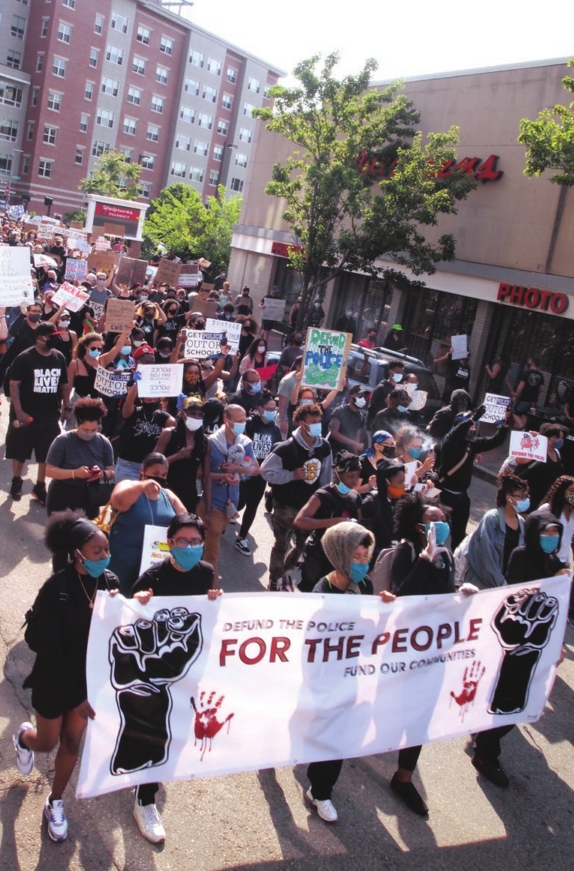
Demonstrators in this June march sought a 10% reduction in the city’s police budget with funds channelled to social services.


