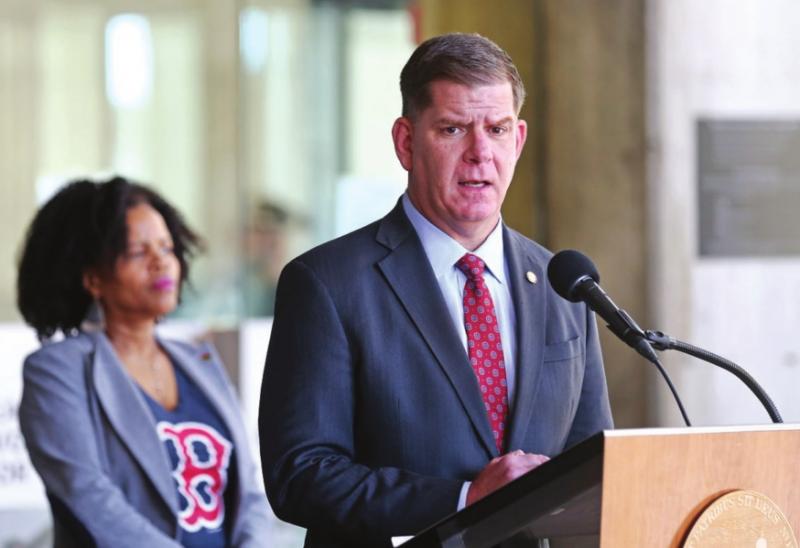
Mayor Martin Walsh addresses reporters during a daily press briefing as City Council President Kim Janey looks on.
Mayor doesn’t expect emergency to be over by May
As of Monday, there were 825 confirmed cases of COVID-19 in Boston and 5,752 statewide, but Gov. Charlie Baker says the worst may be yet to come, predicting that the largest surge of admitted patients won’t come until midmonth — sometime between April 7 and 17.
Mayor Martin Walsh, too, cited a longer timeline for the spread of the virus, telling reporters the crisis will extend beyond the May 4 date previously set for Boston Public Schools to re-open.
“I’m going to be completely honest with people,” he said. “If we think, May 4, the coronavirus is going to be gone, it’s not. I think we’re in this for the long haul.” He later added, “This is not going to be over quickly.”
During his briefing on Monday, Walsh revealed steps to help residents who are currently struggling with housing. The administration will halt eviction proceedings until the end of the crisis, he said, and the administration will provide 1,000 rental vouchers to certain families with students in Boston Public Schools.
“We know that anxiety about housing goes beyond monthly payments,” he said. “Many families have been struggling to find or hold onto housing before this crisis even
began. Homelessness creates barriers for our students to grow, learn
and succeed. Schools being closed presents even more challenges for our
families experiencing housing insecurity.”
The vouchers will be split evenly: 500
to families in shelters and 500 to families at risk of displacement.
The first housing placements are expected to begin in May. This allows
families to seek housing in the private market with significant rent
subsidies, said Walsh.
More than 4,500 students in BPS are essentially homeless, living without a permanent residence.
Walsh
noted that students and families in Boston Public Schools are still
receiving free meals and other essential items at 70 sites around the
city. People in Boston experiencing homelessness can also go to a number
of daytime drop-in sites to pick up food. Shelters have also received
hundreds of new beds, offering a haven for safety and recovery.
With
the $2 trillion federal relief package on its way, city and state
officials are waiting on guidelines for how best to distribute
resources. Walsh said the package will include aid for struggling
renters.
“We’ve
anticipated that the federal stimulus package will provide Boston with
new resources to help renters,” he said, “as well as moratoriums on
evictions and foreclosures at properties with federally backed
mortgages.”
Walsh said
that the administration is working on a plan to allow homeowners to
suspend or defer payments without penalties. He encouraged residents to
reach out to their banks to discuss issues with mortgage payments.
Massachusetts’ current statewide ban on non-essential evictions lasts
until April 21.
The
administration also aims to relieve pressure on taxpayers through other
means, said Walsh. “We intend on delaying property tax payments until
June,” he said. “We will suspend interest charges on late motor vehicle
excise bills until June 30. Late penalties on meals tax collection will
also be waived by the state.”
Walsh
stressed the importance of social distancing for the foreseeable
future. The stay-at-home advisory was issued last week, yet some
residents are still not abiding by the guidelines.
“Please,
if you’re not going to think about yourself, think about someone else
in your family,” Walsh said. “Think about your neighbors, think about
the elderly. Think about the people that we can protect here to make
sure that we can get through to the other side of this.”
The
administration is taking measures to discourage people from playing
group sports in city parks. Playgrounds and golf courses have been shut
down, and now sports gatherings are prohibited in order to slow
COVID-19’s spread.
“To
start, we will temporarily put zip ties on our basketball hoops, and
new signage will also go up in parks,” said Walsh. Hockey nets and
tennis nets will also be taken away, he added. “We’re doing this to
protect our residents and encourage social distancing in our parks.”
Walsh acknowledged the looming sense of anxiety as many prepare for the surge.
“These
are extremely difficult times,” he said. “These adjustments are all
hard and the decisions that we’re making aren’t easy. We want to make
sure that life goes back to normal as soon as possible, so we’re missing
out on some of our favorite springtime traditions.” Boston has already
canceled or postponed traditional events from the St. Patricks’ Day
parade to the Boston Marathon.
“But
we should also remember, Boston has always been a city of champions and
comebacks,” Walsh noted. “We’ve overcome tough situations before and
shown what it means to be Boston Strong.”
At
a press conference Monday, Baker noted that medical facilities are
ramping up to prepare for these “unprecedented times.” He said that the
federal government has already approved a request for 1,000 ventilators,
which the state should be receiving soon. Massachusetts currently has
only about 1,400 ventilators, and many more will be needed in the coming
weeks.
Medical
institutions are also preparing for the surge in other ways: by
increasing staff, expanding testing capacity and clearing space for
oncoming patients.
Nursing
facilities relieve hospital congestion by providing residents with a
place to recover, freeing up resources for those in critical condition.
“The goal is to have about 1,000 beds available for older residents as we prepare for the COVID-19 surge,” said Baker.
Deliveries
of PPE, or personal protective equipment, are en route to
Massachusetts. In the meantime, Baker commended the resourcefulness of
workers throughout the state. Boston-based New Balance, for instance,
has started to manufacture face masks.
“By
harnessing the capabilities of Massachusetts’ skilled manufacturers,
we’ll be able to get gear into the hands of our frontline workers
faster,” said Baker. He also expressed gratitude for those who have
volunteered to help medical professionals or donate PPE.
As
of Monday, there were 56 deaths related to COVID-19 in Massachusetts,
two of them in Boston. It’s not just affecting the elderly: Marty
Martinez, chief of health and human services, noted that close to 50% of
Boston’s cases are among people under the age of 39.
“Our
hearts go out to the families who have lost loved ones,” said Walsh.
“Each loss certainly is a strong reminder of how dangerous the situation
is that we’re all living in right now. And that’s why we’re going to
continue to work around the clock to slow the spread, keep people
healthy and prevent the loss of life.”
ON THE WEB
State updates and resources: Mass.gov/covid19
Boston updates and resources: Boston.gov/covid19
Information and online COVID-19 screening: Buoyhealth.com
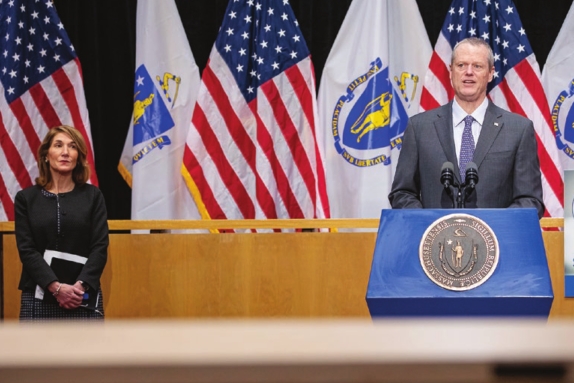
Gov. Charlie Baker and Lt. Gov. Karyn Polito address news media during a press conference Monday.


