
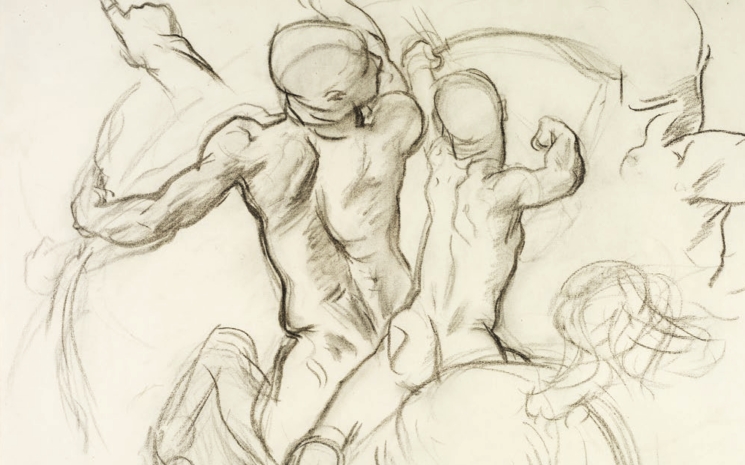
John Singer Sargent (American, 1856–1925), Detail: Study of a
Seated Male Nude above a Roundel for the Rotunda of the Museum of Fine
Arts, Boston, 1916–1921. Charcoal on paper, 63.3 x 48 cm (24 15/16 x 18
7/8 in.) Isabella Stewart Gardner Museum, Boston (S.G.Sar.4.1.5)
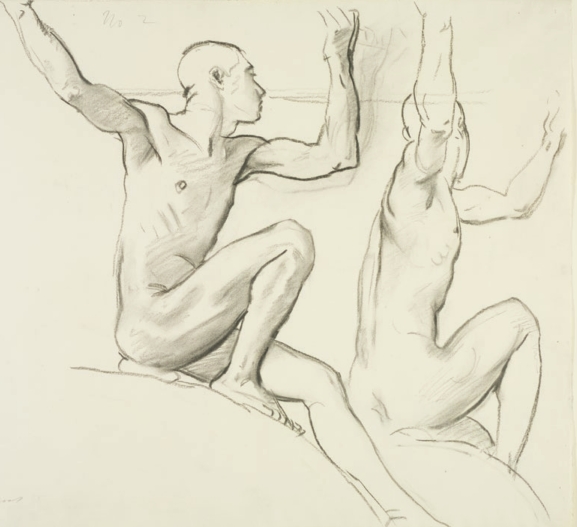
Study for Chiron and Achilles for the Rotunda of the Museum of Fine
Arts, Boston, 1916–1921. Charcoal on paper, 48 x 63 cm (18 7/8 x 24
13/16 in.) Isabella Stewart Gardner Museum, Boston (S.G.Sar.4.1.7)
John
Singer Sargent, Study of Two Male Nudes for a Cartouche for the Rotunda
of the Museum of Fine Arts, Boston, 1916–1921. Charcoal on paper, 47.7 x
63.2 cm (18 3/4 x 24 7/8 in.) Isabella Stewart Gardner Museum, Boston
(S.G.Sar.4.1.2)
GROUNDBREAKING SHOW AT GARDNER EXPLORES ARTIST-MODEL RELATIONSHIP
Last week, the Isabella Stewart Gardner Museum made Boston art history with the opening of their show “Boston’s Apollo: Thomas McKeller & John Singer Sargent.” Running through May 13, this is the first show in the museum’s 117-year history that has centered on images of a black man. It’s also the first time that all three rotating galleries are reflecting on the same theme: race.
“Boston’s Apollo” explores the relationship between famed portrait and mural artist John Singer Sargent and Thomas McKeller, the black man who modeled for and worked with Sargent for eight years. Few Bostonians know it, but McKeller can be seen in famous artworks all across Boston, including the Sargent murals at the Museum of Fine Arts and at Harvard’s Widener Library. Shortly before his death in 1925, Sargent gave the Gardner a number of sketches of McKeller. Those sketches have never been put on view, until now.
At the entry of the show, archival selections, including letters from McKeller, illustrate the intensive research behind the exhibition. There is very little information available about McKeller’s life, but any and every corner of Boston was scoured by the exhibit collaborators in an attempt to piece together a portrait of the model that delves deeper than oil and turpentine. “That story has been told many times from John Singer Sargent’s perspective. I wanted to tell the story through Thomas McKeller’s eyes,” says Nathaniel Silver, William and Lia Poorvu curator of the collection.
The collaboration between Sargent and McKeller resulted in one of Sargent’s only full male nudes. The striking piece, on loan from the MFA, depicts McKeller not as a model for a Greek god, but as himself. But that masterwork is alone in a sea of preparatory sketches where McKeller models for what will become a mural full of white bodies. In “Study for Apollo in Classic and Romantic Art for the Rotunda of the Museum of Fine Arts, Boston,” viewers can see point-blank how McKeller’s face, in the upper right hand corner, is altered to look white in the sketches of Apollo below.
“When
you can visually see someone’s identity being erased, as an African
American in this country it’s hard not to have a visceral reaction to
that,” says Theo Tyson, Polly Thayer Starr Fellow in American Art at The
Boston Athenæum and a community collaborator for the Gardner show.
The
relationship is further complicated by the implicit power dynamic at
play between artist and model, when the artist has both physical and
observational control over the subject.
Though
there is evidence that McKeller was paid, most likely on retainer, it’s
hard to tell how that stacks up to the compensation of Sargent’s white
models.
In one of the
letters on view, McKeller wrote to Sargent’s executor after his death
asking for money to pay off a loan. He received $10. Sargent received
$40,000 as a partial payment for the MFA murals that McKeller posed for.
The economic disparity illustrates another dynamic in the complicated
relationship between artist and model.
In
tandem with “Boston’s Apollo,” two other concurrent exhibits explore
the black experience: Lorraine O’Grady’s exterior installation, “The
Strange Taxi: Stretched” and Adam Pendleton’s site-specific work
“Elements of Me” on view in the Fenway Gallery inside the historic
museum.
Visiting
Curator of Performing Arts Helga Davis and Director of Public Programs
Catherine Morris have created a strong lineup of arts events around the
show, including, a musical composition inspired by Thomas Mc- Keller’s
letters and performed by opera powerhouse Davóne Tines.
Collaboration
with Boston’s black arts community was crucial to the success of
“Boston’s Apollo,” and fortunately, the exhibition reads like a Who’s
Who of the city’s black art scene. Almost every piece is paired with a
personal response by a community collaborator, and collaborators Stephen
Hamilton, Chanel Thervil, Kadahj Bennett, Destiny Polk and many others
provide standalone commentary at the beginning of the exhibit.
“Boston’s
Apollo” is both a love letter to the black body and an analysis of the
exploitation of it. Rooted in a fascinating historic relationship, the
exhibition brings together the contemporary arts community in a
celebration of black life unprecedented at the Gardner.
ON THE WEB
Learn more at: gardnermuseum.org


