
Sen. Bernie Sanders addresses his supporters and volunteers in New Hampshire.
Massachusetts
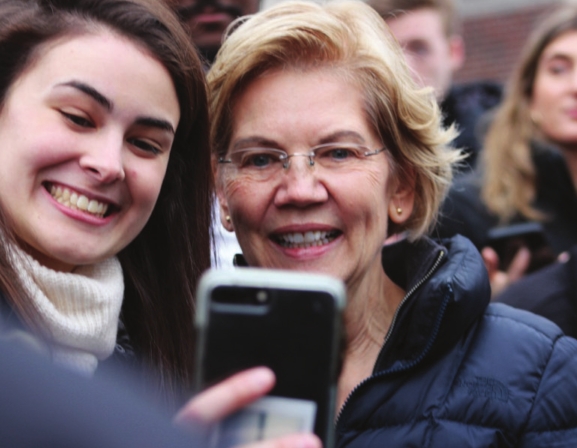
Sen. Elizabeth Warren takes selfies with supporters outside of the
Webster Elementary School in Manchester, New Hampshire.
Candidates need black support to win delegates in Democratic contest
After early-voting contests in the cornfields of Iowa and the snows of New Hampshire, the 2020 Democratic primary race now turns to states where black voters could decide who will carry the party banner into the November showdown with President Donald J. Trump.
Over 60% of the Democratic primary voters in the critical Feb. 29 race in South Carolina are African American. Blacks and Latinos make up about a third of the voters in the Feb. 22 Nevada caucuses this coming Saturday. During Super Tuesday balloting on March 3, black voters in states like California, Texas, Alabama, Virginia and even Massachusetts, will have an outsized influence on who emerges as the likely nominee.
Candidates are accordingly switching menus from the corndogs of the Iowa State Fair to the barbeques of the Palmetto State in a mad rush to convince the gumbo mix of voters they can carry the hope of denying a second term to the ex-reality-TV-personality now starring from the Oval Office.
“Communities of color will be crucial in the upcoming primaries, particularly in South Carolina,” said Melvin Poindexter, a Newton resident who is a 20-year member of the Massachusetts Democratic State Committee and the only African American among the four-member Bay State delegation to the Democratic National Committee. “How candidates do in South Carolina will dictate how much effort they put here in Massachusetts,” which, he noted, will send 114 delegates to the Democratic National Convention.
Headed to a disappointing fifth-place finish in New Hampshire on Feb. 11, former Vice President Joe Biden flew to South Carolina before sundown to shore up his sagging support among African Americans.
“We just heard from the first two of 50 states,” Biden said upon his arrival, as polls showed his share of the black vote nationally dropping from 51% to 27 %. “Not all the nation, not half the nation. Not a quarter of the nation, not 10%. Two. Where I come from, that’s the opening bell, not the closing bell. Up until now, we haven’t
heard from the most committed constituents in the Democratic Party, the
African American community, or the fastest-growing segment of society,
the Latino community.”
Biden’s
weakening hold on black support, based largely on his eight years of
service as President Barack Obama’s number two, has led to rivals
aggressively stepping in to further chip into what was seen as the vice
president’s firewall.
Former
New York City Mayor Michael Bloomberg, riding a tide of $350 million in
TV advertising featuring glowing tributes from Obama, has leapfrogged
Vermont Sen. Bernie Sanders in popularity among black voters, though
Sanders, the self-described “Democratic Socialist,” has a 20- point lead
among African Americans ages 18 to 34.
Like
Bloomberg, entrepreneur Tom Steyer largely skipped Iowa and New
Hampshire to focus on South Carolina and Super Tuesday states and is on
the rise among voters of color, buoyed by a passionate message of
economic and racial justice.
Former
South Bend, Indiana Mayor Pete Buttigieg, who finished first in Iowa
and second in New Hampshire to Sanders, has climbed from 0% polling
among blacks to 4%, while Minnesota Sen. Amy Klobuchar still comes up
goose-eggs, suggesting trouble for both Midwest moderates.
Meanwhile,
Massachusetts Sen. Elizabeth Warren, who finished fourth in New
Hampshire and polls around 10% among African Americans, is trying to
regain the momentum that saw increasing numbers of minority voters
responding to her detailed agenda for economic empowerment and
unflinching denunciation of the criminal justice system as racist.
On
Monday, U.S. Rep. Ayanna Pressley (D-Mass.), a co-chair of Warren’s
campaign, rallied volunteers in Cambridge and Boston to work hard for
her election.
“Elizabeth Warren is the starkest contrast to the equal-opportunity offender, abuser and narcissist-in-chief,” said Pressley.
“Here’s
a guy that wants to go it alone, that sows seeds of division that leads
with chaos. And Elizabeth Warren is a woman, by contrast, who is about
coalition, community and movement-building.”
The
fluid dynamics of the contest going into Saturday’s Nevada caucuses,
with no candidate holding a commanding grip on the nomination, leaves
black voters as potential Democratic king-makers in the remaining races,
especially the 14-state Super Tuesday showdown, when one-third of the
delegates to the Democratic National Convention will be chosen.
“We’re
now seeing voters of color, who are the backbone of the Democratic
Party, particularly black women, flex their electoral muscle,” Bakari
Sellers, a former South Carolina state legislator, told the Washington
Post. “My mom and her friends will decide who the nominee is and who
goes toe-to-toe against Donald Trump.”
Political
operative and Boston Herald columnist Joyce Ferriabough said that
competition for the black vote nationally is fierce, while here in the
Bay State it appears to be a three-way race between Biden, Sanders and
Warren.
“Biden should
be high on that list by virtue of the fact that he was Obama’s vice
president for eight years,” she said. “I do respect that Elizabeth
Warren called out a racist justice system, and the fact that she has
Ayanna Pressley in her camp will make a difference.”
Suffolk
County Sheriff Steve Tompkins, who recently returned from campaigning
for Warren in South Carolina, said voters there “are just getting to
know all the candidates. As her surrogates cross the country and state
and listen to what she’s going to do on racial justice, early child
care, housing and education, I think people are going to stick with
her.”
Former Cambridge
Mayor Kenneth E. Reeves hosted a house party for Sanders in 2016 and
expected 50 people. Over 100 showed up. He has seen the same excitement
for the curmudgeonly independent this time as well. “The Bernie crowd is
a very, very energized crew,” he said, citing a thirst to move beyond
the moderate Democratic past and embrace the more radical change
espoused by Sanders, whose 2016 calls for single-payer health care and a
$15 minimum wage have become mainstream positions.
“I’ve
become a different kind of Democrat,” said Reeves. “I’m not interested
in the Clinton years or the Obama years. It’s hard for me to look at
their combined 16 years in office and realize why we black people are
not better off.”
Prominent
publicist and social convener Colette Phillips said she started off the
campaign season as a Biden backer, switched to Deval Patrick when the
former governor jumped in, and now, with Patrick out, is looking closely
at Bloomberg.
The
ex-Gotham chief executive, a 78-year-old billionaire, deserves
consideration because of his record of business accomplishment, his
success in backing gun safety and climate-change campaigns around the
country and his ability to stand up to Trump in ways she hasn’t seen
from other candidates, said Phillips.
“It’s
no coincidence Bloomberg is winning increasing black support,” she
said. “He has the chops to take on Trump.” While Bloomberg is facing
criticism over his stop-and-frisk policy in New York City as well as
comments blaming the 2008 financial collapse on ending racial
discrimination in lending, Phillips said every candidate has to face up
to past statements and actions that may prove troubling to black voters.
“The
redemptive power of change is something I firmly believe in,” said
Phillips. “Michael Bloomberg apologized and I accept that. I do believe
he may be the best candidate to take on Trump. As a person of color and a
woman, I would vote for a ham sandwich if I thought it could beat the
most dangerous person in the United States, who is President Donald
Trump.”


