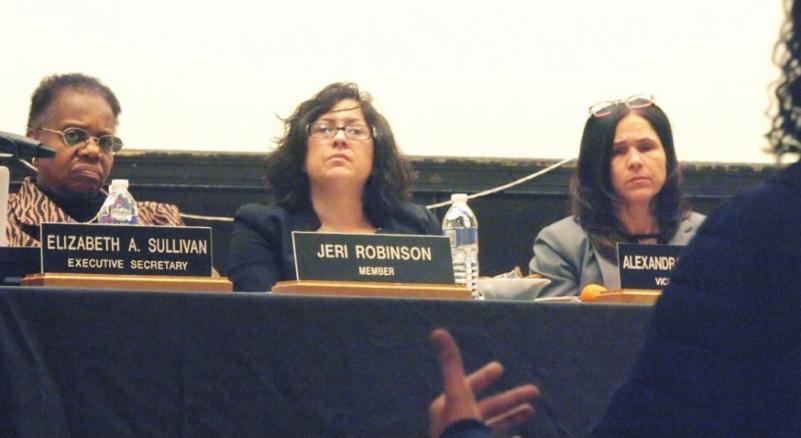
School Committee members Jeri Robinson and Alexandra Oliver Davila and BPS Superintendent Brenda Cassellius listen to Excel High School senior Malita Rosa during a budget hearing at the Curley School in Jamaica Plain.
Department focuses funds on struggling schools
Boston Public Schools officials outlined the plusses of the proposed 2021 BPS budget during a School Committee hearing held at the Curley School in Jamaica Plain last week.
The budget includes funding for 64 additional teaching positions, including arts, music and physical education; 94 additional paraprofessional positions to facilitate the expansion of so-called inclusion classrooms, where students with disabilities are educated alongside those without; and funding for 126 student support positions, including social workers, instructional facilitators and family liaisons.
BPS Chief Financial Officer Nathan Kuder said the budget reflects the district’s push to increase quality at all schools. BPS officials put together the budget after dozens of meetings with parents and school communities across the city.
“Our belief is that this budget reflects those conversations,” Kuder said. “This is the community’s budget that is the community’s vision for the schools.”
The
additional support positions in the budget include 47 social workers,
42 instructional facilitators and 37 family liaisons — positions for
which parents and teachers have advocated in recent years.
The
increases have allowed for a budget in which fewer than 20 of the
district’s 125 schools are receiving cuts, according to a BPS source. In
2017, 49 BPS schools received budget cuts. Under the district’s
weighted student funding formula, which ties funding to the number of
students in a school, budgets are adjusted up or down as the number of
students in any given school increases or decreases.
Critics
of the weighted funding system say the enrollment-based cuts
destabilize struggling schools and make it more difficult for school
communities to attract more students, leading to a downward spiral that
can result in a school closing.
Kuder
said this year’s funding increase of $36 million above ordinary cost
increases — part of a three-year, $100 million commitment to increasing
BPS funding — will help stop the cycle of funding cuts that has plagued
some BPS schools.
“What we’re doing with this budget is to break this cycle,” he said.
Parent testimony
Parents
and students from two schools who testified during the hearing said the
budget relief is not getting to their schools soon enough. At the
Charles Sumner Elementary School in Roslindale, a school due to lose
$194,000 and four positions, parents said they are losing their parent
liaison, a vital link for Spanish-speaking parents whose children make
up 57 % of the student population.
“That negative feedback loop you’re talking about is happening at our school,” parent Alison Friedman said.
While
other schools in Roslindale and West Roxbury have gained sixth-grade
classrooms, the Sumner is remaining a K-5 school, which puts the school
at a disadvantage when parents sign their children up for schools.
Facing cuts for the second year in a row, the Sumner parents say the
quality of the school is being compromised and could lead to even fewer
parents selecting the school.
“I
feel like we’re being set up to fail,” said parent Caitlin Cannon. “We
lose funding because we don’t have a sixth grade, and because
better-funded schools, the schools that historically, year after year,
receive more funding, can offer more [paraprofessionals], more
technology, more specials, more dedicated support personnel.”
As
with most schools facing cuts, the Sumner School is being forced to cut
student support services, Cannon said. Classrooms at the school cannot
be consolidated because the school provides specialized instruction for
English language learners and learning-disabled students who are
educated in inclusion classrooms with general education students.
“I
feel we’re being punished for being a school that welcomes inclusion
learners, welcomes English language learners and truly provides a path
forward for them.”
At
Excel High School in South Boston, projected cuts in enrollment are
similarly leading to the loss of staff. Senior Malita Rosa teared up
when she spoke about her softball coach, whose position is being cut
after consecutive years of budget cuts.
“It just gets worse,” she said. “The school keeps getting less money.”
Transformation schools
State
Education Commissioner Jeffrey Riley is expected this month to release a
report on a review of Boston’s schools. During a January meeting, Board
of Education members reportedly urged Riley to intervene in the
district. Under state law, the Commissioner has the discretion to
intervene in districts, including a full or partial takeover of the
schools.
State
intervention in Boston schools has in the past been controversial.
Former Education Commissioner Mitchell Chester in 2014 appointed the
education start-up Blueprint Schools Network to oversee the Paul A.
Dever School, taking away district control. The school went through five
principals in two years and saw no noticeable increases in student
performance. The school remains under state receivership.
Kuder
noted that $19 million of the new investments in BPS would go to 33
underperforming schools the city has designated “transformation
schools.”
While Mayor
Martin Walsh has vowed that no BPS school would undergo a takeover
during his tenure, the Boston Globe in an editorial last week argued
that the Commissioner ought not take a takeover off the table, citing
lagging student performance in the district, and argued for school
consolidations, changing school start times and increasing student
performance in its high schools.
School
Superintendent Brenda Cassellius last month released a five-year plan
to close the achievement gap between students in the system, bring
uniform graduation requirements to high schools, aligned with the
state’s Common Core standards, and provide equity in access to resources
to the district’s 125 schools.


