Minh-Anh Day
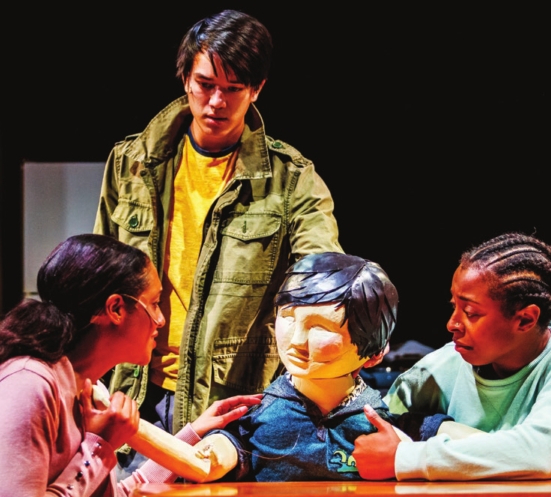
(From left) Inés de la Cruz, Minh-Anh Day and Tonasia Jones in “Wolf Play.”
‘Wolf Play’ explores adoption, champions accessible theater
While strolling through the Boston Public Library’s Central Branch this month, you may hear the tortured howl of a wolf coming from Rabb Hall. Don’t be alarmed; it’s just Company One Theatre breaking down complicated adoption dynamics in their show “Wolf Play,” a new production by South Korean playwright Hansol Jung running at the library through Feb. 29. The spectacular piece of theater is open to the public with paywhat-you-will pricing for every single performance.
Though her wife Ash hasn’t fully consented, Robin is desperate to adopt a baby — desperate enough to engage in an under-the-table adoption, via the internet, of an 8-year-old Korean boy. This process, known as re-homing, is a very real measure often used to bypass the high financial cost of adoption or barriers for same sex-couples or single parents. The boy’s name is Jeenu, and his boy self is represented by a life-size puppet. The hilarious and energetic actor Minh-Anh Day narrates the boy’s inner dialogue, in which he sees himself as a lone wolf searching for a pack.
At the forefront of the show is the trauma Jeenu has experienced from being moved from home to home, not only in a different country, but also among different families. Jeenu was originally adopted from Korea by a white family (presumably legally,
but it’s not confirmed). It’s that family that re-homes him to Ash and
Robin when things get too overwhelming for them. But when the white
adoptive father, Peter, learns that Ash and Robin are a lesbian couple,
he regrets his choice.
Though
there’s substantial comedy in Jeenu’s mask as a wolf, that protective
coating hides a deep-seated inability to trust. While Ash and Robin
attempt to create a supportive, loving environment around Jeenu, Robin’s
brother Ryan insists that he needs to be “roughed up” and have the
influence of a man in his life. This violence masquerading as
masculinity causes tension in the house.
The
heart of the performance explores what it means to be a family, or a
pack, as Jeenu would say. Ash, Robin and Jeenu cross cultural and racial
differences, and the flawed adoption system, to create a space of love
and connection.
Day is
a comedic and emotional force as the protective wolf inside Jeenu. The
use of the puppet works wonders to illustrate at once how little control
Jeenu has over his circumstances and the narrative he’s created inside
himself to feel empowered. The duo illustrates seamlessly how acts of
aggression from a displaced child often are coming from places of
protection either for themselves or for an adult who has guarded them.
“Wolf
Play” is an unending onion of critical layers. But through the
sincerity of the actors and the directing prowess of Summer L. Williams,
the many emotions and plotlines flow together into a painfully
beautiful piece of work.
ON THE WEB
Learn more at: companyone.org/production/wolf-play