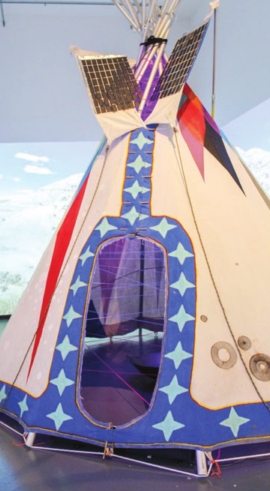
This 21-foot tall canvas tipi greets visitors to “Future Ancestral Technologies: nágshibi.”
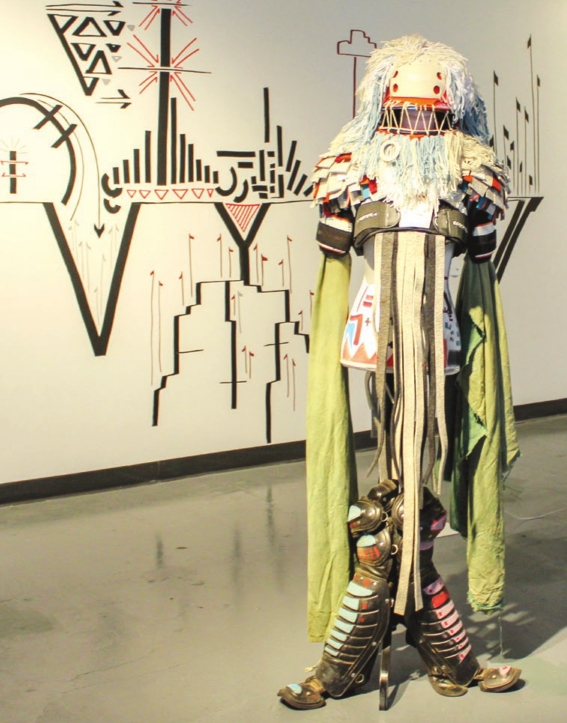
Ceremonial regalia by Cannupa Hanska Luger in front of a storytelling mural he created on site.
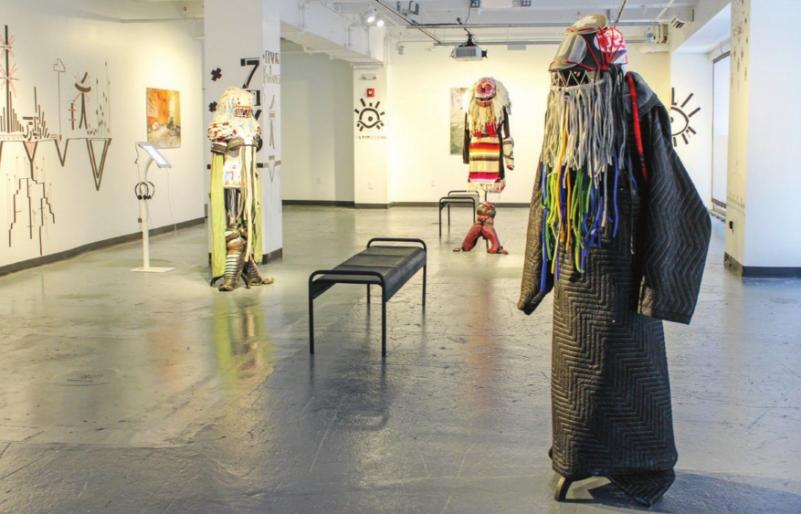
Installation
view of Cannupa Hanska Luger’s exhibition “Future Ancestral
Technologies: nágshibi” at Emerson College’s Media Art Gallery.
Indigenous science fiction at Emerson College gallery
Interdisciplinary artist Cannupa Hanska Luger has transformed Emerson College’s Media Art Gallery into an apocalyptic, indigenous landscape.
“Future Ancestral Technologies: nágshibi,” running at the gallery through Dec. 15, tells a science fiction story, reimagining the future using video production, ceremonial regalia, still images and a mural Luger created live at the opening of the show.
In the indigenous language Hidatsa, “nágshibi” means “to be past, to be after” or “to exceed, to go beyond.” In a video positioned across from the live-created wall piece,
Luger explains the origin myth on which the exhibition is based. The
works occur after a portion of the population has left the planet for
the new frontier in space. Those remaining on Earth have to go back to
their natural roots to start again.
“In
this ongoing series, I prototype designs for objects and their use. I
test rituals and conduct ceremonies,” Luger says in a statement about
the exhibition. “I create a space of futuristic
vision in which societies are nomadic, tipis are solar-powered, and
humans create their own functional regalia to live through ceremony in
acknowledgement of land.”
Several
of the video works on view in the show were born out of
land-acknowledgment performative actions executed in 2018. In one video
piece, a figure gets out of a red pickup truck in the middle of a grassy
plain. The video speed is slowed as he places a headdress (also on view
in the gallery) on his head and begins to walk away from the truck and
into the open plain.
In another piece alongside this video, a child in similar attire joins the figure.
As
the exhibition tours, it will continue to grow with the addition of
dwellings, clothing and tools that merge the use of artificial
intelligence with indigenous rituals and ceremony. Though these pieces
currently exist in the gallery space, Luger is operating on the
understanding that these artworks will become useful pieces of everyday
life in the future.
On
Sunday, Dec. 8, Larry Spotted Crow Mann, a storyteller of the Nipmuc
Tribe of Massachusetts, will give a talk contextualizing the exhibition
with local histories and poetry, connecting these images of Southwestern
Plains to the urban Boston landscape.
“Future
Ancestral Technologies: nágshibi,” provides a unique perspective of
native culture, fusing the past, present and future in objects that are
both artistic and prophetic.
ON THE WEB Learn more at: www2.emerson.edu/urbanarts/media-art-gallery


