
The city’s Department of Neighborhood Development is seeking bids for the Nawn factory, seen from the Eliot Burying Ground.
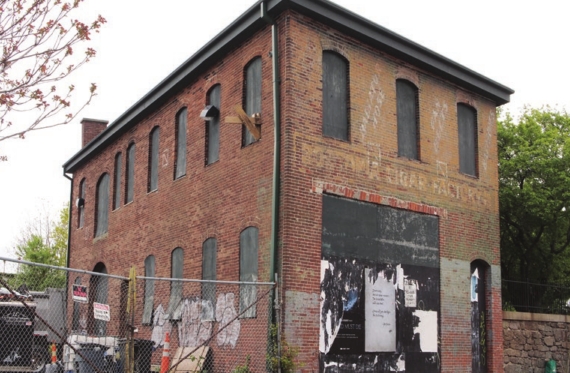
The Nawn factory building.
Historic site must include museum space
A museum interpreting Roxbury history will feature prominently in bids to redevelop the historic Nawn Factory building on Washington Street in Dudley Square, according to a request for proposals released by the city’s Department of Neighborhood Development Monday.
The 1880 brick building occupies the smaller part of a two-parcel 10,841-square-foot site adjacent to the colonial-era Eliot Burying Ground and the long-vacant Parcel 8, at the corner of Washington Street and Melnea Cass Boulevard. In the city’s RFP, developers bidding on the Nawn Factory site are encouraged to coordinate their redevelopment efforts with development proposals for Parcel 8 or to bid on both.
The factory was named for Owen Nawn, the general contractor most widely known for his later work on building the elevated Orange Line. The RFP requires that the existing portion of the factory building — one-third of its original footprint — be preserved and allows for its re-use as retail, cultural and/or entertainment space. Developers are encouraged to rebuild the demolished portion of the building.
A preservation restriction on the portion of the parcel containing the Nawn Factory prohibits additional structures from being built on the parcel and limits new construction
to rebuilding the demolished portion of the two-story factory building.
Any building constructed on the adjacent portion of the Nawn Factory
site will be limited to two stories as well. Those restrictions will not
apply to the neighboring Parcel 8.
The
Nawn Factory parcels are located within the state-designated Roxbury
Heritage State Park and the city’s Eustice Street Architectural
District, which includes the 1630 John Eliot Burying Ground and the 1859
Eustis Street Firehouse. During the Revolutionary war, the Nawn Factory
site lay between the fortifications of the continental army on the
Roxbury side and British troops on the Boston side.
Former
state Rep. Byron Rushing said some Roxbury residents have advocated for
the creation of a small park at the corner of Washington Street and
Melnea Cass Boulevard, noting that the foundations of two 18th-century
buildings remain intact there.
“We
want a park there that relates to that part of Roxbury history — the
neck that connected Roxbury to Boston,” he said, referring to the narrow
isthmus that existed before the South End and South Bay were filled in
during the 19th century.
As for Parcel 8, the RFP for that parcel will likely allow for commercial, cultural and residential uses.
Under
the terms of the Boston Planning and Development Agency’s PLAN Dudley
public land disposition process, any housing developed on either the
Nawn Factory site or Parcel 8 is required to have at least two-thirds of
all units affordable to households of varying incomes.
“Community
members have expressed a strong preference for projects which can
exceed these minimum affordability standards,” the RFP reads.
“Developments which can reach deeper levels of affordability and/or a
higher percentage of income-restricted housing are preferred.”
The
PLAN Dudley guidelines call for development proposals with commercial
uses to promote local businesses and provide job opportunities for local
residents.
The parcel
also falls into the federally-designated HUD Choice area anchored by
the Whittier Street housing development. The Nawn Factory building could
qualify for up to $500,000 in funds for restoration and development of a
public education facility such as a museum, provided the building is
completed no later than Aug. 1, 2023.


