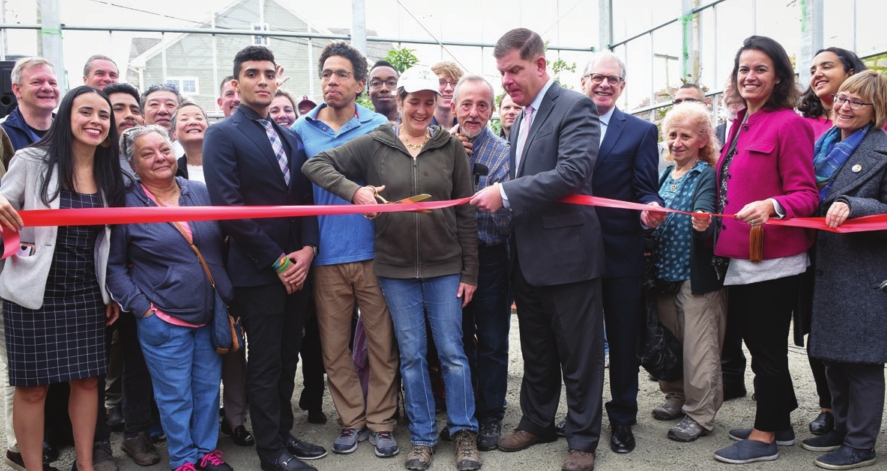
We
Grow Microgreens co-owner Lisa Evans cuts the ribbon on the firm’s new
greenhouse, the main structure on a 37,000 squarefoot urban farm that
opened in Hyde Park.
Standing in a newly-built, state-of-the-art greenhouse in Hyde Park last week, Mayor Martin Walsh and other city officials joined the owners and staff of We Grow Microgreens to cut the ribbon on the firm’s 37,000 square-foot urban farm.
“It’s absolutely amazing that we’re in Boston,” Walsh said, remarking on the farm’s recently-completed landscaping work.
The business tapped $134,000 from the city’s Community Preservation Act fund to pay for landscaping and drainage improvements on the site.
The farm consists of a 4,600-square-foot Dutch-designed climate-controlled greenhouse in which We Grow Microgreens owners are growing the sprouted salad greens, fresh herbs, edible flowers and other produce they sell to local restaurants and at farmers’ markets.
Business owners Lisa Evans and Tim Smith began We Grow Microgreens with a 300-squarefoot greenhouse in the backyard of their Roslindale home. They estimate the new greenhouse will enable them to increase their output tenfold.
Five
years ago, they began the process of acquiring the long-vacant lot in
Readville. The city sold the lot to them with the condition that it be
used for urban agriculture.
The
designation as an urban farm enabled the business to apply for grants,
including city and state funds. The group currently employs six
Boston-area youth to work in the greenhouses.
The
greenhouse features an automated opening roof that allows the facility
to ventilate in hot weather. A portion of the roof is equipped with
translucent solar panels that help power the facility.
The
roof also features a rainwater collection system that feeds into tanks
with a capacity to hold 7,500 gallons — more than enough for the farm’s
growing operations.
In
addition to the main greenhouse, now under construction are two smaller
“hoop houses” — prefabricated green houses that extend the outdoor
growing season — and raised beds.
Inside
the main greenhouse last week, Smith showed visiting city officials and
chefs some of the more unusual edible plants, including piper auritum,
the so-called root beer plant. Chefs use the plant, whose leaves taste
like the soft drink, as an edible wrap.
Microgreen
production will remain the core of the business, according to Smith.
The plants can be grown year round and don’t require as much energy as
most vegetables.
“With
microgreens, the growing cycle is one-to-three weeks, he said. “The
typical growth period is 10 days. You don’t need a lot of light.”
Unlike
large-scale farms, the We Grow Microgreens farm is designed to blend
into the local neighborhood. The hour-glassshaped field abuts a
residential Readville neighborhood that City Councilor Tim McCarthy said
is within sight of the house in which he grew up. At the
ribbon-cutting, McCarthy noted the farm has a newly designed footpath,
open to the public, that leads through the farm site’s wooded land to
state conservation land adjacent to the Mother Brook.
“This has been a five-year journey with the city of Boston,” he said. “It was well worth the wait.”
The
Walsh administration recently released a food access agenda to evaluate
existing food access initiatives and deliver actionable recommendations
to fill gaps, including supporting urban farming in the City of Boston.
City officials say the agenda will guide the city’s work to ensure
everyone has equitable access to affordable, fresh, healthy, and
culturally-connected foods and to end food insecurity in Boston by 2030.


