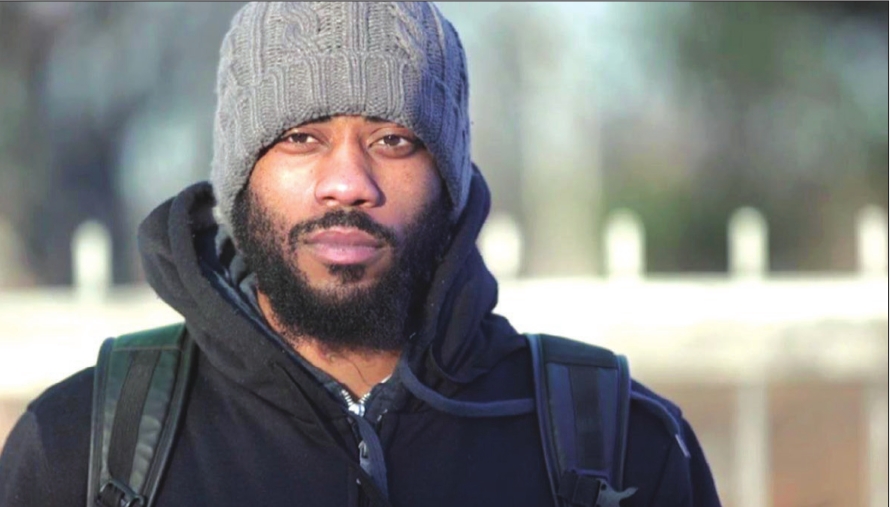
Paul Burns stands outside of College Bound Dorchester in Samoset Street, after a study session.
College Bound program connects ex-convicts to education, careers
Paul Burns sits behind a battered wooden desk. He meticulously takes notes from his book, HVAC Fundamentals: Volume 1: Heating Systems, Furnaces and Boilers, studying the craft of heating and ventilation repair. He bends his head toward the manual and whispers sentences from chapter nine: “Indoor Air Fundamentals.” He rolls up his sleeves as he reads through the next paragraph, revealing two arms covered with ink.
“I got a couple tattoos,” Burns says, pointing at his left arm. “I got some rose on my arm. My grandmother’s name. She passed away a couple of months ago. A lot of this is jail work. These are the buildings that surrounded the prison, that’s my brother’s name, and that one is my daughter’s name.
“This is the name of a friend of mine that passed away on the streets. He got shot.”
Burns was 12 years old when he was first charged for committing a violent crime.
“It was my first week of middle school,” Burns recalls. “I got into a bus and then this kid walked back to me and started swinging mad crazy. I punched him off and he grabbed me.” In the middle of the fight, Burns remembered that he had a small knife in his pocket. “So I just started stabbing the kid,” he says.
Burns grew up in Roxbury with his mother, two older brothers, and a younger brother. His father struggled with alcohol and drug addiction and was not around, while his older brothers were often out of town, incarcerated, or both. Looking for direction, Burns spent a lot of time in the streets, exposed to violence.
“I was getting myself in some sort of trouble,” he says. At 17, he was charged with unlawful possession of a firearm and sentenced to five years in prison.
“That was like a big waste of time,” Burns says. “Jail was a big waste of time.”
More than a school
Burns is one of about 900 students in the College Bound Dorchester program, which helps people rejoin society after they’ve been behind bars, largely by helping them resume their education. Most participants are high school dropouts, studying to pass their General Educational Development, or GED, test. Others are preparing for college; the program’s goal is to get 250 of its students enrolled over the next two years.
“These
are guys who have heard that they can never do well,” says Lealah
Fulton, who works at College Bound Dorchester. “They’ve never heard, You
can be a CEO or an entrepreneur. They’ve only heard they can do bad
things. … We just motivate them to reach their potential.”
Burns’
glasses slide down towards the tip of his nose, and he pushes them back
up with his left hand. His right hand holds a black gel ink pen, which
he presses hard against the lines in his book, “Figure 7-1 shows all the
components of a forced-air system,” as he studies a technical drawing
showing the inside of an air-conditioning unit. He repeats the same
sentences out loud: “A blower, located in a unit called an air handler,
forces the conditioned air through the ducts. In many residential
systems, the blower is integral with the furnace enclosure.” After
practicing several times, he nods and continues to the next paragraph.
“If
it wasn’t for this program, I know that I would be doing something
negative,” Burns says. For him, accepting help when he first got into
College Bound wasn’t easy. “I didn’t really accept the
process at first. The teachers are good, the counselors are good. But
it took me two years to understand what this was about. Now I come to
class, to talk to people or to eat, or just to be here. It’s more than a
school, it really is like a second home.”
Sometimes, Burns says he still finds it hard to stay focused.
“A
couple of months ago, before I had my GED, I was ready to drop out
every day. Feeling like, The hell with it, I can pick up a little bit of
drugs, but it would lead to bull----. To a spiral of me backpedaling. I
don’t want to backpedal.”
Luis
Rodrigues, a program influencer at College Bound, tries to keep Burns
and others focused on their goals. Rodrigues used to be a gang leader
and spent 10 years in prison for drug-related crimes. His life
experience has made him a positive influence for ex-convicts; he’s
someone they can trust.
“I
hang out with Luis a lot because he is the person I knew when I was in
jail,” Burns says. “He is one of those people: good, resourceful,
intelligent. And he is not going to sugarcoat it.”
Rodrigues
walks to College Bound every day from his house a few blocks away. He
believes that being part of the community, along with the experience he
had on the streets, makes it easier for him to reach out to young men
and women from the neighborhood who could benefit from the program.
“It’s
easy for other people to say: Hey, go to school, get a job, but how do
you know? You don’t live in this neighborhood, you don’t live in this
jungle. You don’t go through what we go through,” Rodrigues says. “It’s
never too late to get things in order.”
Deadly fashion
According
to Boston Police Department numbers, as of the end of September, there
had been 162 shooting victims in the city, 12 more than the 150 reported
in 2018 during the same period of time.
“Every
day I know I have to come here and still there is a possibility of
dying coming here or leaving here,” Burns says. “Not just for me, but
for every student. Everyone has that same problem. Guns right now,
they’re just like cellphones, bro. Modern fashion, or whatever it is.
You just have to have one.”
The
fear is not imaginary. According to a 2016 study from the American
Journal of Medicine, in comparison with other high-income countries, the
United States’ gun homicide rate is 25 times higher. According to the
same study, on average, 30 people die by gunshot every day in the US,
while in Boston, police reports from 2017 list 52 homicides by gunshot
that year — 42 of which happened in Dorchester, Roxbury, and Mattapan,
some of the city’s poorest neighborhoods that are “majority-minority.”
The
statistics are daunting; the Centers for Disease Control and
Prevention’s Multiple Cause of Death Database shows that 33,000 people
are fatally shot in the US every year. More than half of the victims are
young men, two-thirds of them black; generally speaking, though, the
media focuses more on mass shootings, even though a third of all gun
deaths — about 12,000 — are single homicides.
“In
this life you have to fight sometimes,” Burns says. “But 60 percent of
the young men out here are scared to fistfight. You should be able to
fight and walk away. You don’t need to shoot people. I don’t feel like I
need to carry a gun. When I was young and immature I felt like a lot of
people needed to get shot. But when you feel like you have a reason to
live, you start to understand that not all people need to die. It’s a
big difference.”
When
Burns was locked up, he asked a fellow inmate to tattoo a
black-and-white wolf on his back. “[It’s a] true work of art,” he notes,
proudly. The image, he says, shows strength, and “kind of tells people
to back off.”
Unacceptable
For
Boston University researchers Molly Pahn, Anita Knopov, and Michael
Siegel, mass shootings typically attract a lot of attention, but most
deaths by gunshot do not occur in such shootings. Their work notes that
the day before one mass shooting in Texas, 43 people were shot to death
in cities and towns around the country. In an article published in the
Conversation, the scholars called for action.
“The
first step in treating the epidemic of firearm violence is declaring
that the everyday gun violence that is devastating the nation is
unacceptable,” they wrote.
Real
world lessons from these episodes come out at College Bound. Burns
shares his ideas on these issues with Rodrigues; even outside of the
program, they often meet and hang out together, oftentimes to ease
Burns’ worries and help him stay on track.
“I
miss my brother a lot,” Burns says, referring to his older sibling
Kelsy Wactor, who died of a heart attack. “Sometimes my life is not
right. Sometimes I feel like I’m not mentally right, like I’m not
financially right. Sometimes I feel that I haven’t had a day to just
relax and not do anything. I feel like I’m taking a lot of
responsibility and I know it’s not gonna stop. One day I want a break,
but I gotta work for it.”
Mitchell
Duneier, a sociologist from Princeton University and author of the book
Ghetto: The Invention of a Place, the History of an Idea, writes that
social uprisings like the ones that have occurred in Ferguson and
Baltimore are more than merely collective responses to police killings
and are also rooted in discontent regarding economic exclusion,
joblessness, housing insecurity, debt, and mass incarceration.
“I
never really had someone to push me the extra step or push me like most
people would have it,” Burns says. “I mentally pushed myself there and
told myself I could do it. I used to feel like I couldn’t, but every
step I took I said, Maybe I can do it. So, I’m doing better now.”
After
finishing his study session, Burns shoves his notebook inside his
backpack. He throws on a black hoodie over his grey beanie, leaving his
face almost entirely covered. He then walks down the stairs and toward
the Ashmont T station, another day of hard work behind him.
Paul
expects to get his diploma in August. For him, repairing air
conditioners and heat systems represents the possibility of acquiring a
steady income. If all goes according to plan, he’ll be able to save up
enough money to build a house for his 3-year-old daughter, Kyndell.
“I’m
starting to understand now, and the engineering of air systems is
fascinating,” Burns says. “I’m going to be self-sufficient. It’s the
best thing.”
This article was published by the Boston Institute for Nonprofit Journalism.


