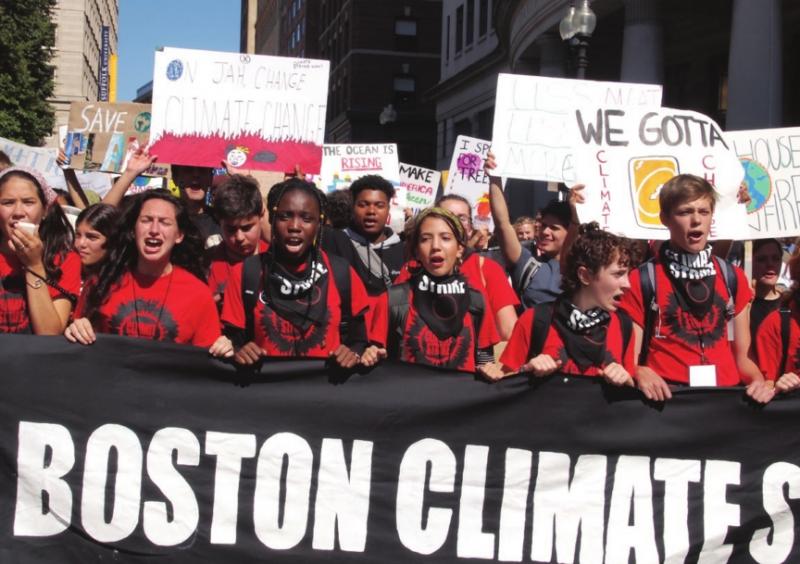
Demonstrators with the Boston Climate Strike march down Tremont Street en route to the State House.
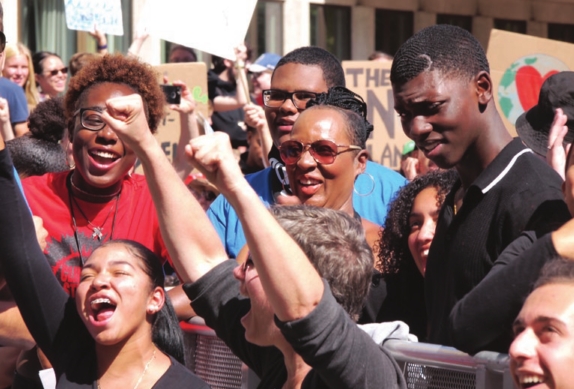
Youth activists at the Boston Climate Strike.
Boston action one of hundreds around the world
On a Friday morning when she normally would have been in school, Anjali Mitra, 17, was directing and guiding people as they entered Boston’s City Hall Plaza for the Boston Climate Strike.
“I hope that, especially [Gov.] Charlie Baker and all the other politicians in the Massachusetts State House, will understand that this generation wants the policies surrounding a Green New Deal,” Mitra said, megaphone hanging in hand. She was one of 40 young organizers of the Boston Climate Strike, all of whom were under the age of 20.
“Specifically, a just transition from fossil fuel infrastructure to one that’s based in renewable energy,” Mitra said, outlining some of the climate strikers’ demands. “Also a declaration of climate and ecological emergency so that they can actually take action on this crisis.”
The crowd that marched on Sept. 20 from City Hall Plaza to the Massachusetts State House, with the first wave of people embarking at 1:15 p.m., was overwhelmingly made up of high school students. However, mothers like Jessica Garrett, a member of local activist group Mothers Out Front, emphasized the support the youth has from parents like her.
She commented on the general dismissiveness of leaders toward youth.
“The
window is closing and our children need them to take action, right
away,” Garrett said about the legislators in the State House.
Strike
organizers said they felt an urgency to speak out against adults such
as Baker, along with a responsibility to speak out for those who may not
be able to, and for those who are disproportionately impacted by
climate change.
“It’s
really important for us to be here, especially because we live in Sharon
which is an upper-class town and a lot of people who are going to be
affected by climate
change
have less benefits than we have,” said protestor Grace Miller-Trabold,
15. “It’s important for us to speak up for those who don’t get their
voices heard.”
Miller-Trabold
was one of many marchers and speakers at the rally who commented on the
disproportionate impact climate change has on low-income and minority
communities.
Former
EPA administrator and Boston native Gina McCarthy described climate
change as an “equal opportunity killer.” Boston City Councilor Michelle
Wu highlighted the potential for families to be displaced due to rising
water levels, a problem more acute for those who do not have the means
to relocate.
“We’re
here because science is being ignored,” Wu said. “We’re here because
people are being ignored for the profits of fossil fuel companies.”
Reverend
and environmental activist Mariama White-Hammond challenged the crowd
of nearly 7,000 people to not only call for an end to the use of fossil
fuels, but to greed and racism-based “fuels” as well, arguing that
systemic racism and the climate crisis are intertwined.
Following
a dance performance by organizers and more chanting of “Climate change
is not a lie, do not let our planet die!” the rally ended, the march
began, and the streets filled with people and their creative signs.
As
the marchers turned onto Park Street from Tremont Street, with the
golden dome of the Massachusetts State House visible in the distance,
police and supporters lined Park Street and the marchers approached the
state capitol.
Some
protestors laid down their signs, a few of which read “There’s no planet
B,” and “Don’t be a fossil fool,” and entered the State House through
the General Hooker Entrance, while many remained on the front steps
chanting, dancing and demanding action.
“We
don’t want to be the last generation,” rally organizers Audrey Lin, 18,
and Amalia Hochman, 17, told the crowd earlier, from the rally stage
before the march began. “We’re now the generation of the Green New Deal!
Gen GND!” “Gen GND! Gen GND!” the crowd cheered in response.
This article was published on The Scope Boston website.


