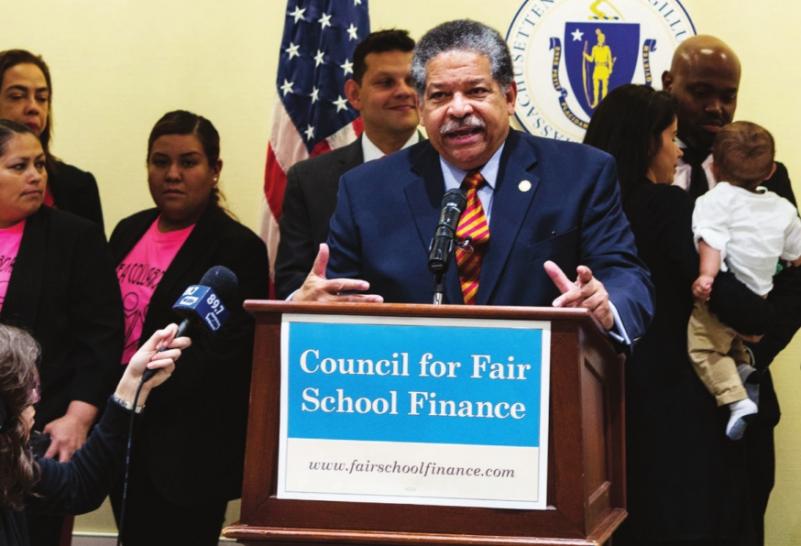
New England Area Conference NAACP President Juan Cofield speaks during a press conference announcing a lawsuit against the state.
Plaintiffs allege funding inequities violate state law
Parents of students in public schools across Massachusetts have announced a lawsuit against the state, alleging a violation of their children’s constitutional right to an education by underfunding many of the state’s low-income districts.
“Students in underfunded school districts are being deprived of the opportunity to receive the education to which they are entitled,” says the lawsuit, which was filed in the Massachusetts Supreme Judicial Court on June 13.
“Public schools are increasingly unable to provide sufficient resources to meet ever-increasing educational challenges.”
The plaintiffs in the case include parents and children from Chelsea, Chicopee, Fall River, Haverhill, Lowell, Orange and Springfield, as well as the New England Area Conference of the NAACP and the Chelsea Collaborative, and the suit was developed and filed by the Council for Fair School Finance.
At a press conference at the Massachusetts State House, Juan Cofield, president of the New England Area Conference of the NAACP, explained that the pattern of underfunding disproportionately affects students of color.
“Education rights are civil rights,
and this complaint documents in stark detail the neglect that persists
in public schools for children of color and poor students throughout
this state,” Cofield said. “Disparities between the wealthiest and the
poorest districts are widening, and students in underfunded school
districts are being denied the education they are constitutionally
granted.”
The lawsuit
specifically notes that the state has not yet fulfilled the 2015
recommendations of the Foundation Budget Review Commission, which would
revise the state’s school funding formula, known as the Foundation
Budget, to better reflect the needs of low-income and special education
students, English language learners and other groups.
Danielle
Andersen, the mother of two students in Orange and a member of the
town’s school committee, said that the district has had to make some
extremely difficult decisions in recent budget meetings, and this past
year had to decide whether to recommend laying off four teachers or
cutting all special classes such as physical education, music,
technology and art.
“After
speaking to the teachers, they all felt it was incredibly important for
the children to have these enrichment activities, and they sent us the
recommendation to go with a layoff,” Andersen said. “Our teachers
recommended that, because they care about our children. What do our
children have to look forward to?” Other speakers gave anecdotes about
their own struggles in their school districts, relating stories about a
special education child whose individual education plan was not
implemented due to funding restraints, a homeless high school student
who spent nights in 24-hour laundromats while studying for her Advanced
Placement classes, and others.
“The
state’s failure to fund the staff, material and services our children
need to succeed targets them for failure, instead of the success their
father and I teach them to strive for,” said Denise DaPonte Mussotte, a
Fall River resident with four children in public school there.
Ivan
Espinoza-Madrigal, executive director of Lawyers for Civil Rights, said
that the lawsuit does not seek a specific amount of money to fund
public education in the state, but instead seeks a promise from the
state that the communities that need more help will receive it.
“We
are pleased to see the issue of public education funding at the top of
the legislative agenda this year,” he said, referring to the PROMISE
Act, which, if passed, would fully fund the recommendations of the FBRC.
“But merely taking action will not be enough to fix the racial,
economic and geographic disparities that have harmed students for more
than a decade. We expect and demand the resources necessary to give
every student the high-quality education they are entitled to under our
Constitution.”