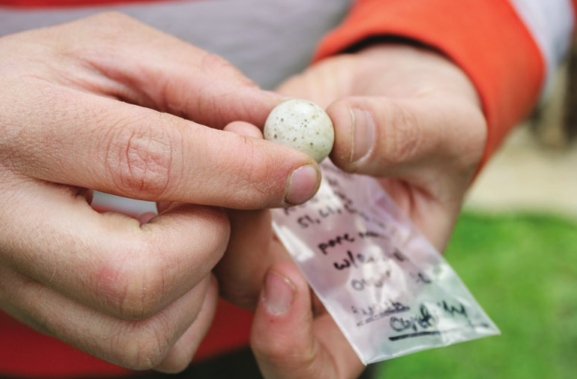
A porcelain marble is among the 19th century artifacts found near the First Church of Roxbury.
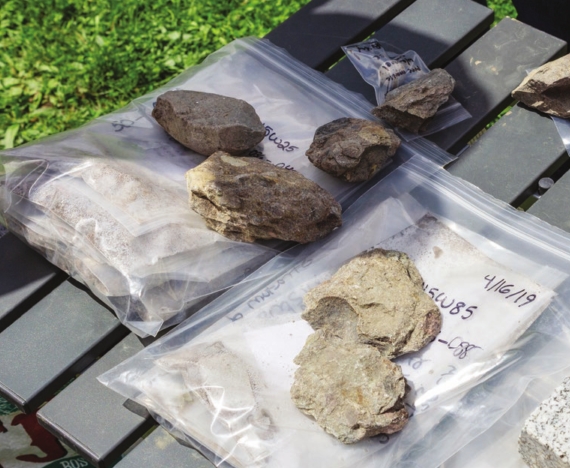
Artifacts are placed in bags at the dig site.
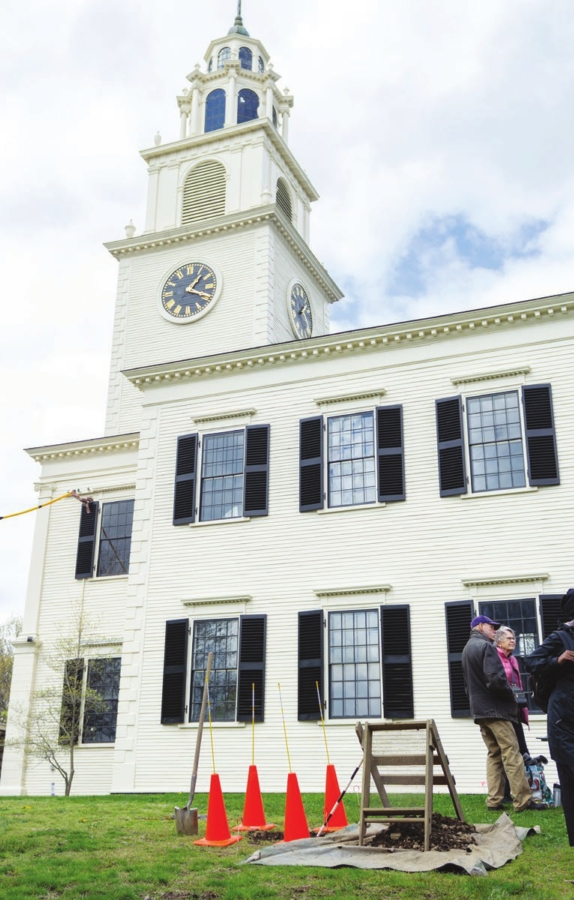
One of the dig sites at the First Church.
Archaeologist sifts through Roxbury soil
An ongoing archaeological survey at First Church in Roxbury has found Native American and 19th-century settler artifacts on the property, which has been the site of five meeting houses since the 1600s.
The dig, which was prompted by planned landscaping changes by the Unitarian Universalist Urban Ministry that owns the church, began on April 8 and will most likely continue for another three weeks.
“Our goals for this survey are just to get a broad view of the entire property to figure out where we’re finding concentrations of artifacts,” said Joseph Bagley, archaeologist for the city of Boston, in a presentation of the archaeological findings this past weekend. “So far what we know is that the Native people are pretty much everywhere on this property.”
Most of what they have found so far have been stone chips that come from tool-making by the Massachuset Native people, which archaeologists have not yet been able to date, and children’s items from the 19th and 20th centuries, such as porcelain marbles and slate pencils. They have also found a gunflint made of flint sourced in England.
Many of the artifacts have been found close to the street, as the modern roads in the surrounding area,
including Dudley and Roxbury Streets on either side of the church
property are actually built on top of the footprint of centuries-old
Native trails. Most likely, people walking by the church dropped these
items in the street.
Bagley
said that before the arrival of settlers, the area was definitely used
by Native people, due to its point at the top of a hill, but most likely
wasn’t a major settlement. Instead, the property was almost a backyard
to a larger site, where the neighboring Dillaway Thomas House is now
located.
However, the dig has not brought up any items yet from the intervening centuries, something Bagley said is frustrating.
“We’re not really rewriting the history of the church, because we’re not finding a lot of history of the church,” Bagley said.
“What we are seeing is the daily recreation of Roxbury residents going at least back to the early 1800s.”
To
canvas the property thoroughly, the dig team has mapped out points
every 10 meters where they dig a small hole through grass, earth and
puddingstone, a type of rock unique to the Boston area. If they find
something in that spot, they also dig in the surrounding area to make
sure they’re not missing anything.
“It’s
like playing a gigantic game of Battleship,” Bagley joked, referring to
the board game in which players guess where their opponents’ “ships”
are located on a grid they can’t see.
In
the coming weeks, a team from the University of Massachusetts Boston
will be conducting a radar survey of the grounds, which may reveal the
foundations of the first and second churches built on the property, as
the current church is not in the same spot. The survey has already found
a large, rectangular area of puddingstone which the archaeology team
believes may be the original foundation of the 1630s building, but they
don’t yet know for sure.
“We’d
love to be able to figure out where the first two churches are on the
property before we leave, because then that can be worked into the
interpretation of the property, to visitors and maybe even the landscape
design going forward,” Bagley said.


