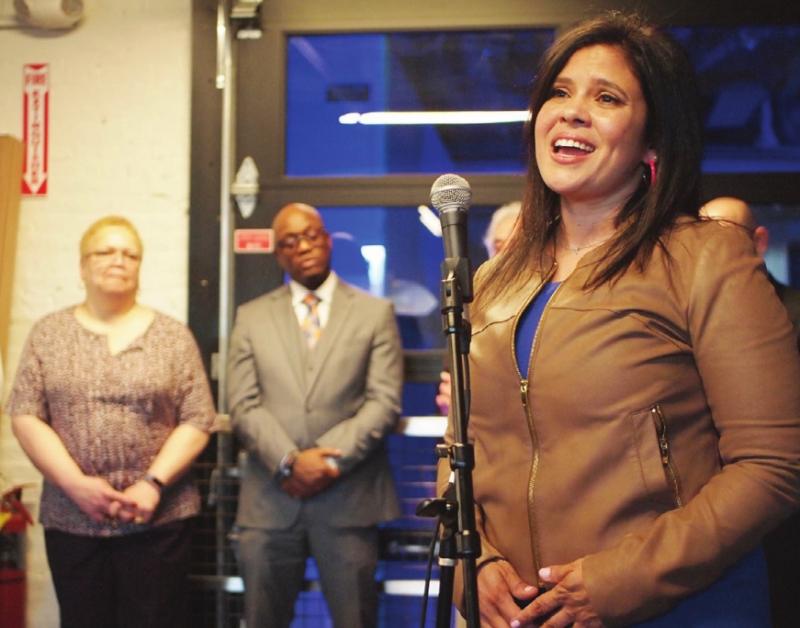
Former director of the of the Mayor’s Office for Immigrant Advancement Alejandra St. Guillen speaks during her campaign kickoff at the Backlash Beer Company in Roxbury.
Alejandra St. Guillen, one of 14 candidates vying for four at-large city council seats this fall, spoke to a who’s who of political activists during her campaign kick-off last week at the Backlash Beer Company brewery in Roxbury.
“We are in a city that is booming,” said St. Guillen. “Boston is seeing economic growth like at no other time. But in many ways, it’s a tale of two cities. One that is benefitting from it and another that is not benefitting from it, but being hurt by it.”
St. Guillen’s themes of fighting gentrification and supporting strong protections for immigrants may well resonate with Boston residents who are being slammed by high rents and hemmed in by luxury developments beyond the reach of most current city residents.
But in a crowded field of candidates vying for voters’ attention, St. Guillen will likely need more than a good message to stand out. She’ll need money.
Money matters
Observers say running an atlarge council campaign requires tens of thousands of dollars to reach out to voters across the city. To win one of the four seats, candidates will likely need some 40,000 votes.
While
some at-large candidates have spent more than $200,000 on races, other
candidates rely more heavily on a strong corps of volunteers. But still,
volunteers need glossy literature to press in the palms of potential
voters and those cards cost money.
“The
cost to turn up citywide is pretty steep,” said former District 7 City
Councilor Tito Jackson. “You’re talking about $20,000 mailers.”
One
of the current at-large councilors managed to gain a seat without such
spending. In 2017, Althea Garrison ran a low-budget campaign, listing no
contributions and a zero balance on her Office of Campaign and Public
Finance filings. She garnered 18,253 votes, putting her in fifth place.
Impressive, though less than half the 45,564 votes fourth-place finisher
Annissa Essaibi-George received to secure a spot on the council.
Only
because Ayanna Pressley left the council to serve in Congress, leaving a
vacancy, was Garrison finally seated on the body earlier this year. But
now, with the same zero-dollar campaign fund she came in with, Garrison
is competing for reelection alongside three other incumbents and ten
challengers Besides St. Guillen, challengers include Mary Church,
Domingos DaRosa, Michel Denis, Raymond Duran, Priscilla Flint- Banks,
David Halbert, William King, Herb Lozano, Julia Mejia and Jeff Ross, who
reports a balance of $69,414 in his war chest, all but $565 of which
came from a $75,000 loan he made to his campaign account.
Garrison
aside, the challengers face three incumbents with substantial war
chests: Michael Flaherty, who reported $347,149 on April 15; Michelle
Wu, who reported $302,565, and Essaibi-George, who reported $83,819.
As
of the April 15 filing date, St. Guillen had $44,754 on hand, Julia
Mejia had $18,807 and David Halbert had $15,608. (The above totals
reflect cash on hand, not what has been raised and spent.)
2019 electoral patterns
Campaign
contributions help buy a candidate’s entrance fee into the arena. The
city’s changing voting patterns may provide a battle plan for a
successful campaign.
A
key factor in this year’s city council race will be whether the
momentum from last year’s historic election will carry forward into this
November. 2018 saw the election of the state’s first black woman to
serve in Congress, Suffolk County’s first black woman district attorney,
and a surge of female and progressive candidates taking power in
Boston, in Massachusetts and across the country, proving right the
pundits who predicted President Donald Trump and the GOP would provoke a
backlash among women voters and progressives.
Missing
in this year’s election will be the halo effect from the congressional
campaign of Ayanna Pressley, which, according to political activist Ann
Chinchilla DeGeorge, helped propel her candidate, Suffolk County
District Attorney Rachael Rollins, into office.
“When
[Pressley’s] campaign decided to reach out to infrequent voters, it
doubled the turnout,” said DeGeorge, who ran Rollins’ successful
underdog campaign. “We were able to work off each other’s efforts.”
But will the new voters stay engaged?
DeGeorge says last year’s race may have permanently altered the city’s electoral map.
“I
think it did wake up nonvoters to their power,” she said. “But there
are a lot of unknowns in general right now about elections. In this
particular race, there are so many minority candidates.”
Political
activist Calvin Feliciano said that even under-resourced campaigns of
black and Latino candidates could produce higher turnout in those
communities, amplifying their political power.
“Even
people who don’t do the work or don’t have resources, they’ll still
bring out a few hundred votes,” he said. “Every candidate has a little
bit of a group.”
The profusion of candidates bodes well for democracy in Boston, noted Jackson.
“I
personally think it’s exciting,” he said. “When we look around a state
that has one of the highest percentages of uncontested races, it’s a
great thing to see people put their ideas forward.”


