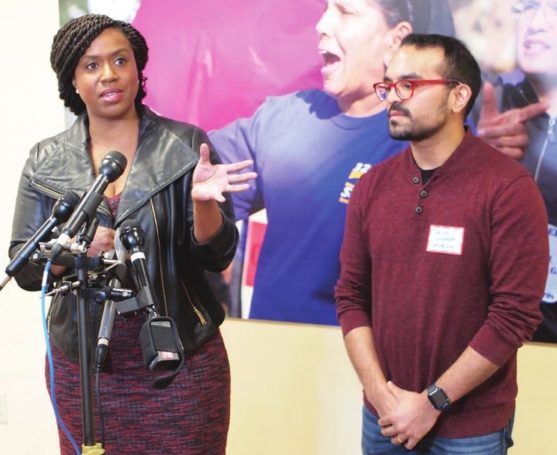
U.S. Rep. Ayanna Pressley and American Federation of Government Employees Vice President Sajid Shahriar speak to reporters.
The 35-day government shutdown ended last week with a continuing resolution providing funding for three weeks, but the aftermath and the threat of another shutdown weigh heavy on federal workers as President Donald Trump continues to battle Congress with his push for $5.7 billion in funding for a wall at the U.S.-Mexico border.
For government workers who have gone five weeks without pay, the effects of the shutdown and Trump’s threat to force another Feb. 15 have created an atmosphere of instability, according to U.S. Rep. Ayanna Pressley, who met with furloughed government workers Saturday.
“We have passed a [continuing resolution], but the residual and reverberating effects and impact of this will go on for many months to come,” Pressley said, speaking to
reporters after her meeting with several dozen federal employees. “They
made the choice to work for the federal government and they are
insecure. They feel vulnerable.”
Hard line on wall
Democrats,
including Pressley, have steadfastly refused to provide funding for the
border wall Trump first promised during the 2016 presidential election.
Pressley said the party would not allow Trump to use government
shutdowns as a bargaining tool.
“This
was a completely manufactured crisis,” she said. “We have a man-made
crisis at the border which will be resolved with policy. A shutdown is
not policy. We need to government to reopen and stay open so that we can
have a debate about how to continue to strengthen and secure the
border.”
During her
hour-and-a-halflong meeting, which was held at the West Street
headquarters of the labor union SEIU 32BJ, Pressley met with workers
from HUD, the EPA, the IRS and other federal agencies.
Sajid
Shahriar, a vice president of the American Federation of Government
Workers 3258 who was in the meeting with Pressley, echoed Pressley’s
call for a longterm solution.
“I
would just ask that that we make sure this is resolved for a longer
time than just three weeks, because the consequences of this over the
last 35 days have been devastating, not only for the people I represent,
but for the people we serve as well,” he said.
While
this is not the first time the government has shut down, it has been
the longest shutdown in history. As Pressley pointed out, recent
shutdowns were caused by legislative wrangling and battles over the
federal budget.
“They were not about the whims and the desires of any one person,” she said.
Prior
to the shutdown, Trump told House Speaker Nancy Pelosi and Senate
Minority Leader Chuck Schumer he would shut down the government if
Congress and the Senate did not approve funding for a wall and said he
would take credit for the shutdown. Trump’s eventual capitulation and
his low public approval ratings seem to point to a major loss for the
president.
Pressley
said she supports further negotiations with the president on border
security but will not support the construction of a wall.
“I
will not support any compromise that further emboldens this
administration’s racist immigration policies or exacerbates what is
already a very dire humanitarian crisis at our border,” she said.
The federal workers with whom Pressley spoke are also against a wall, she added.
“Not
one person in that room supports a wall,” she said. “No matter how dire
their circumstances, workers have repeatedly said, ‘No wall.’”
Contractors
Pressley
says she has filed legislation, co-sponsored with Minnesota Sen. Tina
Smith, that would give back pay to federal contractors who, unlike
employees of the federal government, are not entitled to back pay under
the current law.
“Right
now there is no legislative mechanism to protect food service workers,
security workers, custodians,” Pressley said. “These are hourly low-wage
workers who have already been struggling in this economy and so this
shutdown has only further exacerbated that work.”
Shahriar
said he and other federal employees planned to report to work on
Monday, although as of Saturday, he had not received any communication
from a supervisor at the then-shuttered federal Department of Housing
and Urban Development where he works.
“I just plan on showing up on Monday,” he said. “I assume that’s what they want us to do.”


