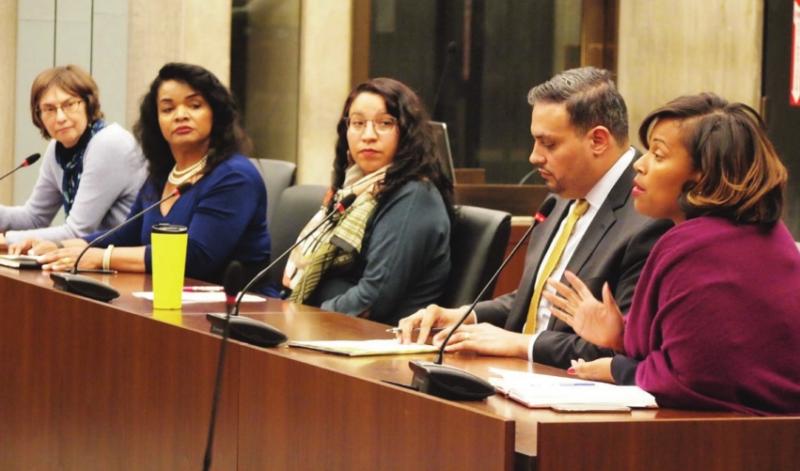
NAACP Boston Branch President Tanisha Sullivan testifies during a city council hearing on the merits of an elected school committee. Looking on are parent activist Mary Battenfeld, Black Educators Alliance of Massachusetts President Edith Bazile, Boston Education Justice Alliance Executive Director Ruby Reyes and NAACP Education Committee Chairman Jose Lopez.
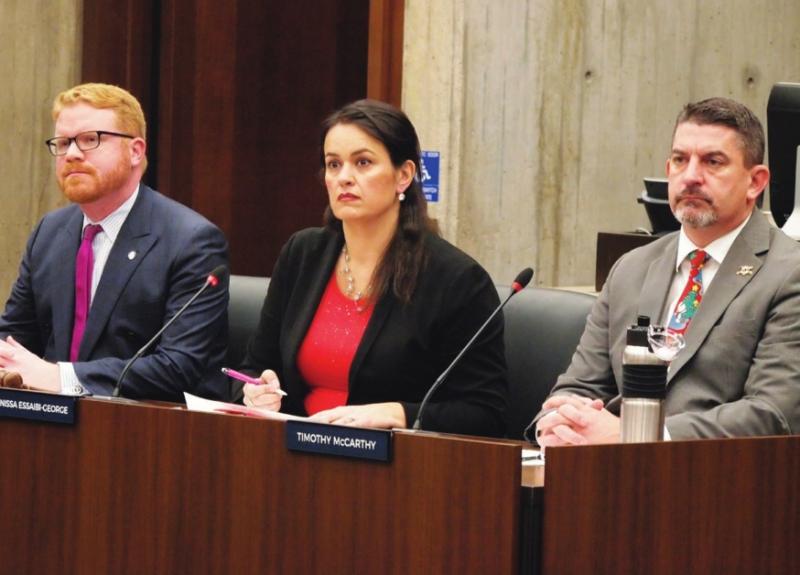
City Councilors Matt O’Malley, Annissa Essaibi-George and Tim McCarthy listen to testimony.
Activists say current body votes against parents’ interests
Depending on whom you listen to, an elected Boston School Committee would return democratic control of the schools to parents or return corruption and political chaos to the school department.
City councilors heard a multitude of perspectives during a hearing held last week by Education Committee Chairwoman Annissa Essaibi-George that probed the ideal structure for the school committee.
“The guiding question here is whether another governing structure could lead to more accountability for actions of our school committee members and whether we should have that mechanism here in Boston,” said Jose Lopez, who heads the NAACP Boston Branch’s education committee.
Limited participation
Lopez said participation of parents and stakeholders in the decision-making process around schools is currently limited to the two-minute blocks allotted for testimony during school committee meetings and through voting for the mayor who appoints school committee members.
Lopez’s comments underscored a common complaint among opponents of the current structure — that parents, students and community members are limited in their ability to debate BPS policy with committee members and that the committee itself has little accountability to anyone other than the mayor.
Critics of the mayor-appointed committee cited the body’s December 2017 vote to change school start times, which Mayor Martin Walsh withdrew within weeks amid fierce parent protest; the forced departure of former superintendent
Tommy Chang and the summary appointment of interim Superintendent Laura
Perille — decisions in which the school committee appeared to have
little say.
Boston
Education Justice Alliance Executive Director Ruby Reyes pointed to the
committee’s upcoming vote on closing the West Roxbury Education Complex.
“On
December 19, they will vote, most likely to close West Roxbury and
disperse students wherever BPS says they have first choice, when their
choice is to remain together,” she said. “Why? Because they almost
always vote to unanimously pass whatever is put before them. That is in
essence what is flawed about an appointed school committee.”
While
Reyes and others noted that the current school committee members may
genuinely care about the students in the system’s 126 schools, the
argued that school committee members appointed by the mayor are neither
accountable to, nor responsive to, the needs of the system’s students
and parents.
Troubled history
Arguing
against a return to an elected body, former City Councilor Larry DiCara
pointed to the dysfunctional dynamics of the committee in the 1970s and
1980s.
“The ’70s were
not a good decade for the Boston School Committee,” DiCara said. “Two
members of the school committee went to jail, others were indicted but
not convicted, the School committee positioned themselves to bring about
a court order that brought about the desegregation of our schools. They
violated law, plain and simple.”
DiCara
said that even with a shift from a seven-member atlarge body, with all
members elected city-wide to a hybrid body with four at-large seats and
nine neighborhood district seats, the dynamics of the council did not
improve, calling it an “abysmal disaster.”
Boston
Municipal Research Bureau President Samuel Tyler, noting he advocated
for the abolition of the elected body in 1992, said an appointed
committee renders the mayor accountable for the schools.
“For
the past 25 years the appointed committee has proven to be more
educationally focused, fiscally responsible and better able to tackle
important, but politically difficult issues than the record demonstrated
by either the seven-member or 13-member elected school committees,” he
said.
Mayoral accountability
But
NAACP’s Lopez argued that municipal elections don’t give parents of BPS
students a viable means for holding the mayor accountable, noting that
many voters don’t have children in BPS schools.
Mary Battenfeld, a member of the parent group Quality Education
for Every Student, said recent decisions by the school committee have
convinced her of the importance of an elected body.
“After
so many years of seeing the people closest to the pain shut out of any
decisions affecting our children, of watching helplessly as the Boston
School Committee makes choices that go against the clearly expressed
wishes and best interests of families and students… I’m firmly in favor
of Boston joining the 98 to 99 percent of the rest of the country in
allowing our community to elect the people who take care of our schools,
and through them, our children,” she said.
Many
of those who spoke said they have not decided whether they would
advocate for a return to an elected body, but said the conversation is
worth having.
“Our
position is that the time is now for us to have an open and transparent
conversation as a city about what is the best governance structure for
our school committee that will lead to the outcomes that we want to see
for our children,” said NAACP Boston Branch President Tanisha Sullivan.
Short-term reforms
District
1 City Councilor Lydia Edwards urged advocates to explore factors such
as how re-drawing district lines might affect an elected body, whether
term limits make sense, whether seats should be limited to parents,
whether seniors in high school should be allowed to vote and whether the
school budget should be subject to participatory budgeting — allowing
Boston residents to weigh in.
Essaibi-George,
who has not taken a position on whether the school committee should be
elected or appointed, noted that returning to an elected body would
require changing the city charter and putting a vote before the state
Legislature, a time-consuming process.
She
asked a panel, including representatives from the NAACP, the Black
Educators Alliance of Massachusetts and Quality Education for Every
Student, for suggestions on improvements that could be made to the
appointed body.
Sullivan pointed to the panel that nominates people to the school committee, noting that few people know who they are.
She
also noted that under the current structure, the school committee’s
responsibilities include hiring, evaluating and, when necessary,
terminating the superintendent, as well as to set the policies for the
district. That, currently, is not happening, she said.
“One
of the other things that could change, is for the school committee to
do its job,” she said. “And that is to act as an independent body and
make decisions that are in the best interests of the children, families
and educators. And as was mentioned on this panel, time and time again,
what we hear in testimony from school committee members is how painful
the decisions are that they’re making, how much they don’t agree with
the decisions that they’re going to make, and yet they cast votes
contrary to their interests and their beliefs all the time.”