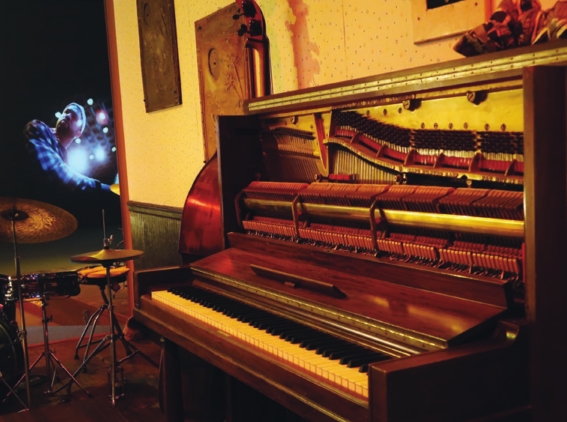
Jason Moran, “STAGED: Slugs Saloon,” 2018. Mixed media and sound. 120 x 168 x 171 inches. Courtesy the artist and Luhring Augustine, New York. © Jason Moran.
Two weeks ago, with a brief performance at the Institute of Contemporary Art, jazz pianist and multimedia artist Jason Moran opened the first museum-scale survey of his collaborations with visual artists. Like these collaborative art projects, his onstage prelude was a semistaged and semi-improvisation combination of words, movement, music and spectacle.
While a recording of a female voice repeated an exhortation urging artists to explain what they do, Moran walked around a bit, as if reflecting on the statement. The recording continued to replay as Moran took a seat at a grand piano and began a lyrical improvisation. The woman’s voice, her words now semi-audible, interwove with his music into dual streams of sound. As his solo progressed, the recorded voice faded off and the shades on the walls behind Moran rose to reveal a twilight view of Boston Harbor.
Theatrical, visual, auditory and intimate, the multisensory performance served as an introduction to Moran’s brief autobiographical comments, an extended tribute to people who have guided and inspired him. Most were women, including his mother, who attended his childhood piano lessons, noisily taking long notes in her beautiful penmanship, and conceptual artist Adrian Piper, whose voice played in the recording. He also spoke of musician and educator Jaki Byard, his influential teacher at the Manhattan College of Music, noting that his mentor was from Worcester.
Moran dedicated his closing piece, “Russian Rag,” to its author, James Reese Europe. As leader of the 369th Infantry Jazz Band, Europe brought the new sound of syncopation, American ragtime, to the Old World during World War I. Moran told the audience that in 1919, the bandleader was murdered by his drummer in a hall located where the Prudential Center now stands.
After concluding the rag with currents of deep, rolling chords, Moran invited all to go up to the gallery and see the show.
On view at the ICA through January 21, the traveling exhibition was organized by the Walker Art Center in Minneapolis and curated by Adrienne Edwards and Danielle Jackson. The Boston presentation was coordinated by Jeffrey De Blois, ICA assistant curator.
The musical grounding, theatricality, immediacy and embrace of history and place that Moran demonstrated on stage also pervades the works on view, which occupy a large gallery and several screening rooms.
Homage to Harlem
The showstopper, “STAGED: Savoy Ballroom I” (2015), greets visitors as they enter the gallery. It is one of three mixed-media installations, on view together for the first time, that evoke hallowed New York landmarks in the evolution of jazz. “Savoy Ballroom I” is an homage to the Harlem ballroom where society couples danced to Ella Fitzgerald and the orchestras of Duke Ellington and Chick Webb. A spellbinding gilded arch with a tiny, ornate sheet music holder at its foot, the structure bathes viewers in its luxuriant glow, conjuring the glamour of the swing-band era.
“STAGED: Slugs Saloon” (2018), commissioned by the Walker Art Center, is a stage set for the imagination with its sawdust-strewn floor, vintage standup piano and juke box summoning a humble dive in seedy Alphabet City that from 1964 to 1972 was home to free jazz pioneers such as Jackie McLean, Sun Ra, Pharaoh Sanders and Cecil Taylor.
The Slugs structure, flanked by tilting mirrors, reflects viewers, as if they are inseparable from the scene. At certain angles, it captures the videos projected on three walls, a nonstop loop of scenes from live performances by Moran and his partners.
“STAGED: Three Deuces” (2015) is equipped with a player piano programmed by Moran to emit music that suits its era. Designed to fit into a corner and enclosed by quilted walls like those
of a recording booth, the installation honors the performers’ corner of
the Three Deuces, a West 52nd Street club where bebop was born in the
1940s in the improvisations of such artists as Miles Davis, Dizzy
Gillespie, Charlie Parker and Max Roach.
A
jazz pianist, composer and educator, Moran, 43, succeeded Jaki Byard as
a teacher at the Manhattan School of Music and in 2010, after his
mentor’s death, inherited his position on the faculty of the New England
Conservatory. That year, Moran was also awarded a MacArthur “genius”
Fellowship. A curator at Park Avenue Armory in New York and artistic
director for jazz at the Kennedy Center in Washington, D.C., Moran also
advances creative ventures through his own recording label, Yes Records.
In
2017, Moran and his wife and collaborator Alicia Hall Moran, a composer
and classically trained soprano, received Ford Foundation Art of Change
fellowships, an award that recognizes socially progressive artists.
Collaborations
Involvement
in social issues and a knack for revelatory spectacle also inform the
work of the Morans’ collaborators, who include Joan Jonas, Glenn Ligon,
Kara Walker, Lorna Simpson, Carrie Mae Weems, and Theaster Gates.
More
than a dozen videos compiled by Moran show these collaborations in
action. Viewers see a whimsically costumed Joan Jonas, an emeritus
professor at MIT and performance artist, moving rapidly amid projections
and props as she creates haunting imagery on ecological themes, to
Moran’s piano improvisations. Also accompanied by Moran, Lorna Simpson
explores identity and gender in mirrors, and a harrowing video by Kara
Walker recreates with hand-held puppets an episode of Reconstruction-era
violence against an African-American family, to a score by Alicia Hall
Moran. Another video shows scenes from a stage production Moran
concocted with Theaster Gates, whose primary art form is his project to
restore blighted neighborhoods in his hometown, Chicago. Their
celebrated evening-length production, “Looks of A Lot” (2014), features
the Kenwood Academy Jazz Band.
Performances
The
ICA exhibition also will feature performances. On Oct. 12, Moran and
the Bandwagon — including bassist Tarus Mateen and drummer Nasheet Waits
— celebrate the trio’s 20th anniversary with a concert at the ICA. On
Nov. 15, Moran and Glenn Ligon revisit their collaboration of a decade
ago, with Moran providing the soundtrack for Ligon’s 16-minute
black-and-white film, “The Death of Tom,” a reimagining of the final
scene in a 1903 silent film of “Uncle Tom’s Cabin.” Following a
screening and live performance, Ligon will interview Moran about his
creative practice.
Meanwhile,
a few works communicate their musical legacy in silence — Moran’s works
on paper are contemplative abstractions in charcoal that he created
with the movement of his piano keys.
ON THE WEB
ICA Boston: www.icaboston.org/exhibitions/jason-moran
Jason Moran:www.jasonmoran.com/


