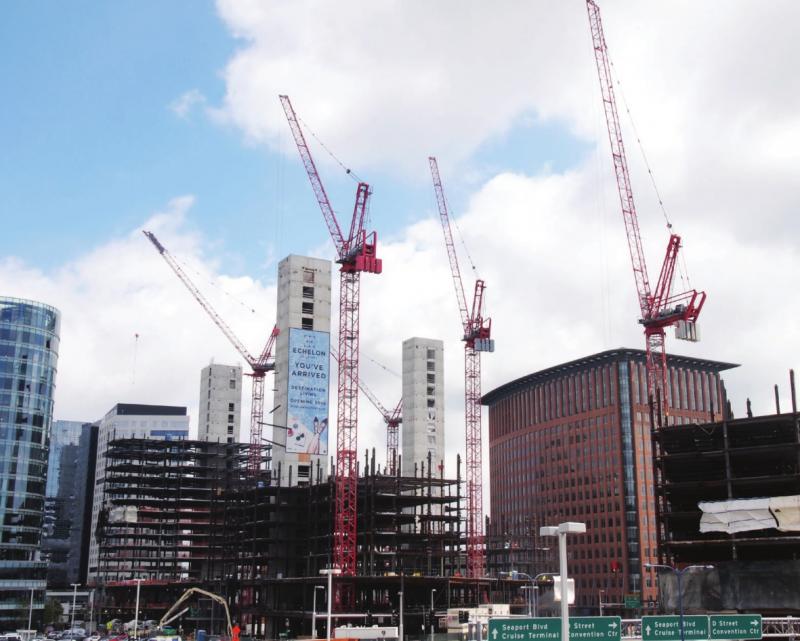
New condominium buildings and office towers have
reshaped Boston’s Seaport District. A new report is calling for a real
estate transfer tax on sales of luxury units and a surtax on units
vacant for more than six months of a year.
Many luxury condos remain vacant
They tower over Boston’s downtown neighborhoods: glass and steel luxury high rises that for some signal economic growth. But many condo owners in the high-rise buildings are harboring a secret: their identities.
A report released last week, “Towering Excess: The Perils of the Luxury Real Estate Boom for Bostonians,” finds that in 12 of the city’s largest luxury buildings, 35 percent of the units are owned by limited liability companies or trusts that hide the identities of the individuals or entities that own them.
Additionally, 64 percent of the 1,804 units in these 12 buildings do not claim a residential property exemption — indicating that the homes, with average sales prices of $3.05 million, are not primary residences for their owners.
While city officials have long looked to housing production as a means of reducing pressure on Boston’s overheated housing market, the report suggests that many of the newly-purchased units in the city’s urban core are sitting vacant for much of the year, with sales prices far above the reach of most area residents.
“We think this is a lot of international investment,” says report co-author Chuck Collins. “The people who are moving into the city from the suburbs can’t afford these units. That forces them into the neighborhoods, where they’re competing with everyone else.”
The
release of Collins’ report comes as housing activists in Boston are
preparing to hold a “People’s Plan” assembly to confront what they say
is a displacement crisis in Boston. While 25 percent of the city’s
current population earns more than $90,000 a year, 60 percent of the
units built in Boston over the last seven years are unaffordable to
those who earn less than that amount.
In
2015, Mayor Martin Walsh launched a Build Boston 2030 housing plan that
calls for the creation of 53,000 new housing units to meet growing
demand as the city’s population continues to grow. With 27,513 units
built, under construction or permitted, the city is well on its way to
meeting its production goal.
“We’re
a city that’s desired,” Walsh told the Banner. “People want to live
here. We’re building housing, and we’re doing this without a federal
partner. We’re doing this mostly on our own by raising inclusionary
development funds, [and] through the Community Preservation Act.”
Of
the 27,513 units built or in the pipeline, 2,085 of the units are
classified as affordable. Just 9 percent of all new housing production
is affordable to those earning 60 percent or less of the Greater Boston
area median income according to members of the Right to the City
Coalition, an affordable housing advocacy group.
While
housing production in Boston has been robust, many have begun to
question what District 1 City Councilor Lydia Edwards has called
“trickle-down housing policies,” wherein production of high-end units is
thought to relieve pressure on the city’s housing market.
Collins
and report co-author Emma De Geode say the proliferation of luxury
units in Boston could have dire consequences for the city, including
higher land costs and greater inequality.
“The
luxury building boom is driving up the cost of land in central
neighborhoods, with a ripple impact on the cost of housing throughout
the city,” the report reads. “Affluent, but not super-rich, households
in Boston find themselves pushed to outer neighborhoods, increasing
competition for scarce affordable and moderately priced housing.”
At
the lower end of the market, low- and moderate-income tenants are
continuing to be forced out of the city, housing advocates say.
“In
the past five years, we’ve supported renters in over 75 cases of
building-wide clear-outs in Boston, where everyone in an apartment
building receives a nofault eviction notice. It’s a tool for flipping an
entire multi-unit property. And the cases we hear about are only a
fraction of the story,” said City Life/Vida Urbana Executive Director
Lisa Owens in a media statement.
Members of Homes for All are planning on convening at the First Church
of Roxbury, Saturday, Sept. 22 to iron out strategies for the city to
prevent displacement of moderate- and low-income Boston residents.
“Collectively,
we’re going to draft a concrete set of recommendations for the future
of our city,” said Darnell Johnson, executive director of the Right to
the City Coalition, in a statement. “We can stop this crisis, but only
if we follow the lead of the people on the front-lines, the people most
affected.”
Collins and
De Geode recommend levying a high-end real estate transfer tax on
properties costing $2.5 million or more, instituting a vacancy tax on
properties vacant for more than six months out of the year and measures
to require greater transparency of ownership of the units.
“Boston’s
past and current city administrations have permitted an explosion in
luxury real estate property construction that is reshaping the city’s
skyline and economic composition,” Collins and De Geode write in their
report. “With thousands of new luxury units either under construction or
seeking permits, city officials ought to be seriously exploring the
perils these units pose.”
Walsh told the Banner he would be open to looking at the recommendations in the report.
“We’ll
look at everything,” he said. “You can’t rule something out that
actually could work here. We’re going to look at all the recommendations
that are in that report.”


