WORKS OF M.C. ESCHER ON DISPLAY AT MFA THROUGH MAY 28
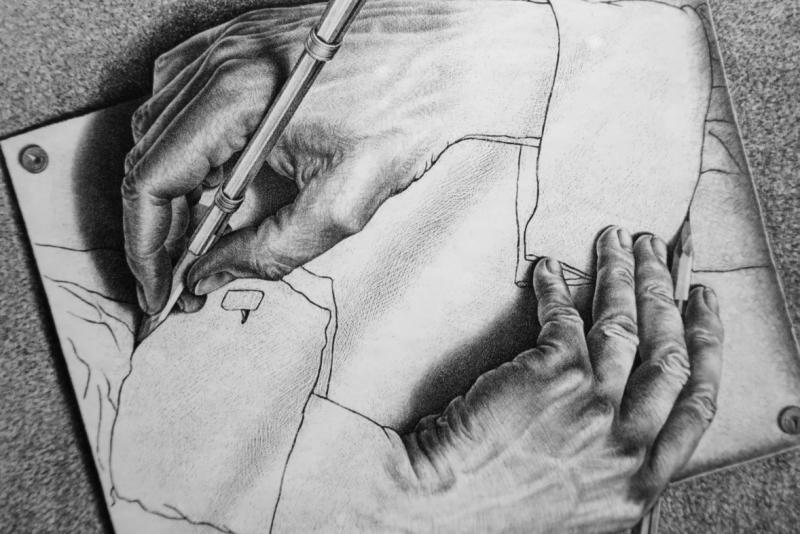
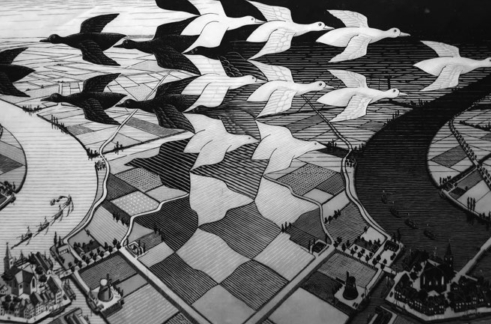
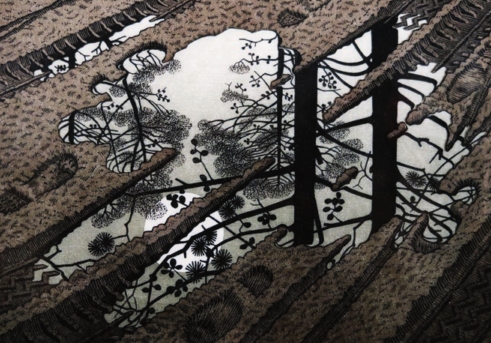
(from top) M.C. Escher, “Drawing Hands” (1948); M.C. Escher, “Day and Night” (1938); M.C. Escher, “Puddle” (1952)
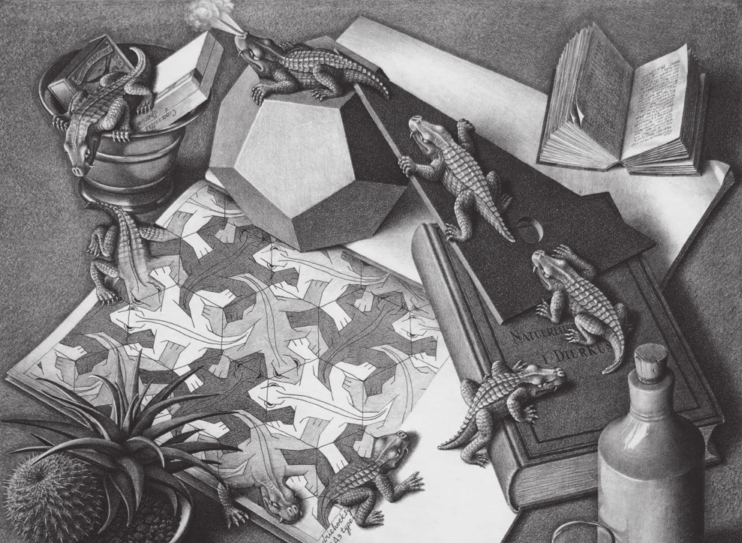
M.C. Escher, “Reptiles” (1943)
Surprises await those who think they know M.C. Escher from the endless reproductions of his works on posters, ties, T-shirts and other paraphernalia. The Museum of Fine Arts Boston exhibition, “M.C. Escher: Infinite Dimensions,” on view through May 28, presents works by the Dutch printmaker from the 1930s through the ’50s that tell a richer story of Escher and his inventiveness.
An image by Maurits Cornelis Escher (1898– 1972) can prompt the question: Is this art or a clever visual feat? Fans of Escher abound among mathematicians and scientists, and it’s not difficult to understand why: His ambitious optical games often embody mathematical principles and invite analysis.
Drawn from public and private collections, all 50 images on view in the MFA’s fascinating exhibition stir visual delight, and some inspire wonder. A few possess a magnetism that engages more than a cerebral response. In their repetitive, rhythmic patterns, they provoke awe and mystery and evoke the very metamorphosis of life—an achievement that goes well beyond the scope of a clever visual game.
Organized
by Ronni Baer, an MFA curator, the exhibition fills two large galleries
connected by a central kiosk with angled walls that reflect the
geometry within the works on view. Escher was a bravura printmaker, and
his works include lithographs, woodcuts, mezzotints, linoleum cuts, and
wood and metal engravings along with a few watercolors and drawings.
Most are in a palette of white, black and gray, but a few include
colors, mainly maroon and the pale green of young plants.
Early career
After
attending architecture school, where a teacher encouraged him to pursue
printmaking, Escher lived from 1922-1935 in Italy, married and raised a
family. Troubled by the rise of Fascism, he and his family left Italy,
and by 1941 he was back in Holland.
Escher
let observed reality into his early works, which include scenes of
Italian hill towns. The earliest and most poignant images on view are
his lithographs “Ravello and the Coast of Amalfi” (1931), and next to
it, “Still Life with Mirror” (1934), an introspective close-up of
personal grooming items on a dresser and, in its mirror, a reflected
view of the narrow hill town street outside.
Inspired
by a visit to the 14th-century Alhambra palace in Granada, Spain, where
he admired the intricate, repetitive patterns of interlocking shapes in
its Islamic mosaics, Escher adopted the technique, known as
tessellation.
In 1936,
he began a multidecade series of prints exploring tessellation,
entitled “Regular Division of the Plane,” replacing the abstract shapes
of the Islamic tiles with the silhouettes of creatures, such as birds
and fish.
The earliest
example on view of these experiments is his hallucinatory woodcut “Day
and Night” (1938), in which identical, interlocking black-and-white
silhouettes of birds take form in relationship to one another, like
pieces in a puzzle. Later examples from the series show winged dogs,
frogs, beetles and chess figures.
Organized
to highlight Escher’s various visual preoccupations rather than by
chronology, the exhibition provides excellent wall texts and pairs many
images with comments from Escher fans in various professions. Ian Hunter
of the rock band Mott the Hoople confesses that he put Escher’s 1943
lithograph “Reptiles” on the cover of the band’s 1969 debut album
without seeking permission.
Metamorphoses
A
dazzling composition of tessellations is at play in Escher’s
hexagon-shaped lithograph “Verbum” (1942). At its center is the work’s
title, Latin for “word,” evoking the opening lines of the Book of
Genesis, “In the beginning was the Word, and the Word was with God, and
the Word was God.” Radiating from the center, triangles morph into
birds, fish and frogs, representing divine creation of sky, water and
earth. Seemingly in flight from their earlier appearance in his 1938
woodcut “Day and Night,” two waves of black and white birds converge and
cross, suggesting the balance between darkness and light.
The
astonishing “Metamorphosis II” (1939–40) shows Escher using
tessellation as a storytelling device. Starting from the left, the
13-foot woodcut, produced from 20 blocks, follows the smallest and
simplest of shapes, tiny cell-like figures, as frame by frame they
evolve into reptiles, bees and flying insects that in turn change into
fish that then become birds. Cubes sprout into an Italian hilltop town, a
symbol of human life, but its tower becomes a chess piece.
Endless motion
Escher’s
narratives are endless, repetitive loops that keep going without
stopping or leading anywhere — like a spinning hula-hoop, but unlike
life. In “Reptiles,” the print borrowed by Mott the Hoople, a
two-dimensional lizard wriggles out of a drawing as a three-dimensional
figure, scales a zoology book and a polyhedron-shaped desk ornament,
snorts in triumph, and then heads downhill to rejoin the drawing.
Two
lithographs of endless motion are somewhat autobiographical: in
“Drawing Hands” (1948), two hands holding pencils form a yin yang
cycle; and in “Bond of Union” (1956), Escher portrays a man and a woman
out of a single, unending ribbon molded to illustrate their facial
features.
Another
series renders landscapes and structures as if seen all at once from the
front, overhead, and below. Closely related are Escher’s images of
impossible buildings, which mingle interior and exterior views.
Reflecting on such a structure in his wall text comments, architect
Graham Gund finds in its multiple, irreconcilable perspectives a
reflection of our times.
Always
in step with his own muse — the power of design to tell its own story —
Escher worked with an outsider artist’s monastic single-mindedness.
Yet, observed reality and human figures return in later works. In a trio
of elegant prints from the late ’50s that render the reflections of
moon, trees, and sky on water, Escher finds forms in nature.
ON THE WEB
For more information about “M.C.Escher: Infinite Dimensions,” visit: www.mfa.org/exhibitions/m-c-escherinfinite-dimensions


