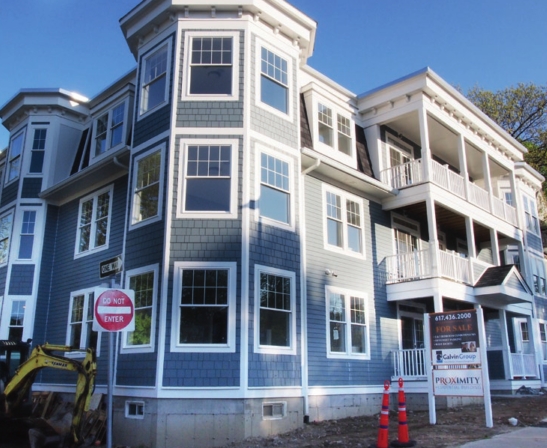
Proximity, a nine-unit development at Humboldt and Howland streets, is selling units from $499,000 up.
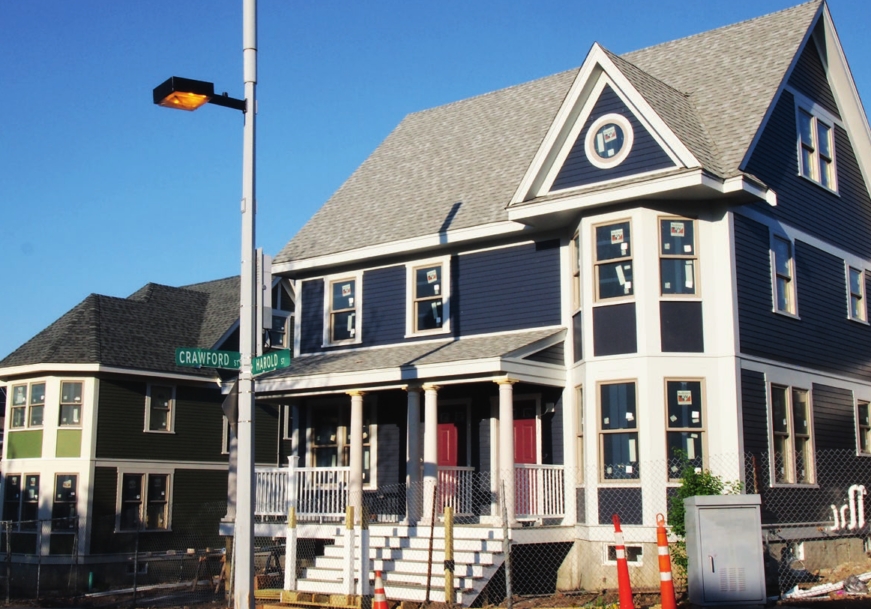
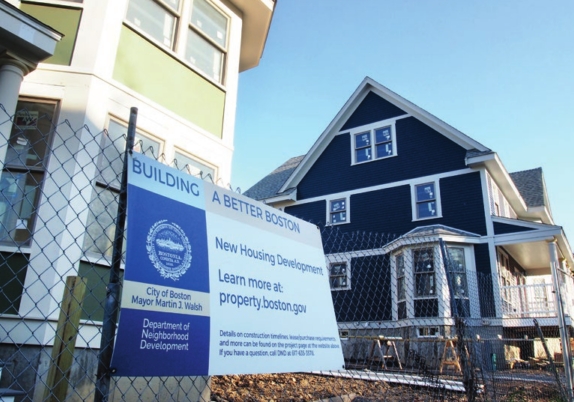
One- and two-family houses built through the city’s
Neighborhood Housing Initiative, such as these on Harold Street, are
affordable to families making between $60,000 and $119,000.
Luxury condo conversions, development show increased interest in neighborhood
For real estate brokers selling condos in Roxbury, 2013 may be little more than a hazy recollection — a quaint, bygone era when the president of the United States had gravitas and dignity and home values in Roxbury were still within reach of some neighborhood residents.
In the sepia-colored memories of that era, one might recall a 1,200-square-foot, three-bedroom condo in a stately old Queen Anne Victorian at the corner of Humboldt and Crawford streets selling for $122,000.
Fast forward five years and witness the miracle of Roxbury real estate. Nine units in a newly constructed faux Victorian just one house away, at the corner of Humboldt and Howland, are priced from $499,000 for a 954-square-foot two-bedroom to $539,000 for a 1,330-squarefoot three-bedroom.
While condo conversions are proliferating in Roxbury, the purpose-built condo building at 176 Humboldt Avenue is a rarity in the neighborhood. The building, named “Proximity,” with the “Rox” highlighted, seems to be capitalizing on Roxbury’s status as an up-and-coming neighborhood in Boston.
“Proximity is a brand-new residential building named for its close relation to amenities often sought after with the caliber of urban community-based living that this property represents,” reads the promotional material posted on the webpage of the listing agent, Galvin Group.
While the building is not particularly close to the Orange Line — it’s about 10 minutes away via the 44 bus — it is in close proximity to Roxbury’s most expensive condo ever sold outside of Fort Hill: a 3,500-square-foot condo three blocks away at 51 Hutchings Street, which sold for $850,000 in February.
In a slightly lower price range, over in the Moreland Street historic district a three-bedroom townhouse condo carved out of a Second Empire Victorian on Perrin Street is listed for $694,999. Over on Whiting Street, a pair of condos in an expansive Queen Anne are selling for $499,000 and $515,000.
Rapid rise
Think the prices in Roxbury are too steep? Try Jamaica Plain or the South End.
“Compared to what’s happening in other neighborhoods, Roxbury is still relatively affordable,” says Deborah Bernat, the broker who sold 51 Hutchings Street.
A few blocks away in Egleston Square, 17 Chilcott Place, a three-unit yellow-brick row house tells the story of rapidly rising prices. In 1987, the home sold for $25,000. Twelve years later, in 1999, it changed hands for more than seven times that at $185,000. In 2007, it sold again for $510,000. Now, with the
high rents pushing further away from the tonier sections of Jamaica
Plain, the building is on the market for a cool $1.3 million.
It’s getting crowded
The
rapid condo-ization of Roxbury’s housing market comes at a cost, not
just to prospective homebuyers, but to abutters of the new developments.
Nowhere is that more the case than in the Fort Hill section of the
neighborhood.
At one
end of Hawthorne Street, City Realty is seeking to tear down the former
St. James African Orthodox Church to build nine units of housing, over
the opposition of abutters. Further down the street, CAD Builders
demolished a single-family and are seeking to build four units on the
site, a move abutters also opposed. While the CAD project is moving
forward, the abutters secured a 90-day stay on the demolition of the
church while the Boston Landmarks Commission reviews the historical
significance of the edifice.
While
those battles are raging, elsewhere in Fort Hill, the city has put out
for bid four parcels of land which, together, could hold as many as 50
new units of housing.
“You
have all these developers who want to do work in this neighborhood,”
says Rodney Singleton, a member of the Highland Park Neighborhood
Coalition. “It’s keeping us really busy.”
With
housing prices and rents surging, developers are seeking more
opportunities to build, putting pressure on residents in all sections of
Roxbury. City Councilor Kim Janey says the growing pressure in her
district often has developers at odds with abutters.
“I
think it’s unfortunate that what residents are being asked to do is
make a choice between living next to a blighted lot or next to a
monstrosity with too many units,” she said. “Neighbors want to see
housing that fits the character of the community, priced so that people
can stay in the community.”
City response
While
there are few options for middle- and low-income families in Roxbury’s
real estate market, the City of Boston has been selling public parcels
of land to developers through its Neighborhood Homes Initiative.
Families earning between $60,000 and $119,000 a year qualify for the
single- and two-family homes, which sell for between $250,000 and
$400,000. Currently, the city’s Department of Neighborhood Development
is advertising two freestanding homes in Dorchester, and six
condominiums and ten townhouses in Roxbury.
The
city is selling a total of 250 parcels of city-owned land for the
program, through which private developers build units using designs
pre-approved by the city’s Inspectional Services Department in order to
speed construction.
Community
development corporations, including Nuestra Communidad, Madison Park
and Jamaica Plain Neighborhood Development Corporation, have affordable
housing projects in various phases of construction. But with declining
federal funds, the pipeline of affordable units remains narrow compared
to the torrent of luxury high-rises and condo conversions hitting the
city.
Janey said the
city should augment its efforts by demanding more affordability from
developers of large apartment buildings — those with 10 or more units —
which are subject to the city’s Inclusionary Development policy.
Currently developers must either set aside 13 percent of units in their
building for lower-income residents or pay into an inclusionary
development fund the city draws on to facilitate the production of
affordable housing elsewhere. Janey says the 13 percent requirement is
too little.
“That needs to go up,” she said. “People say we’re in a housing crisis, and they don’t use that word lightly. This is urgent.”