
PHOTO: COURTESY THE PHILLIPS COLLECTION, WASHINGTON, D.C.
Panel
1 of “The Migration Series” (1940-41) by Jacob Lawrence, which the
artist captioned: “During World War I there was a great migration north
by southern African Americans.” Casein tempera on hardboard, 12 x 18 in.
The Phillips Collection, Washington, D.C., Acquired 1942
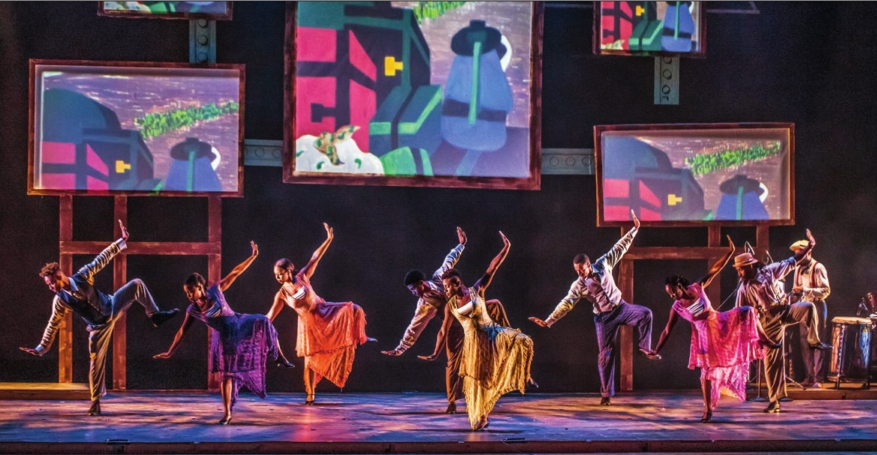
PHOTO: ILLIAM PERRIGEN A
scene from the Step Afrika! production of “The Migration: Reflections
on Jacob Lawrence,” showing Panel 39 of “The Migration Series” (1940-41)
by Jacob Lawrence, which the artist captioned: “Railroad platforms were
piled high with luggage.”
Multimedia dance piece honors Jacob Lawrence paintings
Major American modernist Jacob Lawrence (1917-2000) first catapulted to fame with his “Migration Series” (1941), which in 60 small tempera paintings chronicles the Great Migration, the multi-decade exodus of six million African-Americans from the rural South to the urban North that began around 1915.
Lawrence, then age 23, had previously produced multipanel narratives of abolitionists Harriet Tubman and Frederick Douglass and Haitian liberator Toussaint L’Ouverture.
A storyteller with a modernist’s visual and verbal economy, Lawrence created with his brushstrokes a host of semi-abstract, kinetic human figures that readily express emotion and movement. Forging a single composition and injecting the whole with a rhythmic forward momentum, Lawrence painted every panel in the same Harlem-infused palette and, with assistance from his wife, artist Gwendolyn Knight (1913-2005), wrote captions for each panel in plain, strong language, repeating certain phrases like refrains.
A great American epic with movement and rhythm at its core, Lawrence’s “Migration Series” inspired the dance company Step Afrika! to create “The Migration: Reflections on Jacob Lawrence,” a multimedia production that incorporates dance, live and recorded music and projections of Lawrence’s paintings. Presented by ArtsEmerson, Step Africa! will perform the production May 3 through May 6 at the Emerson Cutler Majestic Theater in Boston.
Directed and choreographed by Step Afrika! Artistic Director Jakari Sherman, the 90-minute production begins its story earlier than the Lawrence chronicle — in Africa — and concludes with the arrival in Chicago, leaving out Lawrence’s portrayal of the hardships the newcomers faced in their new urban settings.
Instead, the Step Africa! production lets arrival in the North be a triumphant conclusion to the journey. “The first half of the production
focuses on the challenges of life in the South,” says C. Brian
Williams, founding executive director of the Washington, D.C.-based
company, in a phone interview. “The journey north was a huge undertaking
for men and women of the South. But they made that decision, which for
many descendants of slaves was their first free choice. We honor their
choice. Our show is a percussive tribute to those men and women who left
the South, changed the country, and changed their lives.”
When
Sherman, Williams and other company members first created the
production, which debuted in June 2011 in a small theater in Washington,
D.C., they spent a lot of time viewing panels from Lawrence’s
“Migration Series” in the Phillips Collection, which shares ownership of
the series with the Museum of Modern Art.
Lawrence’s
color scheme and urban rhythms as well as his story line infuse the
Step Afrika! production, which moves to a combination of live and
recorded music as well as the sounds dancers make with their bodies. A
djembe drummer weaves his rhythms with those of the Step Afrika!
dancers, who are steppers.
“Stepping
is an African-influenced and African American-informed dance
tradition,” says Williams, who first learned to step as a member of his
fraternity at Howard University, and five years later, in 1994, founded
Step Afrika!. Williams notes that unlike in tap, another
African-American dance form, in step, “The arms are as engaged as the
legs in creating rigid shapes, lines and military-like formations.”
Rooted
in musical traditions that sustained slaves after their drums were
outlawed, stepping uses the body as a drum to create polyrhythmic music
that unifies a group while retaining members’ unique voices. Evolving
from such practices as the sacred dances of South Carolina Gullah
people, who shuffled their feet and used a stamping stick on a wood
floor in their rituals, stepping also borrows from such traditions as
Pattin’ Juba, in which dancers slap their hands on their arms, legs,
chest, and cheeks. Its roots go back even further, to South Africa,
where miners whose drums were banned invented Gumboot, a percussive
style based on pounding, boot-clad feet. “Many of our former dancers
become cast members of ‘Stomp,’” says Williams.
The
Step Afrika! production also incorporates more recent African American
musical traditions, including jazz, with recordings of Nina Simone and
John Coltrane injecting an urbane lyricism into its celebration of a
migration that spans multiple decades and generations.
Lawrence’s
parents took part in the migration, and his unflinching narrative
shifts between scenes of people on the move and moments of introspection
and struggle — both in the South, where lynchings, poverty and hunger
made life unbearable, and after arrival in teeming cities with hazards
of their own. Yet the “Migration Series” is a celebration of human
resilience.
Speaking
about his series and its concluding panel’s caption, Lawrence said, “To
me, migration means movement. There was conflict and struggle. But out
of the struggle came a kind of power and even beauty. ‘And the migrants
kept coming’ is a refrain of triumph over adversity. If it rings true
for you today, then it must still strike a chord in our American
experience.”
ON THE WEB
See STEP AFRIKA!, page 22
For information and tickets, visit: https://artsemerson.org.
The entire 60-panel “Migration Series” by Jacob Lawrence can be viewed by visiting: http://lawrencemigration.phillipscollection.org


