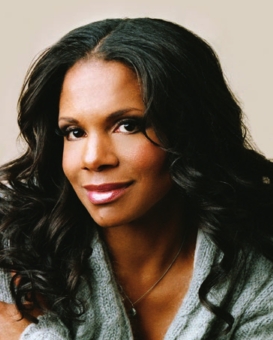
Actress/singer took part in on-stage interview
“If something scares me, I have to do it,” says renowned actress and singer Audra McDonald in a short video that preceded her on-stage interview on Saturday at Massachusetts Institute of Technology, which has chosen McDonald as the recipient of its 2018 Eugene McDermott Award in the Arts.
The video included a glimpse at McDonald’s chill-inducing rendering of Billie Holiday in “Lady Day at Emerson’s Bar & Grill” as she channeled the late jazz singer’s voice and anguished facial and body language.
After the video ended, McDonald entered the 300-seat lecture hall accompanied by her friend and fellow conversationalist Oskar Eustis, artistic director of the Public Theater in New York, whose award-winning productions include the world premiere of “Hamilton.”
Sleek in a black sheath with billowing white-trimmed sleeves, McDonald took a seat next to Eustis, a burly man with a leonine mane, attired in a black suit with a red bow tie.
MIT Associate Provost Philip S. Khoury spoke first, congratulating McDonald and describing her as “a serial award winner” who embodies the values of MIT: risk taking, versatility, and creativity across disciplines.
Then Eustis launched a lowkey but penetrating interview with McDonald, who is known for the stirring emotional truth of her performances as well as her unaffected warmth and naturalness both on the concert stage and in conversation. Eustis guided the actress through a closer look at the resources she brings to her award-winning performances and multifaceted life.
The
recipient of six Tony Awards, more than any other actor, McDonald, 47,
has amassed a host of honors that also include two Grammy Awards, an
Emmy Award and a 2015 National Medal of Arts from President Barack
Obama. While performing lead roles in musical theater and drama
productions, McDonald also maintains a major career as a concert artist
and is currently on a North American concert tour that included her
Friday night Celebrity Series concert in Symphony Hall. McDonald has
often said that her favorite pursuits are offstage, as an advocate for
equal rights and homeless youth, the wife of actor Will Swenson, and
mother of four children, including a 17-month old girl.
Concise
and to the point from the start, Eustis began by saying, “Let’s get the
formalities out of the way, Audra. You are the greatest singing actress
in the history of the world.”
After
audience laughter subsided, he asked, “How do you do it?” “I was a
terrible student,” Mc- Donald replied, “but I’m good at researching my
roles. I researched Billie Holiday into oblivion.” She read every book,
listened to every audio interview, talked with recovered heroin addicts
and their doctors and any people she could find who had known Holiday.
“People came backstage after performances and told stories,” said
McDonald. “One woman picked up Holiday for shows in her father’s club.
They always stopped to get a bottle of gin. It was half full at the end
of a 20-minute ride.”
But
the turning point, said McDonald, was when she recognized that Holiday
spoke in the same cadence as her paternal grandmother, whose voice she
had ceaselessly imitated as a child. “She spoke like Nana. That’s how I
found Billie.”
She
also discovered how much Holiday wanted children. “She tried adopting
twice and understandably, was turned down,” said McDonald. “This was a
key to understanding the bottom of her sadness.”
Preparing
to play another tormented character, Bess, in “The Gershwins’ Porgy and
Bess,” Mc- Donald said, “I went back to the original novel. Bess had a
huge scar on her face. I wanted to find out what life was like for an
African-American woman at that time.
I visited Catfish Row in Charlestown, and the cabin in which Gershwin wrote the musical.”
Resisting
the production’s initial attempt to allow Bess a happy ending after she
finds love with street beggar Porgy, McDonald’s Beth does not escape
the clutches of Sportin’ Life, her drug dealer. She and Eustis noted
that in his critique of the 1959 movie, author James Baldwin observed
that Billie Holiday should have played Bess.
As
Julie in the Rodgers and Hammerstein classic, “Carousel,” McDonald
expressed the anger and resignation in her character, whose husband
beats her.
“She still loves the man, but can’t figure out why,” said McDonald.
She and Eustis agreed that truth-telling is the source of a play’s power, whether it is a tragedy or comedy.
“The Greeks got it right,” Mc- Donald said. “By understanding ourselves, we get to catharsis.”
Eustis
closed the 45-minute conversation by asking McDonald, “What do you want
to do next? What scares you now?” “I want to keep evolving as an artist
and as a person,” said Mc- Donald. “We need to make good use of the
time we’re given. I’m grateful for my success. I want to keep growing as
an artist, wife and mother and citizen of the world. Maybe I’ll run for
office.” Whether she was joking or not, the audience roared in
approval.