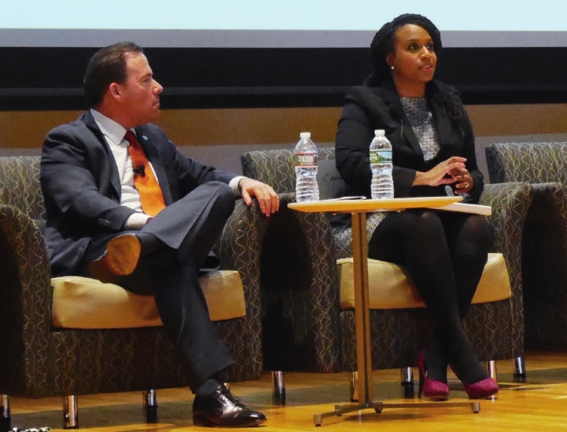
Eastern Bank Chairman
and CEO Bob Rivers and City Councilor Ayanna Pressley were part of a
panel discussion at the “Solutions to Address Racial and Economic
Equality in the Commonwealth” forum Monday night.
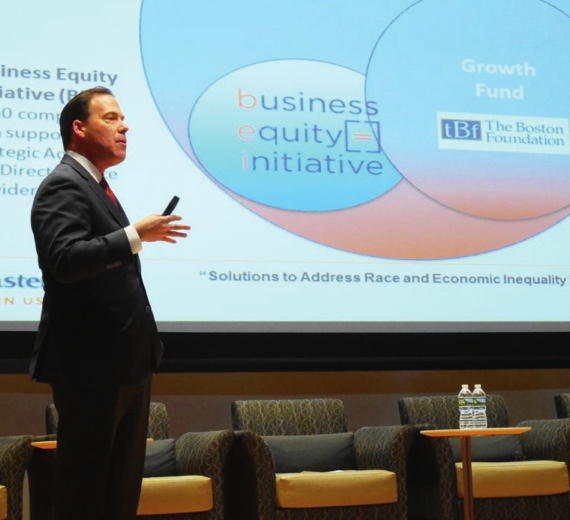
Bob
Rivers, Chairman and CEO of Eastern Bank, spoke about successful
programs to support greater capacity, capital and revenue for black- and
Latino-owned businesses.
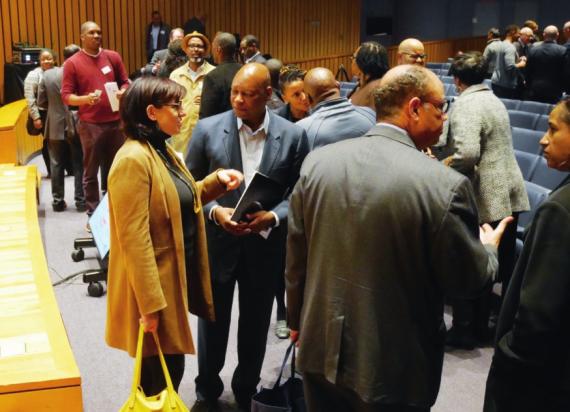
BECMA
co-founder Darryl Settles (center) and other attendees conversed after
the Feb. 26 forum at the Federal Reserve Bank of Boston.
Speakers tout success models for easing Hub economic inequality
An audience of some 350 people gathered Monday night at the Federal Reserve Bank in Boston for a discussion of solutions to racial and economic inequalities in Massachusetts. The event, organized by the Black Economic Council of Massachusetts, brought together political, government and business experts. In short presentations, a slate of speakers described successful models that help minority-owned business enterprises thrive and grow.
The impetus for the discussion was the Boston Globe’s recent Spotlight series examining the state of racism in Boston, which laid bare some of the ways that blacks in Boston have been left out of the city’s thriving economy, as well as the 2015 Federal Reserve Bank of Boston report, “The Color of Wealth in Boston,” which revealed massive racial disparities in income and wealth between white households and black and Latino households.
At the Feb. 26 event, Federal Reserve Bank Senior Community Development
Analyst Marija Bingulac reviewed key findings of that 2015 report.
“The disparities are huge,” she said. While the revealed income gaps were sobering, it was the gap in wealth that emerged as a shocking truth: while the median net worth of white households in Boston is $247,500, for black households it is only $8. Lack of accumulated wealth makes it difficult or impossible to invest in education, make a down payment on a house, amass enough capital to start a business and withstand unexpected expenses like large medical bills.
At-large City Councilor Ayanna Pressley, in her turn at the lectern noted
that the surest way to end poverty is to ensure opportunities to build
and maintain wealth — particularly through home ownership and business
ownership.
The policy
example Pressley presented was the recently-passed city ordinance she
authored with At-Large Councilor Michelle Wu promoting equity in city of
Boston contracts. The ordinance aims to increase contract opportunities
for minority- and women-owned business enterprises (M/WBE) by such
measures as creating a supplier diversity program and instituting a
quarterly reporting requirement to measure progress.
Karilyn
Crockett, the city’s director of economic policy and research, gave
further details about how the city promotes equity in its procurement
and contracting processes, highlighting the city’s outreach, assistance
and direction of procurement dollars to small and local businesses and
M/WBEs and the city’s willingness to be held accountable for these
efforts.
Bob Rivers,
chairman and CEO of Eastern Bank, described a constellation of programs
that the bank has helped launch to support greater capacity, capital and
revenue for small, and especially, black- and Latino-owned businesses:
the Business Equity Initiative; the Growth Fund with the Boston
Foundation; and the Pacesetter Initiative with the Greater Boston
Chamber of Commerce.
Kenn
Turner, director of diversity and inclusion at Massport, described his
agency’s ambitious effort to make diversity and inclusion an integral
part of its entire business process. He highlighted the innovative bid
process for a $550 million hotel project on land it owns in the Seaport
District.
Massport’s
request for proposals for that project established minority
participation as one of four factors in review and selection of design
and construction firms.
“We
trashed the existing [diversity] paradigm, took a blank slate and
started over. You cannot do that without vision, courage and political
will,” Turner said, drawing applause.
Peter
Hurst, president and CEO of the Greater New England Minority Supplier
Diversity Council (GNEMSDC), spoke of a pathway to closing the wealth
gap through minority business ownership. He stressed the need for
greater equity capital as the “fuel” for real growth and called for
greater involvement of the private sector. He also urged MBEs to do
business with other successful MBEs to increase revenue.
Diversity
programs in the construction industry typically are focused on
subcontractor hiring — after the general contractor has already been
selected, said Greg Janey, President and CEO of Janey construction, in a
co-presentation with John Moriarty of John Moriarty & Associates.
The two, whose joint venture won the Massport hotel general contractor
bid, presented a model of partnership between white- and black-owned
firms that’s proven successful in building minority-owned firms’
experience to the point where they can break through the “glass ceiling”
to win larger projects.
After
the event, as attendees and presenters mingled and chatted, Ed Gaskin,
executive director of Greater Grove Hall Main Streets, said he
appreciates BEC- MA’s effort to present solutions. He said he hopes the
conversation continues to move along from getting a fair share of
procurement dollars from the public and private sectors to a larger
strategy that emphasizes other forms of entrepreneurship as well,
including high tech and black-owned private equity firms.
Restaurateur
and real estate developer Darryl Settles, BECMA co-founder and one of
the key organizers of Monday’s event, said the purpose of the forum was
to go beyond discussion of the Globe’s racism series and publicize
what’s actually working.
“We
wanted to highlight the positive impact that’s being made. I know there
are examples out there that are already working, and people don’t know
about them,” he told the Banner in a phone interview the day after the
event. “I heard from many people last night, ‘Great information — I
didn’t know this.’” At any given gathering, he noted, “There could be a
visionary like John Moriarty or Bob Rivers in the audience, and this
sort of event could get them motivated to act — so these types of events
are very important.”
ON THE WEB
Black Economic Council of Massachusetts (BECMA): www.becma.org
“The Color of Wealth” report: www.bostonfed.org/publications/one-time-pubs/color-ofwealth.aspx


