BPS officials say growing share of funds going to charters
Boston Public Schools Superintendent Tommy Chang last week released a school year 2019 budget with a 4.4 percent increase in overall school funding.
While Chang and BPS officials touted the budget’s investment into schools, the majority of parents and BPS employees who testified during the School Committee meeting on Feb. 7 called for greater investments in schools and staff, citing the effects of several years of cuts.
BPS officials said diminished state funding continues to impede further investments in Boston schools, noting a $17 million shortfall in local aid in Gov.
Charlie Bakers proposed budget for fiscal year 2019. In addition, the Legislature has for several years level-funded the reimbursements that partially compensate cities and towns for the funding they lose when students leave the district for charters.
“The city has continued to support BPS despite declining state aid,” Chang told reporters before the School Committee meeting.
This year, state Chapter 70 funding for education will account for just 4 percent of the BPS budget, down from 30 percent 20 years ago as charter schools in Boston have expanded and state Chapter 70 education funds have remained largely flat. More than 90 percent of the $219 million the city receives from the state will go to charter schools next year.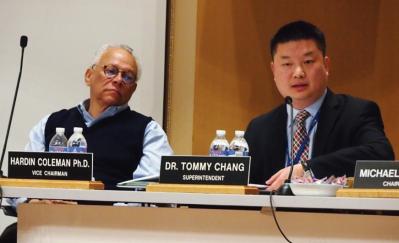
This
year, 15 schools whose enrollment has declined will see their budget
reduced, due to the district’s weighted student funding formula, under
which schools are funded by the student. When students transfer from a
school, the funding follows them to the school in which they enroll. At
the same time budgets are increasing at chools with a net increase in
students.
Brighton
High School, a Level 4 school with a large English language learner
population that last year entered into a state-mandated turnaround plan,
is slated to lose $790,000. Dorchester Academy, an alternative high
school that saw its enrollment drop after BPS officials encouraged
students to transfer to other schools, is slated to lose $1.4 million.
BPS
officials tout the fairness of the weighted school funding formula,
noting that before it was instituted, schools were sometimes funded
according how much political pressure they could apply to the district.
Critics
of student weighted funding, some of whom refer to it as a “backpack
full of cash” scheme, say it disproportionately affects schools with
high needs populations and schools in low-income communities. While the
system essentially lets parents chose which schools thrive and which
ones tank, the gains and losses in students and funding are often out of
the control of school leaders.
Parents
from the Winship School who testified at the School Committee meeting
said the school’s budget was cut by $338,550 because the school isn’t
able to offer Advanced Work Class, a program that starts in grade 4.
“Forty
percent of Winship third graders qualified for Advanced Work, which
means most left the school,” said parent Lynnelle Pittet.
The
Winship parents said they have asked to have the Excellence for All
program, which Chang is T:6.25” implementing as a replacement for
Advanced Work, but BPS officials have yet to approve the request. In the
meantime, the school will have to weather deep cuts to its budget,
noted parent Matt Hodge.
“We’re
a school in transition,” he testified. “We recognize that. But the
changes we’re facing next year are not changes we can survive.”
District
7 City Councilor Kim Janey praised the school department for its work
on the so-called opportunity gap — the lower test scores and graduation
rates in black and Latino student populations — but called for greater
investment.
“That work cannot be done if we’re not investing in our schools and our children,” she said.
At-large
Councilor Annissa Essaibi-George also called for greater investment,
citing the need for school psychologists, nurses and social workers in
every school. Currently many schools do not have full-time nurses and
there are only 56 school psychologists in the district 126 schools,
creating a 1-to-1,111 ratio of psychologists to students in the
district, noted school psychologist Jacqueline Rodriguez.
Numerous
school psychologists testified about their struggles to meet the needs
of students in crisis working in multiple BPS buildings during a given
week. Cuts to school budgets have forced principals to make difficult
decisions, said psychologist Kelly Gallagher.
“Do
I keep the psychologist, or do I keep the social worker?” she said.
“The services right now are delivered in a very fragmented manner.”
The
school department’s $48 million increase in spending brings the BPS
budget to $1.09 billion, and includes $30 million in pay raises for
teachers. The administration of Mayor Martin Walsh negotiated those
raises with the Boston Teachers Union last year. Last year’s BPS budget
also included $20 million set aside for the raise.