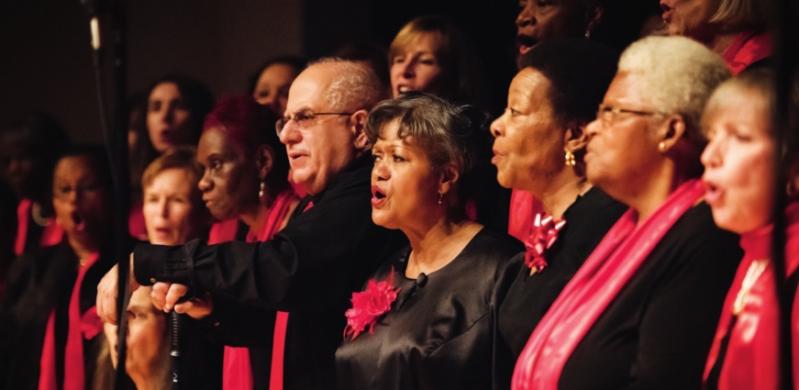
The New England Conservatory Millennium Gospel Choir performed its 11th annual Christmas concert at the Museum of Fine Arts, Boston last weekend, with two sold-out shows on Friday night and Saturday afternoon.
Demonstrating the individual and collective power of gospel musicians to elevate the spirit and thrill the senses, the choir delivered a goosebump-inducing program of 12 songs. Their program showed also the variety within this ever-new tradition and its symbiosis with other African-American veins of music, including jazz, R&B and soul.
Created in 2000 through the New England Conservatory’s Community Collaborations Program to celebrate the new millennium, the choir is in its 17th year.
The excitement began as soon as the 63-member chorus streamed onto the stage, clapping, swaying and singing as they formed three rows. They were uniformly attired in black, the men’s outfits accented with red ties and the women’s with red scarves. Meanwhile, a group of young women, also dressed in black, ascended an outer aisle to the rear of the auditorium, where they awaited their turn as guest performers.
Musicians and conductors
Joining the choir were its able, long-serving musicians, a trio of Berklee alumni: drummer Jamal Shoffner, keyboardist David Langford and brother Gerald Langford on bass.
Among the choir’s conductors were its administrative coordinator, Deborah Grant-Fair, and Rebecca Kenneally, chair of performing arts and choir director at Endicott College.
Appearing as both pianists and conductors were David F. Coleman, choral music director at Dana Hall School, director of the Tufts University Gospel Choir and minister of music at Greater Framingham Community Church; Jonathan Singleton, Berklee assistant professor of ensembles and musical director of the Twelfth Baptist Church; and two of the choir’s co-founders, Herbert S. Jones and Donnell L. Patterson. Jones is director of the Boston University Inner Strength Gospel Choir; Paterson is minister of music at St. Paul A.M.E. Church, director of music at Belmont Hill School, former chair of gospel music at New England Conservatory and the evening’s emcee.
Grant-Fair
conducted the first song, “We Sing Praises,” with Coleman on the piano.
A small and slender woman, she used her whole body to channel the
choir’s voices into an oceanic roar. With their hands clapping and
bodies swaying, they summoned the audience into their surge of joy.
Next,
Herbert S. Jones led the choir, with Singleton on piano, as they swayed
slowly and sang his composition, “The Living Word of God.” With each
repetition of its chorus, “Let the word of the Lord dwell in your
heart,” their rendering deepened in momentum.
Instilling
a fresh round of goosebumps, Kenneally led the choir in “You Oughta
Know” by Joseph Joubert, with Patterson on piano. Suzanne Buell
delivered its solo with authority.
Through its repeating refrain, she informed her audience that for the parents of Jesus there was “no room in the inn.”
Patterson
conducted the fourth song, “Magnify,” by Teresa Hairston, with Jones at
the piano. Elegant solos by Carolyn Saxon and Vicki Zelski lent
intimate power to the performance, while Patterson led the entire chorus
into a majestic crescendo that whipped all into a state of soaring joy.
The songs
The
program included the choir’s signature works, “Total Praise,” by
renowned gospel artist Richard Smallwood; and the Hallelujah Chorus of
“Handel’s Messiah — A Soulful Celebration,” a gospel-inflected
arrangement of Handel’s 1741 oratorio by multi-Grammy Award recipient
Mervyn Warren. But some selections explored the irresistible power and
variety of the ever-evolving gospel tradition through lesser-known
works.
Accompanied
solely by percussion, a radiant Singleton led the choir in
“Hlonolofatsa,” a South African chant. As he simultaneously sang and
danced with widening arms and legs and swaying torso, the choir followed
him, their voices and bodies moving in unison.
Other
thrilling performances included the choir’s rendering of “Go Tell It,”
pop artist Kirk Franklin’s jazz-inflected version of “Go Tell It on the
Mountain,” the classic spiritual composed by John Wesley Work, Jr.
during the Civil War. Led by the sensational Fair, with Patterson on the
piano, the chorus and powerful soloists Sayida Farmer-Rivers and Val
Harris-Alleyne reveled in the pulsing repetitions of “Tell it/tell it,”
and the scat-like elongation of vowels when singing the name of Jesus.
The
evening’s guest artists, the Dana Hall School Chamber Singers, came to
the stage and, accompanied on piano by their teacher, Herb Jones, sang a
tender rendering of the hymn “Mary, Did You Know?” They remained on
stage to join the choir in the finale, the Hallelujah Chorus. Conducting
the singers with his arms, hands, legs and feet, Patterson showed how
gospel music engages not just the voice but the whole person, and draws
individuals into both expressing themselves, and, with others, moving as
one.


