Boston-based group denounces colonization of island
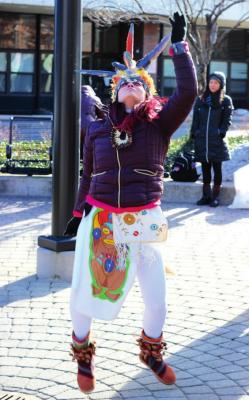
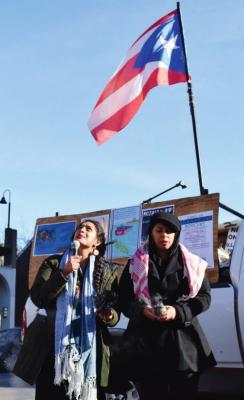
More than 100 people on Sunday marched from the South End’s Villa Victoria down Dartmouth Street and to Copley Square to support the end of what the radical Boston-based group Raíces Borikén Collective calls the “colonization” of Puerto Rico.
 Raíces Borikén Collective organized the guerilla rally and march, which included spiritual, political and cultural elements, to call on the U.S. government to repeal the Jones Act, cancel Puerto Rico’s debt and dismantle the Puerto Rico Oversight Management and Economic Stability Act (also known as PROMESA).
Under PROMESA, the U.S. government established an unelected fiscal control board to oversee Puerto Rico’s debt restructuring.
“We’re artists, activists and organizers, and the majority of us are women and queer,” said Jasmine Gomez, an RBC organizer. “We support the work of dismantling the imperialist white supremacist, capitalist, patriarchal system.”
She added, “We’re working to continue the movement of decolonizing Puerto Rico through education and action.”
Patricia Chali’Inaru Dones, a representative of the United Confederation of Taíno people, presented a Taíno prayer before the march began. “Borikén has been colonized for over 500 years,” said Dones, referring to Puerto Rico by its original, native Taíno name.
“I’m
calling for a full review of the 1920 Merchant Marine Act, also called
the Jones Act,” said Dones. “The archaic Jones Act cripples Puerto Rico
and drives up costs of imports.”
 She
continued, “Los Boricuas including our Taíno people, don’t need to be
saved by benevolent outsiders. We just need the tools to save
ourselves.”
She
continued, “Los Boricuas including our Taíno people, don’t need to be
saved by benevolent outsiders. We just need the tools to save
ourselves.”
The Jones
Act was enacted in 1920 to regulate maritime commerce and it requires
all transport between U.S. ports to be carried on U.S.-built ships.
Criticism of the 97-year-old act sparked up again when relief for Puerto
Rico after Hurricane Maria was limited and delayed during a time of
great need.
One of the
rally organizers, Eroc Arroyo-Montano, said the march and rally was a
way for everyone to “dance together, sing together, love together and
look at our children and say they are better beings than us and we can
empower them.”
“As a
person of color, I can relate,” said Jared Hicks, a Dorchester resident
who joined the march with friends. “But there are things that are unique
to Puerto Rico that makes them totally second-class to the eyes of our
government, which is unjust and disgraceful. [Being treated as
second-class] is what indigenous, black people, undocumented people deal
with, all over the country.”
Ushering
the crowd of singing and chanting activists, a pickup truck blasting
music made its way down the street to Copley Square and arrived at its
destination, Arlington Street Church, for a Bomba party, a traditional
music style of Puerto Rico. All of the rally’s participants were invited
to join the indoor gathering, a welcome reprieve from the 30-degree
weather.
Cassandra Lopez-Fradera, another rally organizer, told the crowd, “May we continue to build roots here in Boston.”
Myriam
Ortiz, executive director of The City School, a youth leadership and
development center in Uphams Corner, said, “Decolonizing our mind is the
first step. To free our land, we must free our minds.”
Luana
Morales, a Puerto Rican Reiki practitioner and teacher, shared an
anecdote with rally participants about how she brought a tobacco seed
from Puerto Rico and planted it in her yard.
The
tobacco plant did not fully grow because Morales did not plant the
seeds in deep enough soil, so she brought the plant inside where it
managed to survive the winter, but grew in a contorted manner.
“This
plant taught me that sometimes, like our ancestors, we grow up in
spaces we’re not meant to survive,” she said. “But guess what, we twist
ourselves up and we survive anyway.”